
Regulatory Exclusivity: How Non-Patent Protections Keep Drugs Alone in the Market
When a new drug hits the market, it doesn’t just rely on patents to keep competitors away. In fact, many drugs have regulatory exclusivity-a government-backed shield that blocks generics and biosimilars from entering the market, even if no patent is in play. This isn’t a loophole. It’s a deliberate part of U.S. and global drug policy, designed to reward innovation without depending on patent law. And for many companies, especially those developing biologics or drugs for rare diseases, this exclusivity is the real reason they can recoup billions in R&D costs.
What Exactly Is Regulatory Exclusivity?
Regulatory exclusivity is a time-limited period during which the FDA (or other regulatory agencies) can’t approve competing versions of a drug. Unlike patents, which protect specific chemical structures or manufacturing methods, exclusivity protects the drug product itself. It doesn’t matter if someone else invents a slightly different version of the same medicine-if the original drug has exclusivity, the FDA can’t approve the copy until that clock runs out.
This system started with the Hatch-Waxman Act of 1984. Before that, innovator companies spent years developing drugs, only to see generics rush in the moment their patents expired. The law created a trade-off: generics got a faster, cheaper path to market (through abbreviated applications), but innovators got guaranteed market time. The result? A balance between competition and innovation.
Here’s the key difference: patents are filed early, often before human trials even begin. They can expire before the drug is approved. Regulatory exclusivity, on the other hand, starts counting only after the FDA approves the drug. That means even if a patent expires in 2020, but the drug gets approved in 2023, the exclusivity still runs from 2023 onward.
The Main Types of Regulatory Exclusivity in the U.S.
Not all exclusivity is the same. The FDA grants several types, each with different rules and durations:
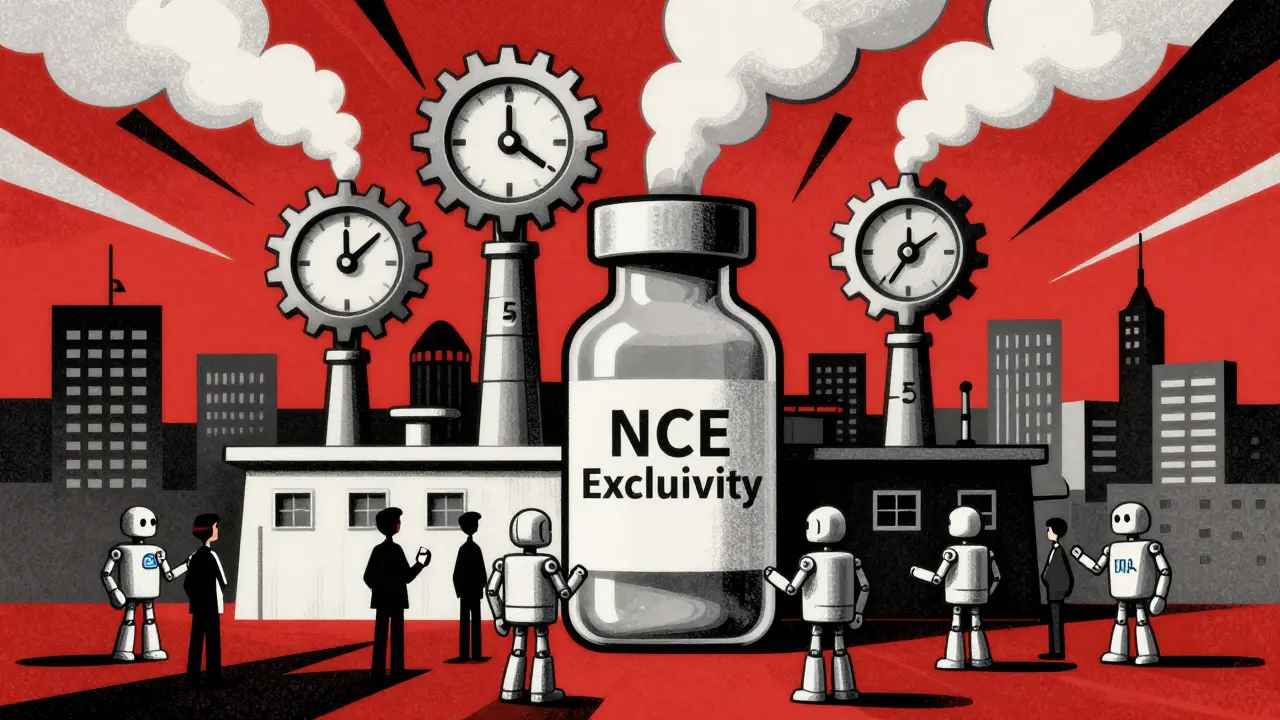
- New Chemical Entity (NCE) Exclusivity - 5 years. This applies to drugs with a brand-new active ingredient. During the first 4 years, the FDA can’t even accept applications from generics. At the 5-year mark, they can approve them. This is the most common type for small-molecule drugs.
- Orphan Drug Exclusivity - 7 years. For drugs treating rare diseases affecting fewer than 200,000 people in the U.S. The drug doesn’t need to be the first treatment-just the first approved for that specific rare condition. In 2023, nearly half of all new drug approvals were for orphan diseases.
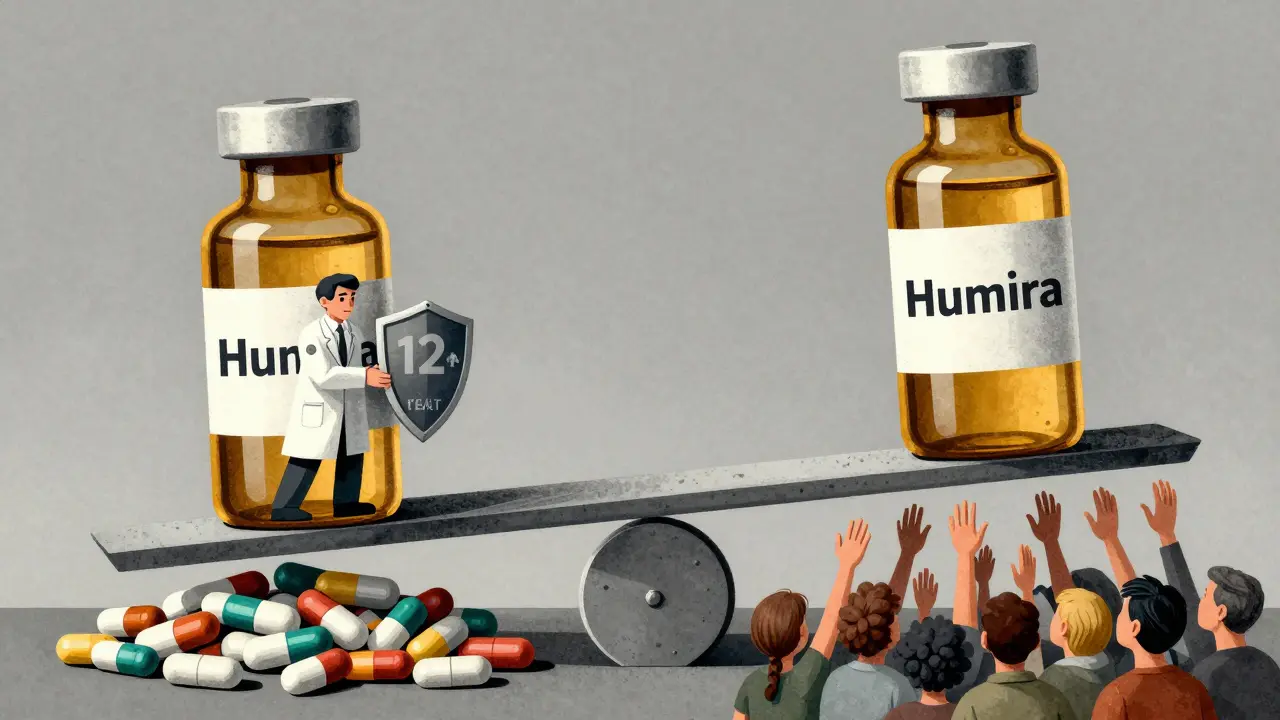
- Biologics Exclusivity - 12 years. Created by the BPCIA in 2009, this protects complex biological drugs like Humira or Enbrel. Unlike small-molecule drugs, biologics can’t be easily copied. But even so, this 12-year window has sparked major debate. AbbVie’s Humira, for example, kept competitors out until 2023-even though its last patent expired in 2016.
- 3-Year Exclusivity - For new clinical studies that support changes to an approved drug’s labeling. Think: a new dose, new patient group, or new use. This doesn’t block all generics, just ones that rely on the same data.
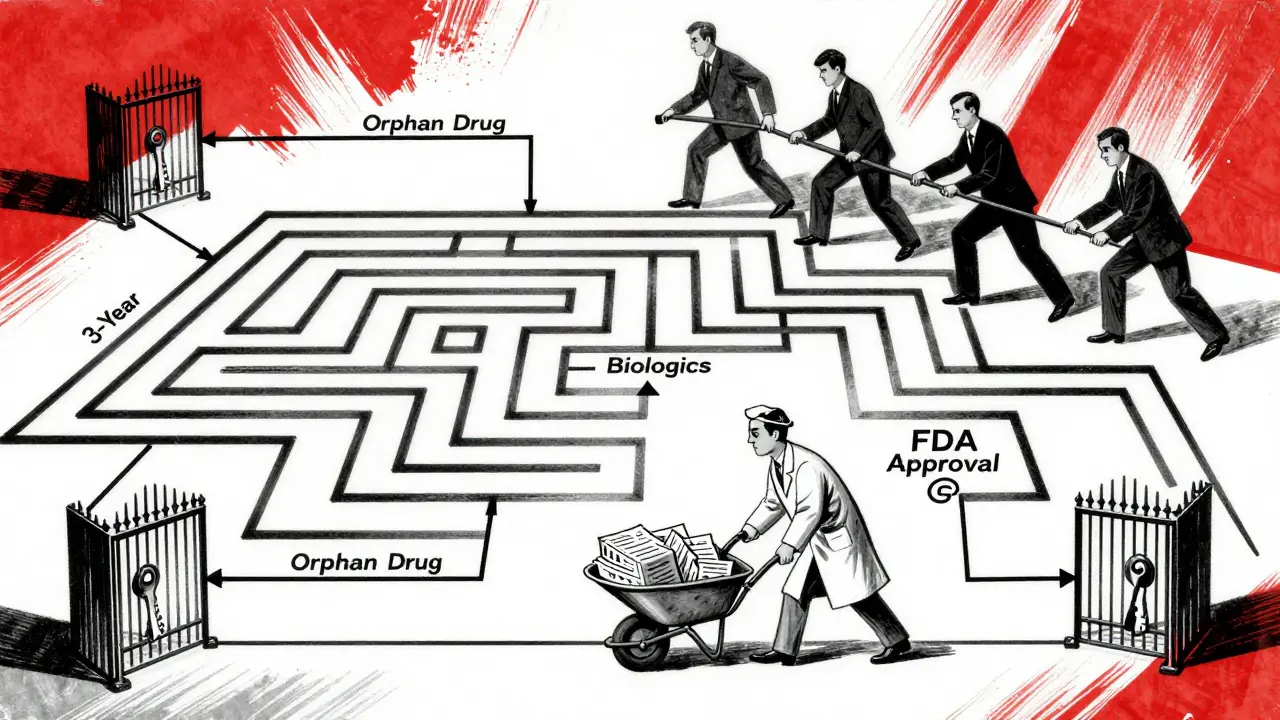
These periods can overlap. A drug might have 5 years of NCE exclusivity, 7 years of orphan exclusivity, and 12 years of biologics exclusivity-all running at once. The longest one wins.
How It Compares to Patents
Patents and exclusivity are often confused, but they’re fundamentally different:
| Feature | Regulatory Exclusivity | Patent Protection |
|---|---|---|
| Who grants it? | FDA (automatic upon approval) | USPTO (requires application and fees) |
| Starts when? | Upon FDA approval | Upon patent issuance (often years before approval) |
| Duration | Fixed: 5, 7, 12 years depending on type | 20 years from filing date |
| Scope | Protects the drug product itself | Protects specific chemical structures or methods |
| Enforcement | Automatic-FDA blocks approvals | Requires lawsuits-patent holder must sue |
| Can it be challenged? | No-unless the drug didn’t qualify | Yes-through litigation or patent office reviews |
For biologics, this difference is huge. A biologic might take 10-12 years to develop. If a patent is filed at the start of clinical trials, it could expire before the drug even hits the market. Regulatory exclusivity fixes that. It ensures the company gets real market time.
Global Differences
The U.S. isn’t the only player. Other countries have their own rules:
- European Union: Uses an “8+2+1” system: 8 years of data protection, 2 years of market exclusivity, and 1 extra year if a new indication is added.
- Japan: Grants 10 years of data exclusivity for new chemical entities.
- Canada: 8 years of data protection, with no market exclusivity.
These differences matter. A company might launch a drug in the U.S. with 12 years of protection, but in Europe, it only gets 8. That’s why global drug pricing varies so wildly.
Why It Matters for Drug Prices
Regulatory exclusivity directly affects what you pay at the pharmacy. IQVIA found that drugs under exclusivity sell for 3.2 times more than their generic equivalents. In 2023, Pfizer made $52.3 billion from exclusivity-protected drugs alone. Humira generated $19.9 billion in U.S. sales in 2022-despite having no patent left.
That’s why critics say exclusivity goes too far. Public Citizen argues that 12-year biologics exclusivity delays competition longer than needed to justify R&D costs. Meanwhile, generic manufacturers say the 4-year barrier to filing ANDAs (for NCEs) forces them to start development blind, increasing risk and cost.
But for innovators, it’s essential. A senior regulatory affairs manager at a major pharma company said on Reddit: “NCE exclusivity is our most reliable protection. Unlike patents, which get challenged in court, the FDA simply won’t approve generics during the 5-year window.”
Real-World Impact: The Humira Case
Humira (adalimumab) is the textbook example. Approved in 2002, it had multiple patents that expired between 2016 and 2023. But because it’s a biologic, it had 12 years of regulatory exclusivity, which ran from 2002 to 2014. So why did biosimilars still not enter until 2023?
Because AbbVie kept filing new patents for new uses and formulations-extending patent life. And when those patents expired, the FDA still couldn’t approve biosimilars until 2023 due to legal battles and settlement agreements. This is where exclusivity and patents work together. Exclusivity gave the initial shield. Patents extended it. The result? A decade of monopoly pricing.
What’s Changing in 2026?
Pressure is building to shorten exclusivity periods. In 2023, Congress proposed reducing biologics exclusivity from 12 to 10 years. The European Commission is pushing to cut data exclusivity from 8 to 6 years. The FDA’s own 2024 action plan says it’s “modernizing exclusivity frameworks to better balance innovation with timely generic competition.”
But change is slow. The industry spent $1.2 billion lobbying in 2023 to keep exclusivity long. Meanwhile, 89% of originator companies say these protections are “essential” to recoup R&D costs. And with 88% of new drugs qualifying for some form of exclusivity, it’s clear this isn’t going away.
By 2030, experts predict the average combined patent and exclusivity period will drop from 12.3 years to 10.8 years. But biologics? They’ll likely still get 12.
How Companies Use It
Managing exclusivity isn’t just legal-it’s a full-time job. Pharma companies hire dedicated exclusivity managers. Their job? Track expiration dates across global markets, ensure clinical data meets requirements, and coordinate with regulatory teams.
For orphan drugs, qualifying means proving the disease affects fewer than 200,000 Americans. That’s not easy. Many companies now design drugs specifically for rare conditions-not because they’re more ethical, but because 7 years of exclusivity is easier to get than 5.
And it works. In 2023, orphan drugs made up 47% of all novel approvals-up from 18% in 2010. That’s not coincidence. It’s strategy.
Final Thoughts
Regulatory exclusivity isn’t a loophole. It’s a legal tool, built into law, to keep drugs on the market without competition for a set time. It’s why new drugs get developed. It’s also why prices stay high. And as governments look to cut costs, this system is under fire.
But for now, it’s the backbone of pharmaceutical innovation. Whether you’re a patient, a pharmacist, or a policymaker, understanding this system helps explain why some drugs cost so much-and why others still haven’t come to market.





Oh my god, I just spent three hours reading this, and I’m emotionally drained-but in the best way? Like, I didn’t realize how much power the FDA has just by saying ‘no’ to a generic application. It’s not just about patents anymore-it’s about bureaucratic inertia wrapped in a bow labeled ‘innovation.’ And don’t even get me started on how Humira’s 12-year shield was extended by legal chess moves… It’s not capitalism. It’s feudalism with a pharmacy counter.
This is one of those rare posts that makes you pause mid-scroll. Regulatory exclusivity isn’t just a policy-it’s a silent architect of global health inequality. In India, we see the consequences daily: patients rationing insulin because biosimilars are still locked out by U.S.-style exclusivity. The 12-year biologics window? It’s not innovation-it’s insurance for billionaires. Meanwhile, a child in rural Bihar waits for a drug that could’ve been affordable 8 years ago. We need global alignment, not corporate loopholes.
Wow, this was so well-structured… I actually learned something today, which is rare on Reddit. The difference between patents and exclusivity finally clicked for me. I always thought patents were the main barrier, but the fact that exclusivity doesn’t even start until approval? That’s wild. And the table comparing them? Chef’s kiss. Makes me wonder how many people in Congress even understand this stuff. Maybe we need a ‘Pharma 101’ for lawmakers… or at least a meme series.
Let’s be clear: this isn’t innovation-it’s a legalized racket. The U.S. is the only country that lets pharma milk exclusivity for over a decade while other nations move on. We’re subsidizing corporate greed under the guise of ‘encouraging R&D.’ Meanwhile, the NHS is rationing cancer drugs. If this were a British company, we’d have nationalized it by now. Shameful. And don’t even mention how they game orphan drug status-turning ‘rare disease’ into a profit pipeline. This is what happens when lobbyists write the laws.
Wait, so you’re telling me a drug can have 5+7+12 years of exclusivity all at once? And the longest one wins? That’s like winning three lottery tickets and only cashing the $1M one. I love it. Also, I just realized why my $8,000/month insulin still costs $8,000. It’s not just patents. It’s a whole ecosystem of legal velvet ropes. Who’s the genius who designed this? I need to hug them. Or sue them. Probably both.
So let me get this straight: we’re rewarding companies for being the first to treat a disease that affects 199,000 people… but not the one that affects 201,000? That’s not science. That’s a spreadsheet with a moral compass made of wet noodles. And don’t even get me started on how ‘orphan drugs’ are now the new gold rush. I’m pretty sure some startup in Silicon Valley is currently coding a ‘rare disease’ algorithm to exploit this. We’re not saving lives-we’re gaming a system designed to save lives. Classic.
It's evident that the regulatory exclusivity framework is a masterclass in economic engineering, albeit one that prioritizes shareholder value over public welfare. The conflation of 'innovation' with 'monopoly duration' is not merely a policy flaw-it's an epistemological failure. One cannot legitimately assert that 12 years of exclusivity equates to R&D justification when the marginal cost of production for biologics is negligible. The FDA's role, in this context, has devolved into a rent-seeking enabler. One wonders whether the term 'public health' still holds semantic integrity.
Exclusivity isn’t the problem. The problem is how it’s applied. The 4-year no-file window for NCEs is ridiculous. Generic companies can’t even start developing until year 5. That’s like telling builders they can’t lay bricks until the architect finishes the blueprint-and the architect doesn’t even have the blueprint yet. Fix the process, not the duration. And stop using ‘innovation’ as a shield for price gouging. It’s not rocket science.
✨ This is why I love deep dives. The fact that regulatory exclusivity starts AFTER approval? Genius. Also, orphan drugs making up 47% of approvals? That’s not accidental. That’s capitalism with a spreadsheet. 📊 I’m just imagining some pharma exec in a suit whispering: ‘Let’s make a drug for 199,000 people… because 7 years > 5.’ 😂❤️👏