
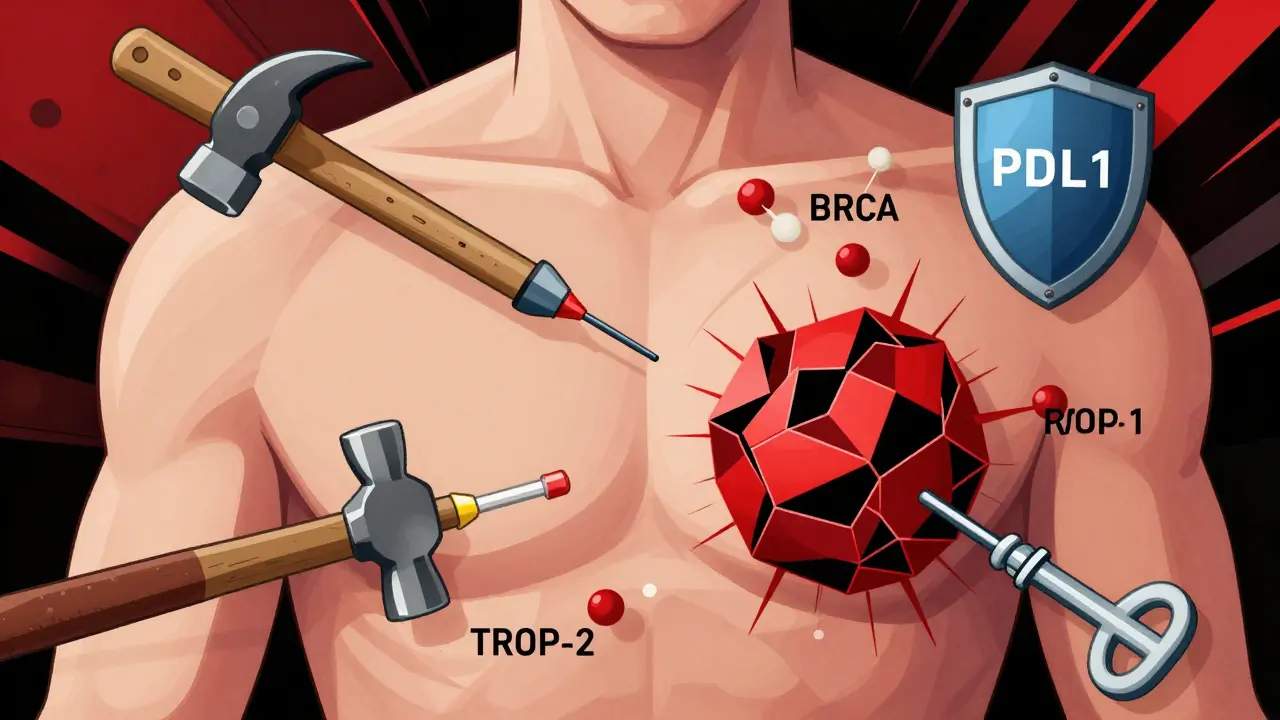
Triple-Negative Breast Cancer: Modern Treatment Strategies and Ongoing Clinical Trials
Triple-negative breast cancer (TNBC) doesn’t respond to hormone therapy or HER2-targeted drugs. That leaves chemotherapy as the main tool-for now. But the landscape is changing fast. In 2025, doctors aren’t just giving the same old drugs to everyone with TNBC. They’re using biomarkers, sequencing treatments differently, and even designing custom vaccines. This isn’t science fiction. It’s happening in hospitals right now.
Why TNBC Is So Hard to Treat
Most breast cancers grow because they’re fed by estrogen or progesterone, or they overproduce the HER2 protein. Drugs exist to block those signals. TNBC doesn’t have any of those targets. It’s like a car with no keyhole-you can’t turn the ignition with the usual tools.
That makes it aggressive. TNBC grows quickly, spreads early, and often comes back within the first three to five years after treatment. About 10% to 15% of all breast cancers are triple-negative. It’s more common in women under 40, and in Black and Hispanic women. But it’s not just about demographics. The real challenge is biology. TNBC tumors are messy. They’re made up of different cell types, some resistant to chemo, some hiding from the immune system. That’s why traditional treatments often fail.
Standard Treatment: Chemo First, Then Surgery
For early-stage TNBC, the standard still starts with chemotherapy before surgery-called neoadjuvant chemo. The goal isn’t just to shrink the tumor. It’s to kill as many cancer cells as possible before removing the breast tissue. If the tumor disappears completely after chemo, that’s called a pathologic complete response (pCR). Patients who reach pCR have a much better chance of long-term survival.
Typical regimens include anthracyclines like doxorubicin and taxanes like paclitaxel. But in recent years, platinum drugs-cisplatin or carboplatin-have become part of the mix, especially for patients with BRCA mutations. These drugs damage DNA in a way that’s harder for cancer cells to repair. In fact, patients with BRCA mutations respond better to platinum chemo than those without.
After chemo, surgery follows-either a lumpectomy or mastectomy. Then radiation, and sometimes more chemo. But this path isn’t perfect. Only about 40% of patients get a pCR. The rest face a higher risk of recurrence. And the side effects? Fatigue, nerve damage, low blood counts, nausea. Many patients can’t tolerate the full 18 to 24 weeks of treatment.
Immunotherapy: Turning the Body’s Defense Against Cancer
One of the biggest breakthroughs in TNBC came with immunotherapy. Not all TNBC patients benefit, but those with PD-L1 positive tumors do. PD-L1 is a protein some cancer cells use to hide from immune cells. Drugs like pembrolizumab and atezolizumab block that signal, letting the immune system see and attack the cancer.
The KEYNOTE-522 trial showed that adding pembrolizumab to chemo before surgery boosted pCR rates from 51% to 64.8% in PD-L1 positive patients. That’s a big jump. In 2025, pembrolizumab is now standard for early-stage TNBC patients whose tumors test positive for PD-L1 (using the 22C3 pharmDx test).
For metastatic TNBC, pembrolizumab plus chemo is also first-line if PD-L1 expression is at least CPS 10. The IMpassion130 trial showed a median progression-free survival of 7.2 months with atezolizumab plus nab-paclitaxel, compared to 5.5 months with chemo alone. But here’s the catch: only about 40% of metastatic TNBC tumors are PD-L1 positive. So you need a test before you start.
PARP Inhibitors: Exploiting Genetic Weaknesses
BRCA1 and BRCA2 mutations are found in 15% to 20% of TNBC cases. These genes help repair damaged DNA. When they’re broken, cancer cells rely on backup systems-like the PARP enzyme-to survive. PARP inhibitors like olaparib and talazoparib block that backup. Without it, the cancer cells can’t fix their DNA and die.
The OlympiAD trial showed that for patients with germline BRCA mutations and metastatic TNBC, olaparib improved progression-free survival by 7.8 months compared to standard chemo. It also had fewer severe side effects than chemo. That’s why BRCA testing is now recommended for every TNBC patient at diagnosis-not just those with family history.
But PARP inhibitors don’t work for everyone. Only those with BRCA mutations benefit significantly. Researchers are now looking at broader markers like homologous recombination deficiency (HRD) to find more patients who might respond.
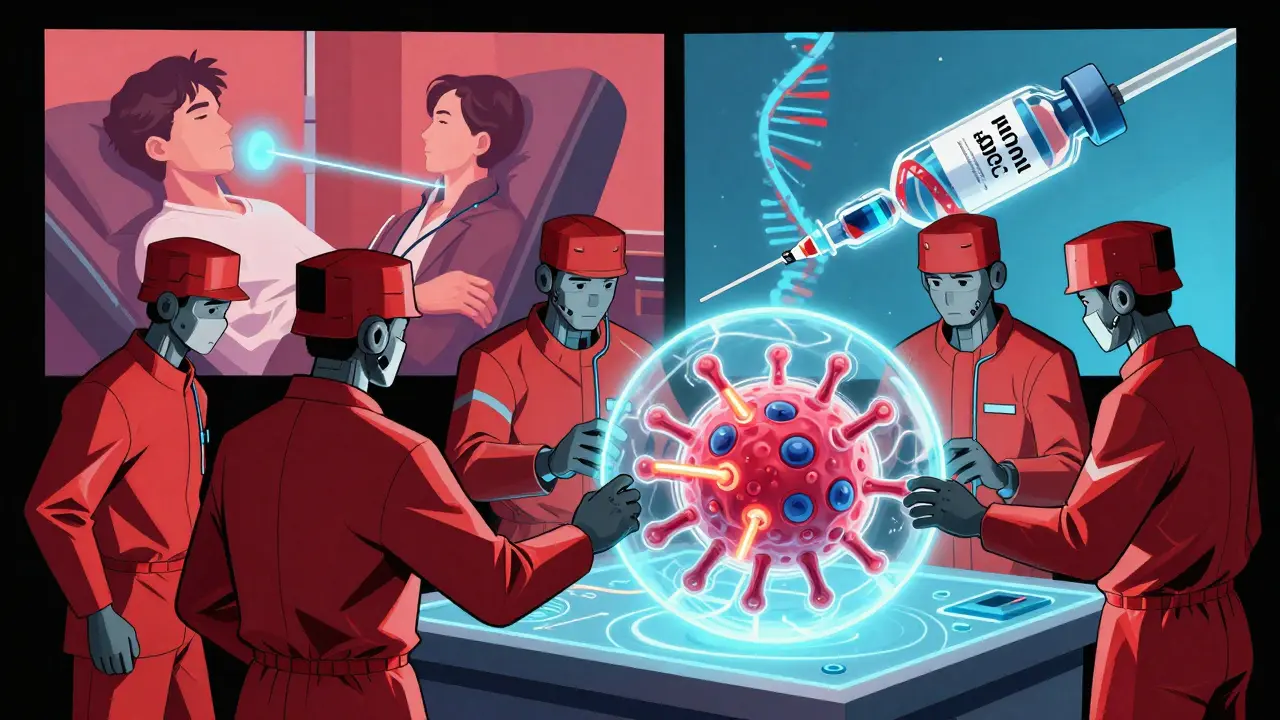
Antibody-Drug Conjugates: Smart Bombs for Cancer Cells
Antibody-drug conjugates (ADCs) are like guided missiles. They deliver powerful chemo drugs directly to cancer cells while sparing healthy tissue.
Sacituzumab govitecan (Trodelvy®) targets a protein called TROP-2, which is common on TNBC cells. The ASCENT trial showed it doubled progression-free survival compared to chemo in patients who had already tried two or more lines of treatment. Response rates hit 35%, and the median time before the cancer worsened was 5.6 months. It’s now approved for metastatic TNBC after prior chemo.
Another ADC, trastuzumab deruxtecan (Enhertu®), was originally made for HER2-positive breast cancer. But some TNBC tumors have very low levels of HER2-too low to qualify as HER2-positive, but enough to be targeted. In the DESTINY-Breast04 trial, it showed a 37% response rate in these patients. That’s a game-changer for a group previously left with few options.
A New Protocol: Less Chemo, Same Results
What if you could get the same results with less treatment? That’s what researchers at UT Southwestern Medical Center discovered in early 2025.
They flipped the script. Instead of starting with chemo, they gave radiation first-right at the beginning. Then, only two doses of pembrolizumab. After that, chemo. Surgery followed. Total treatment time: about 12 weeks.
The results? A 59% pCR rate-almost as good as the 64.8% from KEYNOTE-522. But here’s the kicker: only 41% of patients had serious side effects, compared to 82% in the standard group. Fewer doses of chemo. Fewer doses of immunotherapy. Less toxicity. Same survival benefit.
Dr. Heather McArthur, who led the study, said it best: “We think it’s very encouraging to achieve the same results with less chemotherapy, less immunotherapy, and less toxicity.” This protocol is now being reviewed by the NCCN and could become standard by mid-2026.
Personalized Vaccines: The Future Is in Your DNA
At Houston Methodist Hospital, scientists are doing something wild. They’re making custom vaccines for each patient.
They take a sample of the tumor, sequence its DNA, and find unique mutations-neoantigens-that the immune system has never seen before. Then, they create a vaccine that trains the body to recognize and attack cells with those exact mutations. The whole process, from biopsy to vaccine, takes just six weeks.
In phase I trials, 78% of patients showed a strong immune response. The vaccine is given with pembrolizumab to boost the effect. Early data suggests it may help prevent recurrence after surgery.
Dr. F. Gary Cooke, director of the Breast Cancer Center there, says: “That’s the group of patients we really need to find new therapies for.” These are the ones who finish chemo, think they’re done-and then the cancer returns.
If this works, it could change how we treat not just TNBC, but other hard-to-treat cancers too. As Dr. Alessandro Taraballi, who leads the vaccine program, says: “Once we establish it for triple-negative breast cancer, it can be adapted to other difficult cancers, like pancreatic cancer.”

Dual-Target Therapies: Hitting Two Weaknesses at Once
One reason TNBC resists treatment is that cancer cells find workarounds. Block one pathway, and another takes over. So researchers are testing drugs that hit two targets at once.
For example, combining CDK4/6 inhibitors (which stop cell division) with PI3Kα inhibitors (which block growth signals) has shown strong synergy in lab models. Another combo-CDK12 and PARP inhibitors-creates synthetic lethality, killing cancer cells by overwhelming their DNA repair systems.
In preclinical studies, dual-target approaches achieved 68% tumor growth inhibition, compared to just 32% with single-agent PARP inhibitors. These are still in early trials, but they represent the next wave of precision medicine.
What’s Next? The Big Picture in 2025
Five new drugs have been approved for TNBC since 2018: pembrolizumab, atezolizumab, olaparib, talazoparib, and sacituzumab govitecan. More are coming. Datopotamab deruxtecan, a new ADC targeting TROP-2, is in phase III trials. Adagloxad simolenin, a vaccine-like therapy, is also advancing.
By 2028, experts predict more than half of TNBC treatment decisions will be based on comprehensive biomarker profiles-genomic, immune, and protein-based. No longer will we treat TNBC as one disease. It’s made up of subtypes, each needing a different strategy.
But access remains a problem. In low- and middle-income countries, only 35% to 40% of patients get the biomarker tests needed to qualify for these new therapies. Even in the U.S., not every hospital has the labs or expertise to run them.
And while survival has improved for early-stage TNBC, metastatic survival still hovers around 12% to 15% at five years. That’s far behind other breast cancer types.
What Patients Should Ask Their Doctors
- Have my tumor been tested for PD-L1 and BRCA mutations?
- Is my cancer stage early or metastatic? Does that change my options?
- Am I eligible for any clinical trials right now?
- Can we consider a shorter, less toxic treatment plan like the UT Southwestern protocol?
- Will I need genetic counseling based on my results?
Treatment for TNBC is no longer one-size-fits-all. It’s a puzzle. And every patient’s puzzle is different. The key is testing, timing, and teamwork. A multidisciplinary tumor board-oncologists, surgeons, radiologists, genetic counselors-should be involved in every complex case.
Is triple-negative breast cancer curable?
Early-stage triple-negative breast cancer can be cured in many cases, especially if the tumor disappears completely after chemotherapy (pathologic complete response). About 40% to 65% of patients reach this milestone with modern treatments. But if the cancer has spread beyond the breast and lymph nodes, it’s considered metastatic and currently not curable. The goal then is long-term control and quality of life. Survival rates for metastatic TNBC are still low-around 12% to 15% at five years-but new therapies are slowly improving those numbers.
Do I need genetic testing if I have TNBC?
Yes. All patients diagnosed with TNBC should be offered germline BRCA1/2 testing, regardless of family history. About 15% to 20% of TNBC cases are linked to inherited BRCA mutations. Finding one changes your treatment options-you may qualify for PARP inhibitors like olaparib. It also affects your risk for other cancers, like ovarian or pancreatic cancer, and may impact family members. Genetic counseling is recommended before and after testing.
What does PD-L1 positive mean for my treatment?
PD-L1 positive means your tumor expresses a protein that helps it hide from your immune system. If your tumor tests positive (CPS ≥10), you’re a candidate for immunotherapy with pembrolizumab or atezolizumab combined with chemotherapy. This combination significantly improves response rates and survival compared to chemo alone. Testing is done on a biopsy sample using the 22C3 pharmDx assay. If it’s negative, immunotherapy won’t be part of your first-line treatment.
Are there clinical trials I should consider?
Yes, especially if you have advanced or recurrent TNBC. Over 1,500 clinical trials for TNBC are active worldwide. Trials are testing new antibody-drug conjugates, dual-target inhibitors, personalized vaccines, and novel immunotherapy combinations. Many are at major cancer centers like MD Anderson, Memorial Sloan Kettering, and Houston Methodist. Ask your oncologist for a referral to a trial coordinator. Even if you’re not eligible now, new trials open every month.
Why do some TNBC patients respond better than others?
TNBC isn’t one disease-it’s a collection of subtypes with different molecular drivers. Some have BRCA mutations, others have high immune activity, some overexpress TROP-2, and others have PI3K pathway changes. That’s why a treatment that works for one person may not work for another. Biomarker testing helps match patients to the therapies most likely to help them. Researchers are now dividing TNBC into at least six molecular subtypes to guide treatment more precisely.
Can I avoid chemotherapy altogether?
For most patients with early-stage TNBC, chemotherapy is still necessary because the cancer is too aggressive to treat with targeted therapies alone. But the amount and duration are changing. The UT Southwestern protocol cuts chemo exposure by using radiation and immunotherapy upfront, reducing total treatment time and toxicity. For metastatic TNBC, some patients with specific biomarkers (like BRCA or TROP-2) can start with targeted drugs or ADCs instead of traditional chemo, especially if they’ve already had chemo. But chemotherapy remains a backbone for many.
Treatment for triple-negative breast cancer has moved from a blunt instrument to a scalpel. We’re no longer guessing. We’re matching the right tool to the right tumor. That’s progress. And for patients who once had few options, it’s hope.



OMG this is literally giving me hope 🥹 I had a friend go through TNBC last year and the chemo was brutal. The idea of a shorter, less toxic protocol? YES PLEASE. 🙌
Ugh, another ‘miracle cure’ article. Everyone’s acting like we’ve solved cancer. Newsflash: 12% five-year survival for metastatic is still a death sentence. Stop hyping this.
The integration of biomarker-driven therapeutics into clinical workflows remains an aspirational paradigm in resource-constrained healthcare ecosystems. While the data presented is methodologically sound, equitable access remains a critical lacuna in global oncology practice.
Let me just say - this is the most comprehensive, accurate, and hopeful summary of TNBC advances I’ve seen in years. The UT Southwestern protocol? Genius. Cutting chemo by 40% while maintaining pCR rates? That’s not just innovation - that’s dignity. And the personalized vaccines? Holy hell. Imagine if we could train the immune system to remember cancer like it remembers a cold. This isn’t just science - it’s a revolution in patient care. We need to push for universal biomarker testing, not just in the US but everywhere. If your hospital doesn’t offer BRCA and PD-L1 testing at diagnosis, demand it. Your life might depend on it.
This is why I love medicine today. Not because it’s perfect, but because it’s getting smarter. The fact that we’re moving from ‘one-size-fits-all chemo’ to custom vaccines and smart missiles? That’s not sci-fi. That’s Tuesday in a good oncology center.
I’m sitting here with my coffee reading this and just… crying. Not because it’s sad - because it’s beautiful. We’re finally seeing cancer as a puzzle, not a monster. And that shift? It changes everything.
Everyone’s acting like these new drugs are magic. Have you seen the price tags? One dose of sacituzumab govitecan costs more than my car. And don’t get me started on how many patients get dropped because their insurance won’t cover the biomarker test.
Funny how ‘personalized vaccines’ get all the press but nobody talks about how 90% of TNBC patients still get the same old chemo. This is just fancy marketing wrapped in jargon.
I’m so tired of ‘hope porn.’ Yes, some people benefit. But most of us are still stuck with the same brutal chemo, same side effects, same odds. Stop pretending this is progress. It’s just more expensive suffering.
I’m from the UK and we’ve got a few of these treatments on the NHS now - but the wait for genomic testing is still 8-12 weeks. I wish people knew how much bureaucracy slows this down. The science is ahead of the system, always. But hey - at least we’re talking about it. And that’s a start.
As a medical professional from India, I applaud the advancements but must highlight the stark disparity. In rural India, even basic mammograms are inaccessible. These breakthroughs remain a luxury. We need global equity, not just innovation.
Oh look, another American miracle. Meanwhile, my cousin in Pakistan got diagnosed and was told to ‘pray and eat healthy.’ Funny how progress only exists where the money is.
I think the real win here is that we’re finally listening to patients instead of just throwing chemo at them. The UT Southwestern thing? That’s not just a protocol - it’s a middle finger to the ‘more is better’ mindset. And honestly? I’m tired of being told to ‘be strong.’ I just want to be treated like a human.
The 59% pCR rate with reduced chemo is statistically significant, but the sample size in the UT Southwestern study was under 80 patients. Until phase III trials replicate this, it’s anecdotal. Also, ‘less toxicity’ is relative - neutropenia and neuropathy still occur. Don’t oversell.
I’m a TNBC survivor. I did the full 18 weeks of chemo. I lost my hair, my energy, my sense of self. And now I’m reading this and thinking - if I’d known about this protocol, I could’ve saved myself so much pain. To every doctor reading this: STOP WAITING FOR THE ‘STANDARD.’ START LISTENING TO THE DATA. We’re ready.