
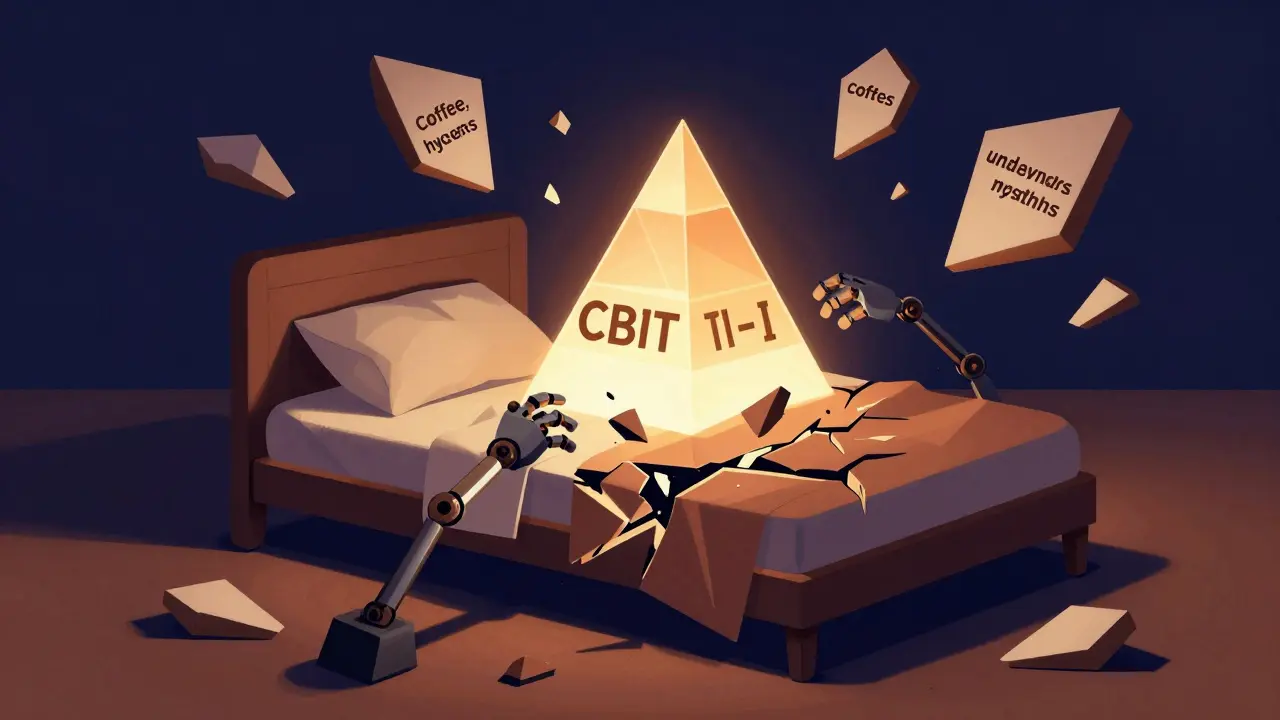
Chronic Insomnia: Why Sleep Hygiene Alone Doesn't Work and What Actually Does
For years, people with chronic insomnia were told to just sleep better. Turn off the lights earlier. Stop drinking coffee after noon. Keep your bedroom cool. No screens before bed. But if you’ve been lying awake for months-sometimes years-knowing all the "rules" and still not sleeping, you know: sleep hygiene isn’t enough.
What Chronic Insomnia Really Means
Chronic insomnia isn’t just having a rough night. It’s struggling to fall asleep, stay asleep, or feel rested-on at least three nights a week-for three months or longer. The American Academy of Sleep Medicine defines it clearly: it’s not stress. It’s not jet lag. It’s a persistent, disruptive condition that wears you down day after day. Fatigue. Brain fog. Irritability. Anxiety about sleep itself. And the more you worry about not sleeping, the harder it becomes to sleep.
Here’s the hard truth: most people try to fix it by tweaking their habits. They buy weighted blankets. They try melatonin. They switch to chamomile tea. These things might help a little, but they don’t fix the root problem. And that’s where CBT-I comes in.
Why Sleep Hygiene Isn’t the Answer
Sleep hygiene sounds simple. Avoid caffeine. Keep your room dark. No naps. Sounds reasonable, right? But here’s what the science says: sleep hygiene alone has moderate evidence of effectiveness. That means it might help someone with occasional trouble sleeping. But for chronic insomnia? It’s like trying to fix a leaky roof by putting a bucket under it.
Studies show that sleep hygiene education alone improves sleep in fewer than 20% of people with long-term insomnia. In fact, leading experts like Dr. Jack D. Edinger warn: "Don’t offer sleep hygiene as a standalone treatment for chronic insomnia." Why? Because it doesn’t address the mental habits that keep insomnia going.
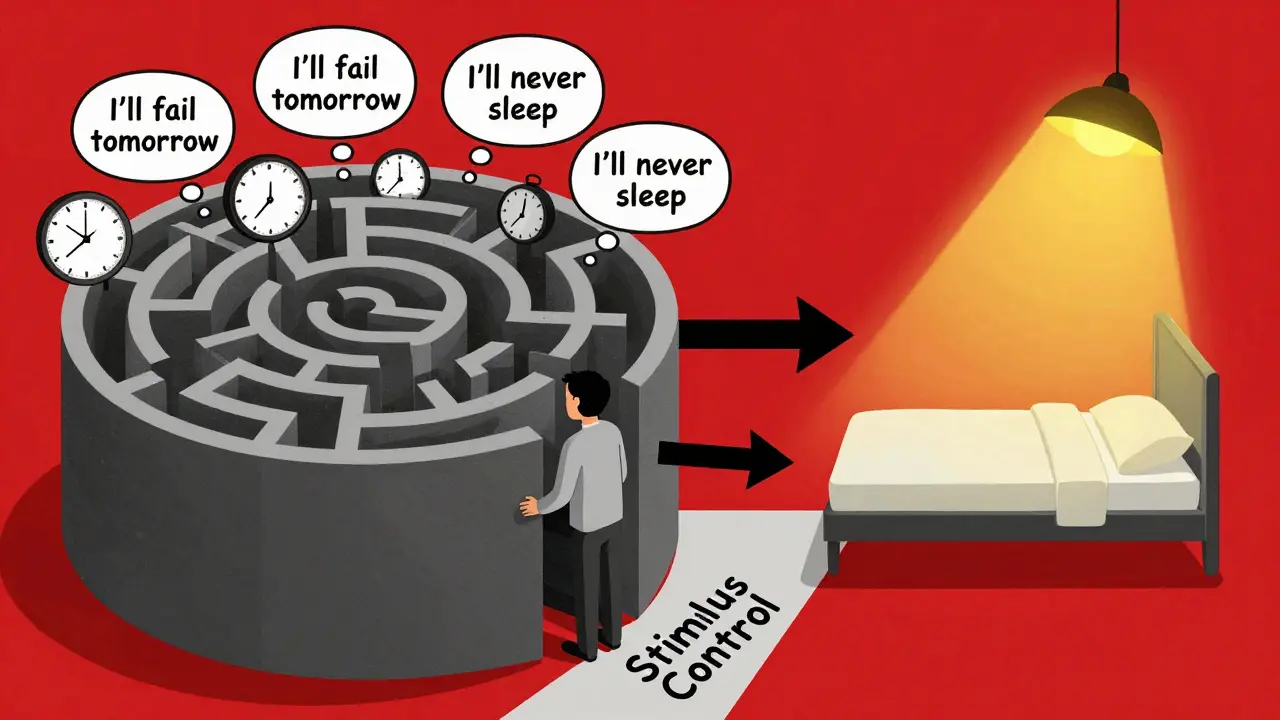
Think about it: if you’ve been lying awake for an hour, you start thinking, "I’m going to fail at work tomorrow," or "I’ll never get enough sleep." That anxiety becomes part of your bedtime ritual. Your brain starts associating your bed with stress, not rest. That’s not a hygiene problem. That’s a conditioned response. And hygiene doesn’t rewire your brain.
What Is CBT-I-And Why It Works
Cognitive Behavioral Therapy for Insomnia, or CBT-I, is the only treatment endorsed as first-line by the American College of Physicians, the American Academy of Sleep Medicine, and the National Institutes of Health. It’s not a pill. It’s not a gadget. It’s a structured, evidence-based program that rewires how you think about-and respond to-sleep.
CBT-I works because it targets the three factors that keep insomnia alive:
- Predisposing factors: Your natural tendency to be a light sleeper or anxious thinker.
- Precipitating factors: The event that started it-a job loss, illness, or major stress.
- Perpetuating factors: The habits and thoughts that keep it going long after the original trigger is gone.
CBT-I doesn’t just treat symptoms. It breaks the cycle.
The Five Core Components of CBT-I
CBT-I isn’t one trick-it’s five tools working together. Most programs run for 6 to 8 weeks, but even a 2-session version can make a difference.
1. Stimulus Control Therapy
This is about retraining your brain to associate your bed with sleep-not stress, not scrolling, not worrying.
- Only go to bed when you’re sleepy.
- If you’re not asleep in 15-20 minutes, get up. Go to another room. Do something quiet and dimly lit-read a physical book, listen to calm music. Don’t check the clock.
- Return to bed only when sleepy again.
- Wake up at the same time every day, even on weekends.
This sounds simple. But it’s hard. When you’re exhausted, the urge to stay in bed and "just rest" is strong. But staying in bed awake reinforces the link between your bed and frustration. Getting up breaks that link.
2. Sleep Restriction
This is the most uncomfortable part-for most people.
You track your sleep for a week using a sleep diary. Let’s say you’re in bed 8 hours but only sleeping 5. Your therapist will limit your time in bed to 5 hours. That means if you wake up at 6 a.m., you can only go to bed at 1 a.m.
It sounds brutal. And it is-for the first week or two. You’ll be tired. Maybe even more tired than before. But here’s the science: sleep restriction increases your sleep drive. Your body starts to crave sleep. Over time, as your sleep efficiency improves (say, from 60% to 85%), your bedtime gets pushed earlier, gradually restoring a healthy rhythm.
One Reddit user wrote: "The first two weeks were hell. I was a zombie. But after that? I fell asleep in 15 minutes. I hadn’t done that in 5 years."
3. Cognitive Restructuring
This is where the "cognitive" part kicks in. You’re not just changing behavior-you’re changing beliefs.
Common thoughts like:
- "I need 8 hours or I’ll collapse tomorrow."
- "If I don’t sleep tonight, my whole week is ruined."
- "My brain will never shut off."
These aren’t facts. They’re fears. CBT-I helps you challenge them with data. For example: people who sleep 6 hours still function fine. Many high performers sleep less than 7. And your brain doesn’t need to "shut off" to sleep-it just needs to stop fighting.
A 2019 study found that 65% of patients saw a drop in sleep-related anxiety after cognitive restructuring. That’s not just better sleep-it’s less fear. And less fear means less insomnia.
4. Relaxation Training
Chronic insomnia is tied to hyperarousal-your nervous system is stuck in "on" mode. Relaxation techniques like diaphragmatic breathing, progressive muscle relaxation, or mindfulness meditation help lower that baseline.
You don’t need to meditate for an hour. Even 5 minutes of slow breathing before bed-inhale for 4 counts, hold for 4, exhale for 6-can signal safety to your brain.
5. Sleep Hygiene (Used Correctly)
Yes, sleep hygiene has a role-but only as a supporting player. In CBT-I, it’s not the main tool. It’s the background tune.
- Keep your bedroom around 65°F (18.3°C)-cool is better for sleep.
- Use blackout curtains or an eye mask. Even small amounts of light can suppress melatonin.
- Use white noise if outside sounds wake you. A fan or app works.
- Avoid caffeine after 2 p.m. (some people need to cut it off by noon).
- Don’t drink alcohol close to bedtime. It might make you drowsy, but it fragments sleep later.
- Stop fluids after 7 p.m. to avoid bathroom trips.
These aren’t magic fixes. But when combined with stimulus control and sleep restriction? They become part of a powerful system.
CBT-I vs. Medication: The Long Game
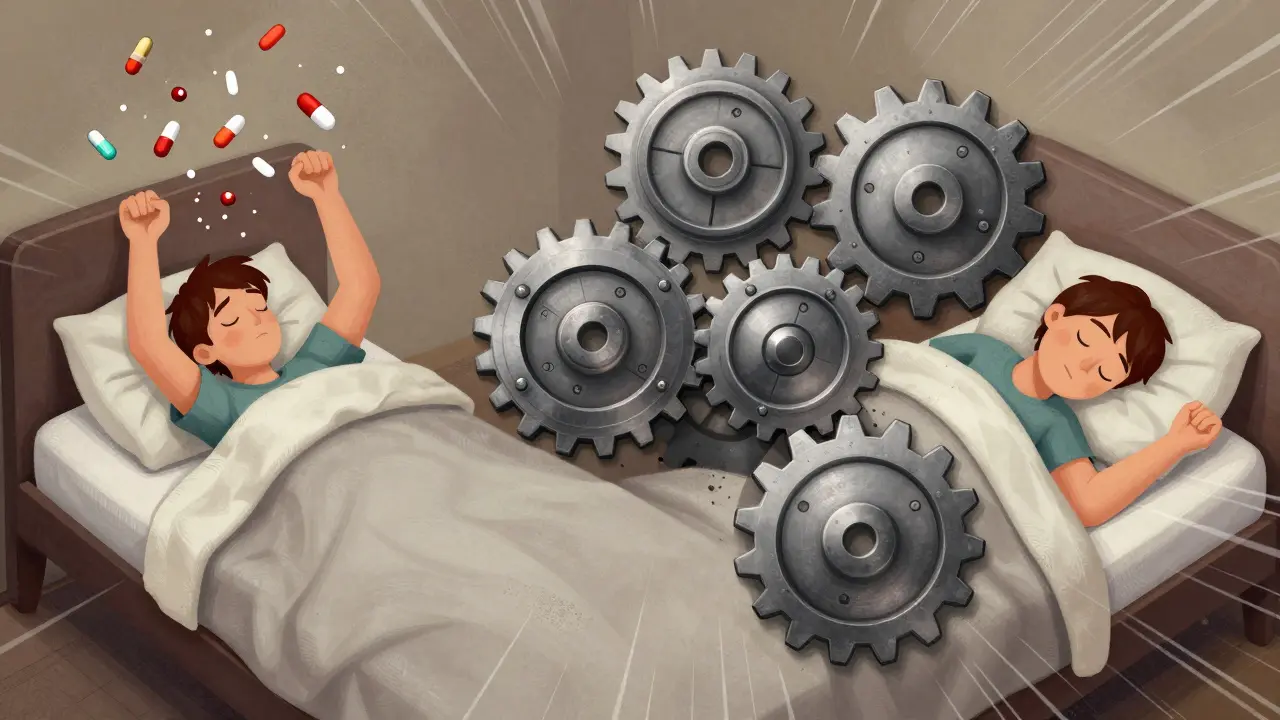
Medications like zolpidem, eszopiclone, or suvorexant can help in the short term. But after 4-6 weeks, their effectiveness drops. And you can get dependent.
CBT-I? The benefits last. A 2020 meta-analysis showed CBT-I reduced time to fall asleep by 18.2 minutes and nighttime wakefulness by 27.4 minutes. Medications? Only 12.1 and 15.8 minutes. And when people stopped taking pills, their sleep got worse. When they finished CBT-I? Their sleep stayed better-even a year later.
Dr. Rachel Manber at Stanford says it best: "CBT-I changes your relationship with sleep. Medications just mask the symptoms."
Can You Do CBT-I on Your Own?
Yes. And more people are.
Apps like Sleepio and SHUTi are FDA-cleared digital CBT-I programs. A 2021 JAMA study found they led to 50-60% remission rates-far better than control groups (15-20%). Somryst, a prescription app, showed 55.4% remission in FDA trials.
But here’s the catch: these programs still require discipline. You need to track your sleep. You need to follow the rules-even when you’re tired. And you need to stick with it for 6-8 weeks.
One user on Reddit said: "My insurance only covered 3 sessions. I couldn’t finish. I gave up."
That’s the biggest barrier: access. There are only 0.5 CBT-I-certified therapists per 100,000 people in the U.S. Rural areas? Most have none.
But digital options are growing fast. The market is projected to hit $1.2 billion by 2027. And more employers are offering CBT-I through wellness programs-37% of Fortune 500 companies now do.
How to Start
If you’ve had chronic insomnia for months or years:
- Get a sleep diary. Use a notebook or app like Sleep Cycle or Insomnia Coach. Track bedtime, wake time, and how long you were awake during the night.
- Calculate your average sleep time over 7 days. That’s your starting point for sleep restriction.
- Set a fixed wake-up time. No exceptions. Even on weekends.
- Download a CBT-I app like Sleepio, SHUTi, or Somryst. They’re affordable and guided.
- Eliminate caffeine after 2 p.m. and alcohol within 4 hours of bed.
- Start stimulus control: if you’re not asleep in 20 minutes, get up.
Don’t expect overnight results. Improvement usually takes 2-4 weeks. Full results? 8-12 weeks.
What to Expect When You Start
The first two weeks are the hardest. Sleep restriction makes you tired. Stimulus control feels unnatural. You’ll wonder if it’s working.
But here’s what happens next:
- By week 3, you start falling asleep faster-even if you’re still waking up.
- By week 5, you stop checking the clock.
- By week 8, you’re sleeping through the night without medication.
- By week 12, you feel like yourself again. Daytime fatigue fades. Anxiety about sleep drops.
A 2022 Sleepio survey found 78% of users reported reduced daytime fatigue. That’s not just sleep. That’s life.
The Bottom Line
Chronic insomnia isn’t a sleep problem. It’s a brain problem. And you can’t fix a brain problem with bedtime rules.
Sleep hygiene is a nice start. But it’s not the solution. CBT-I is. It’s the only treatment proven to change the way your brain responds to sleep-long-term, safely, and without drugs.
If you’ve tried everything and still can’t sleep, it’s not your fault. It’s just the wrong approach. CBT-I isn’t magic. But it’s science. And for millions of people, it’s the only thing that’s worked.
Start today. Track your sleep. Pick one tool-stimulus control or sleep restriction-and stick with it for 2 weeks. You might be surprised what your brain can do when you stop fighting it.
Is sleep hygiene enough to treat chronic insomnia?
No. While sleep hygiene helps with occasional sleep trouble, it’s not effective as a standalone treatment for chronic insomnia. Experts like Dr. Jack D. Edinger and the American Academy of Sleep Medicine state that sleep hygiene alone improves sleep in fewer than 20% of chronic cases. It doesn’t address the mental habits and conditioned responses that keep insomnia going. CBT-I is the only treatment proven to produce lasting results.
How long does CBT-I take to work?
Most people start seeing improvements in 2-4 weeks, especially with better sleep efficiency and reduced nighttime worry. Full benefits-like falling asleep quickly, sleeping through the night, and feeling rested during the day-typically take 8-12 weeks of consistent practice. The most challenging part, sleep restriction, often causes temporary fatigue but leads to the biggest gains.
Can I do CBT-I without a therapist?
Yes. Digital CBT-I programs like Sleepio, SHUTi, and Somryst are FDA-cleared and backed by clinical trials. These apps guide you through all five components of CBT-I with daily exercises, sleep tracking, and personalized feedback. Studies show they achieve 50-60% remission rates, comparable to in-person therapy. The main challenge is sticking with the program-discipline matters more than access.
Why does CBT-I work better than sleeping pills?
Sleeping pills like zolpidem or eszopiclone work for a few weeks, but their effects fade. They also carry risks of dependence, tolerance, and side effects like dizziness or memory issues. CBT-I addresses the root causes of insomnia-thought patterns, anxiety, and conditioned arousal-so the improvements last. A 2020 meta-analysis found CBT-I reduced time to fall asleep by 18.2 minutes and nighttime wakefulness by 27.4 minutes, with results lasting over a year. Medication benefits disappear once you stop taking them.
Is CBT-I right for older adults?
Yes. Research shows CBT-I is just as effective for older adults as it is for younger people. Dr. Daniel Buysse’s 2020 review found effect sizes of 1.0-1.3 on the Insomnia Severity Index-considered large clinical improvements. In fact, older adults often respond better than younger ones because they’re more likely to have developed maladaptive sleep habits over time, which CBT-I directly targets. The American Academy of Sleep Medicine recommends it as first-line treatment for all adults, including those over 65.
What’s the Insomnia Severity Index (ISI), and why does it matter?
The Insomnia Severity Index (ISI) is a 7-question tool used by clinicians to measure how severe insomnia is. Scores range from 0-28. A score of 15-21 means moderate insomnia; 22-28 means severe. It’s the gold standard for tracking progress in CBT-I. Most digital programs and therapists use it to adjust treatment. If your score drops by 7+ points after 8 weeks, you’re likely in remission. It’s not just about hours slept-it’s about how much insomnia is impacting your life.
Next Steps
If you’re ready to try CBT-I:
- Download a free sleep diary template from the American Academy of Sleep Medicine website.
- Start tracking your sleep for 7 days-no guessing. Write down when you get in bed, when you fall asleep, when you wake up, and how long you were awake.
- Choose one digital CBT-I app. Sleepio and SHUTi offer free trials.
- Set your wake-up time and stick to it, no matter what.
- Stop caffeine after 2 p.m. and alcohol 4 hours before bed.
Don’t wait for perfect conditions. Start with one step. Your brain doesn’t need more rules. It needs a new system. And CBT-I gives you one.




Anyone who thinks sleep hygiene is enough is just deluding themselves. I’ve been up for 12 hours straight and I didn’t even drink coffee. It’s not about curtains or tea. It’s about your brain being wired wrong. You need to reprogram it. That’s it. No magic. Just work.
And if you’re still using melatonin like it’s candy? You’re part of the problem.
cbt-i is the only thing that saved me. i tried everything. weighted blanket? cool. chamomile? nah. meditation? i fell asleep mid-breath. but stimulus control? holy shit. got up at 2am for a week. felt like a zombie. but then-bam. fell asleep in 10 mins. no pills. no bs. just science.
also, stop checking the clock. it’s a trap. i used to stare at 3:17 like it was my destiny. now? i just turn it over. life’s better.
I just want to say… I’ve been where you are. Three years. Three. Years. Lying there, heart pounding, mind racing, thinking, ‘Is this it? Is this my life now?’
Then I found CBT-I. Not because it was trendy. Not because someone on Instagram said so. Because I was tired of being a ghost in my own body.
Week one? I cried. Week two? I screamed into my pillow. Week five? I slept through the night. Not perfectly. Not always. But enough to feel human again.
If you’re reading this and you’re still trying to ‘fix’ yourself with lavender oil? Please. Give CBT-I a real shot. Your future self will thank you. I’m still crying. But now it’s because I’m finally tired, not because I’m terrified of sleep.
Let’s be real-sleep hygiene is a scam marketed by mattress companies and yoga influencers. You think turning off your phone fixes anxiety? Nah. You’ve got a dysregulated HPA axis, cortisol spikes at 2am, and your amygdala is running a 24/7 horror movie.
CBT-I works because it targets neuroplasticity. It’s not ‘behavioral.’ It’s neurobiological reconditioning. You’re literally rewiring the fear-memory loop tied to your bed.
And yes, sleep restriction is brutal. But so is chronic fatigue. Choose your pain.
Also, stop drinking chamomile tea like it’s a sacrament. It’s placebo with extra steps.
What if insomnia isn’t a disorder… but a message?
Maybe your soul is screaming, ‘I’m not ready to rest.’ Maybe you’ve been running on autopilot for so long that your mind refuses to shut down because it’s afraid of what it’ll find in the silence.
CBT-I isn’t just about sleep. It’s about surrender. Letting go of control. Stopping the performance of being ‘productive’ even when you’re broken.
That’s why it works. Not because of timers or diaries. But because it forces you to face the void. And in that void? You finally meet yourself.
And sometimes… that’s the only thing that can make you sleep.
CBT-I? Cute. But you’re all ignoring the elephant in the room: capitalism. You’re exhausted because you’re working 60-hour weeks, scrolling for dopamine, and being told to ‘optimize’ your sleep like it’s a KPI.
Fix the system. Don’t fix your brain.
Also, Sleepio costs $30/month. That’s not accessibility. That’s exploitation disguised as therapy.
The empirical evidence supporting CBT-I as a first-line intervention is unequivocal. Multiple randomized controlled trials, meta-analyses, and longitudinal follow-ups confirm its superiority over pharmacological agents in both efficacy and durability of outcomes.
Furthermore, the National Institutes of Health and the American College of Physicians have formally endorsed CBT-I based on Level 1 evidence. Sleep hygiene, by contrast, demonstrates only marginal effect sizes in chronic populations.
It is not merely a preference-it is a clinical imperative.
Just… thank you.
I didn’t know I was allowed to feel this tired. I thought it was weakness. Turns out, it was a signal. CBT-I didn’t ‘fix’ me. It helped me stop fighting myself.
Still not perfect. Still wake up sometimes. But now I don’t panic. I breathe. I turn over. I trust.
That’s enough.
For those saying CBT-I is too hard: I get it. I was there. I skipped days. I lied on my sleep diary. I wanted to quit.
But here’s what I learned: you don’t have to be perfect. You just have to show up.
One night, I got up at 2 a.m. and read a book. No guilt. No clock-checking. Just… being.
That was the night my brain started to believe the bed was safe again.
You don’t need a therapist. You just need one small, stubborn act of courage. Do it tomorrow. Then again the next day. And the next.
You’ve survived 100% of your worst nights so far. You can do this.
Oh my god, I’m crying right now. Not because I’m sad. Because I finally feel seen.
I spent five years buying expensive pillows, wearing blue-light glasses, drinking magnesium tea at 8 p.m., and still waking up at 3:13 a.m. like a haunted clock.
Then I tried sleep restriction. I was SO mad. I felt like a prisoner. My boss thought I was drunk. My cat started avoiding me.
But then… one morning, I woke up at 6:30 and didn’t feel like I’d been run over by a truck. I just… felt calm.
It’s not about being ‘fixed.’ It’s about being gentle with yourself. You’re not broken. You’re just tired of fighting your own mind.
And if you’re still reading this? You’re already on the path. Just keep going. Even if it’s slow. Even if it’s messy. You’re not alone.
I’m rooting for you. I’ve been there. And I’m sleeping now. Not perfectly. But better.
Love you all.
CBT-I is just placebo with a textbook. I slept better after I stopped caring. Maybe that’s the real cure: indifference.
So you’re telling me the solution to insomnia is… more discipline? More tracking? More stress?
Why not just take a pill and chill? At least then I’m not obsessing over whether I slept 5.2 hours or 5.8.
Also, who has time to keep a sleep diary? I work two jobs and my kid wakes up every two hours. CBT-I is for people with free time and a therapist on retainer.
In India, we say: ‘Jaldi so jao’-just fall asleep fast. But no one teaches you how. We’ve got chai, yoga, and silence… but no real tools.
CBT-I? I found it on YouTube. Free. No fancy app. Just a guy from Ohio explaining stimulus control in broken Hindi. I tried it. Didn’t work at first. But I kept going.
Now? I sleep like a cow. No drama. No guilt.
It’s not magic. It’s just… not giving up.
sleep is the only thing we can’t force… but we try anyway 🤡
we buy pillows, apps, crystals, weighted blankets, and still lie there like a broken robot whispering ‘please just shut off’
CBT-I is like telling your brain: ‘hey, you’re safe. no one’s coming. you can rest now.’
it’s not about rules. it’s about trust. 🌙💤
CBT-I is overhyped. 50% remission? That’s just people who stopped caring and started drinking more alcohol. The studies are funded by app companies. Wake up.
Real solution? Sleep meds. Just take them. Stop pretending you’re a self-help guru.