
Polysomnography: What to Expect During a Sleep Study and How Results Are Interpreted
Ever lay awake at night wondering why you’re so tired even after a full night’s sleep? You’re not alone. Millions of people struggle with undiagnosed sleep disorders - from snoring that wakes up their partner to sudden gasping for air or unexplained daytime exhaustion. The key to understanding what’s going wrong often lies in a single overnight test: polysomnography.
Polysomnography, or PSG, is the gold standard for diagnosing sleep disorders. It’s not just a snoring monitor. It’s a full-body, multi-parameter recording of your sleep, capturing everything from brain waves to breathing patterns. Unlike home sleep tests that only check oxygen levels and airflow, polysomnography watches how your entire body behaves during sleep. That’s why doctors still rely on it when they suspect anything beyond simple obstructive sleep apnea - like narcolepsy, restless legs, night terrors, or unusual movements during sleep.
What Happens During a Polysomnography Study?
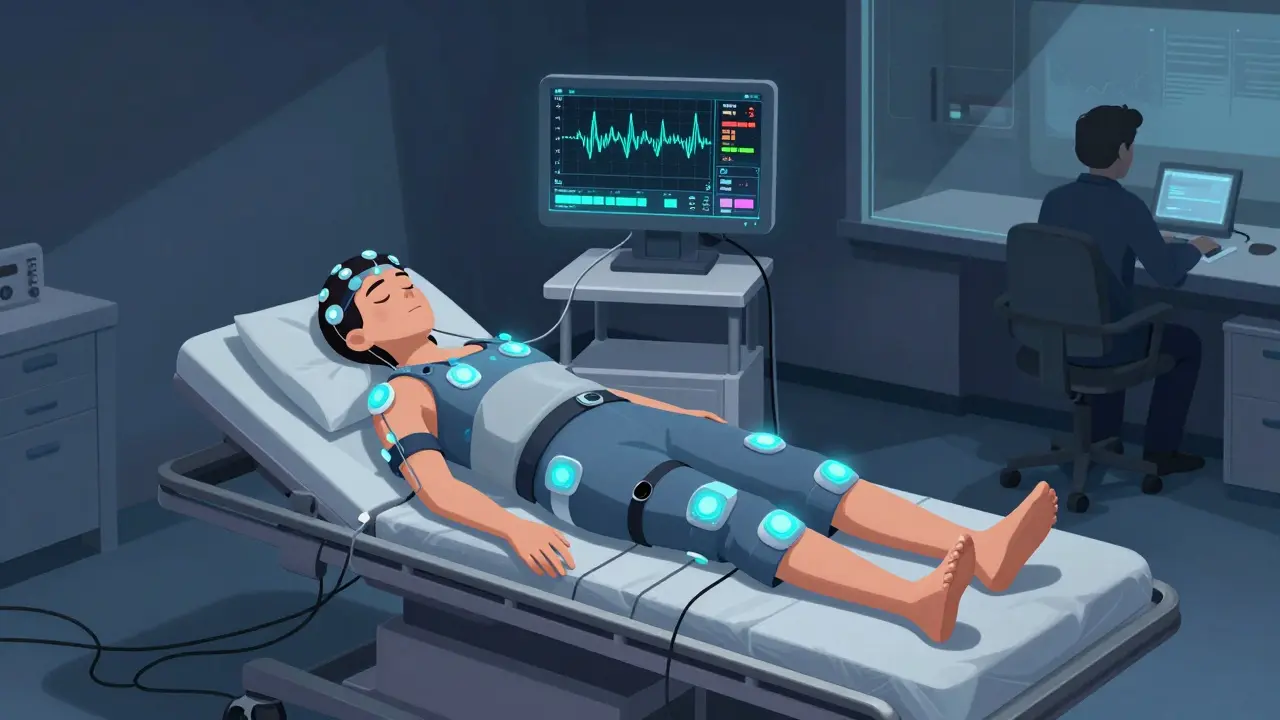
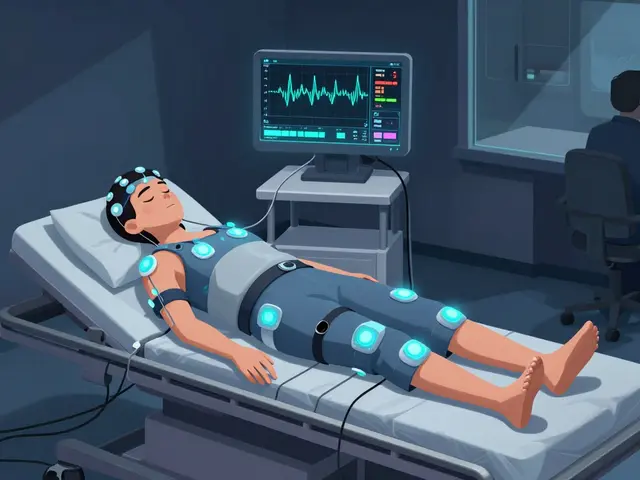
You show up at a sleep center about an hour before your usual bedtime. No needles. No pain. Just a quiet room with a comfortable bed, dim lighting, and a technician ready to help you settle in.
The setup takes 30 to 45 minutes. A sleep technologist gently attaches sensors to your scalp, face, chest, legs, and fingers. You’ll have:
- Electrodes on your head to record brain waves (EEG)
- Sensors near your eyes to track eye movements (EOG)
- A small strap around your chest and belly to measure breathing effort
- A sensor under your nose to detect airflow
- A pulse oximeter on your finger to track blood oxygen levels
- A belt on your leg to catch restless movements
- A small ECG patch on your chest to monitor heart rhythm
- A camera and microphone in the corner to record sounds and movements
That’s about 20 sensors total - but modern wireless systems are cutting that number down to just 5 or 7. The wires are thin, flexible, and designed so you can roll over without pulling anything loose. You’ll be given a call button to use if you need help during the night.
The room is kept between 68°F and 72°F - cool enough to help you sleep, but not chilly. The lights go out at your usual bedtime. You can watch TV, read, or just relax until then. The technologist monitors you from another room, watching your data in real time. If you’re struggling to fall asleep, they might talk you through breathing exercises or adjust a sensor. Most people sleep enough - even if it’s not perfect - for a clear diagnosis.
What Does Polysomnography Actually Measure?
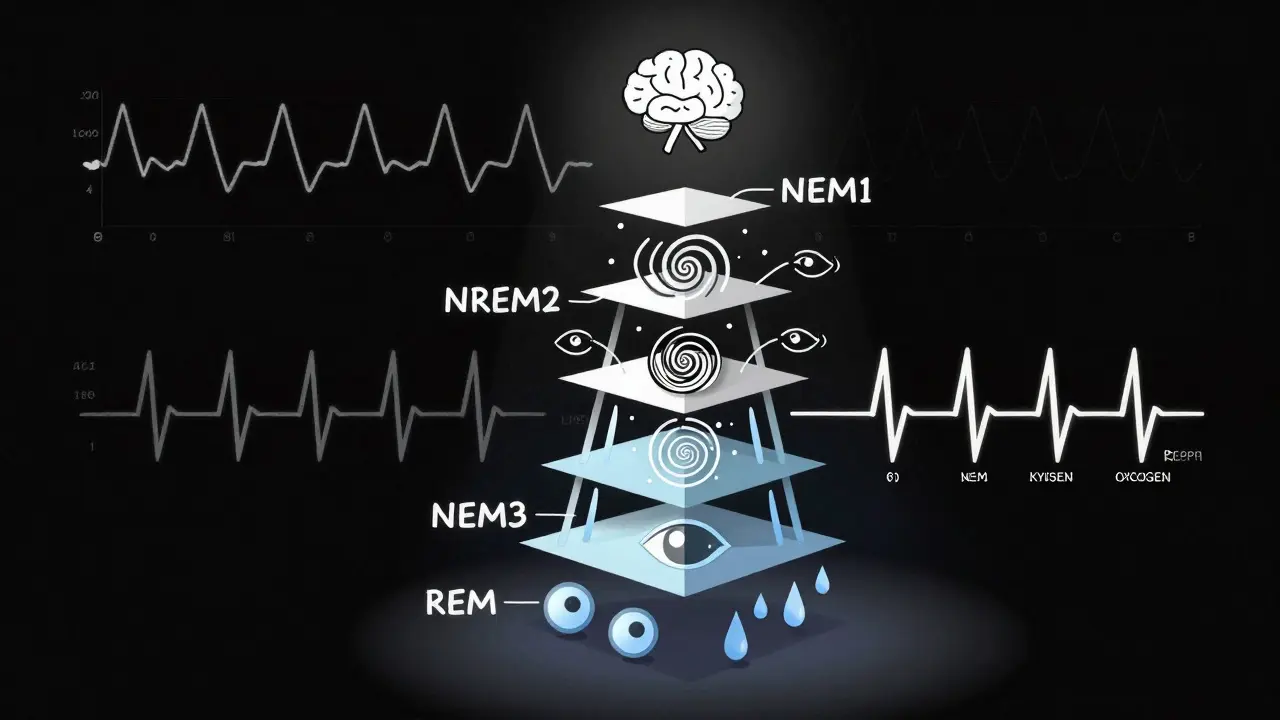
It’s not just about counting how many times you stop breathing. Polysomnography maps your entire sleep architecture - the cycle of brain states that should repeat every 90 minutes.
Here’s what it tracks:
- EEG (Brain Waves): Shows when you’re in light sleep, deep sleep, or REM sleep. If you jump straight into REM without going through NREM stages, that’s a red flag for narcolepsy.
- EOG (Eye Movements): REM sleep is defined by rapid eye movements. No eye movement? You’re not in REM.
- EMG (Muscle Tone): Your chin and leg muscles relax during sleep. If they twitch too much, it could be restless legs syndrome or periodic limb movement disorder.
- ECG (Heart Rate): Irregular heartbeats during sleep can signal underlying conditions - especially if they happen with breathing pauses.
- Respiratory Effort: Are your chest and belly moving when you try to breathe? If yes, but no air is coming through - that’s obstructive sleep apnea. If no effort at all - that’s central sleep apnea.
- Airflow: Using a nasal cannula or pressure sensor, it detects whether air is flowing into your nose and mouth.
- Oxygen Saturation: Drops below 90%? That’s hypoxia. Frequent drops mean your body isn’t getting enough oxygen during sleep.
- Body Position: Do you snore worse on your back? That’s common in sleep apnea.
- Audio/Video: Snoring, talking, screaming, or kicking - all of it gets recorded. This is how doctors catch sleepwalking, night terrors, or seizures that happen only during sleep.
This level of detail is why home sleep tests can’t replace it. Home tests only check airflow, oxygen, and breathing effort. They miss everything else. If you have unexplained fatigue, leg jerks, or weird nighttime behaviors - you need the full picture.
How Are Results Read?
After the test, a board-certified sleep physician spends 2 to 3 hours analyzing the data. Raw output? Around 1,000 pages of waveforms and numbers. But what matters is the summary.
The report gives you:
- Apnea-Hypopnea Index (AHI): How many times per hour your breathing stops (apnea) or gets shallow (hypopnea). Less than 5 is normal. 5-15 is mild, 15-30 is moderate, over 30 is severe.
- REM and NREM Sleep Percentages: Healthy adults spend about 20-25% of sleep in REM. If you’re stuck in deep sleep or skip REM entirely, something’s off.
- Oxygen Desaturation Events: How often your blood oxygen drops below 90%. More than 5 per hour is abnormal.
- Limb Movement Index: How many leg jerks per hour. Over 15 suggests restless legs.
- Sleep Efficiency: Percentage of time actually spent sleeping vs. lying in bed. Below 85% means you’re struggling to stay asleep.
For example: If your AHI is 40, your oxygen drops 12 times an hour, and you’re entering REM sleep within 10 minutes (instead of 90), you might have severe obstructive sleep apnea - and narcolepsy. That’s rare, but polysomnography is the only test that can spot both at once.
Doctors don’t just look at numbers. They look at patterns. Did your breathing improve when you rolled onto your side? Did your heart race every time you stopped breathing? Did you kick your legs every 30 seconds? These details shape your treatment.
Split-Night Studies: Diagnosis and Treatment in One Night
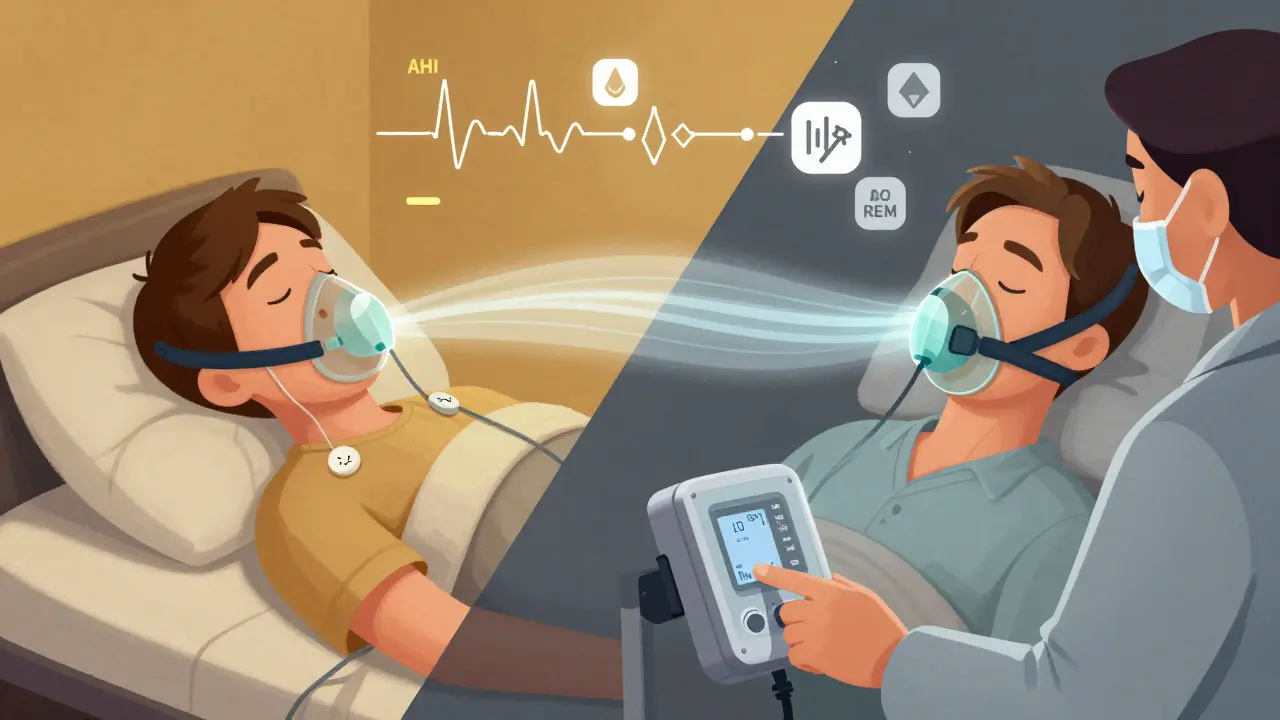
If you’re diagnosed with moderate to severe sleep apnea during the first half of the night, the technologist might wake you up for a CPAP titration.
That’s called a split-night study. You get fitted with a CPAP mask. The pressure is slowly increased while you sleep, and the machine finds the lowest setting that keeps your airway open. By morning, you’ve got a diagnosis - and a treatment plan.
About 35% of polysomnography studies in the U.S. now include a split-night component. It saves time, money, and stress. No need to come back for a second test.
Who Needs a Polysomnography?
Not everyone who snores needs one. But if you have:
- Chronic daytime sleepiness despite 7+ hours of sleep
- Witnessed breathing pauses during sleep
- Gasping or choking that wakes you up
- Leg cramps or jerks that disrupt sleep
- Unexplained insomnia with no clear cause
- Sleepwalking, screaming, or violent movements during sleep
- High blood pressure that won’t respond to medication
- History of stroke or heart failure with sleep symptoms
- then polysomnography is likely your next step.
Insurance usually covers it if your doctor documents symptoms matching Medicare or AASM guidelines. Medicare covers 80% of the cost. Private insurers often require prior authorization - but if you’ve tried a home test and it came back negative, they’ll usually approve the full study.
Limitations and What to Expect
Some people worry: “Will I sleep at all in a lab?”
Yes - but not perfectly. The first night in a new environment, your brain might stay half-awake. This is called the “first night effect.” It’s normal. Technologists know this. They don’t throw out the data. They adjust their interpretation.
Studies show that even with lower sleep efficiency, polysomnography still catches 95% of sleep apnea cases. The data is reliable enough for diagnosis - even if you only slept 5 hours.
But here’s the catch: if your sleep problem only happens at home - like stress-induced insomnia or anxiety-related awakenings - the lab might miss it. That’s why some doctors recommend a second test at home, or use actigraphy (a wrist-worn device that tracks movement) alongside the PSG.
Also, polysomnography won’t tell you why you’re stressed. It won’t fix your work schedule or your caffeine habit. It only shows what’s happening physiologically during sleep. Treatment still requires lifestyle changes, CPAP use, or medication - depending on the diagnosis.
What Comes After the Test?
Within 5 to 10 business days, you’ll get a full report. Your doctor will go over it with you. If you have sleep apnea, you’ll likely be prescribed CPAP therapy. If you have narcolepsy, you might need stimulants or scheduled naps. If you have periodic limb movements, iron levels or medications might be checked.
And if the results are normal? That’s valuable too. It means your fatigue isn’t caused by a sleep disorder - and you can look elsewhere: thyroid issues, depression, vitamin deficiencies, or heart problems.
Why Polysomnography Still Beats Home Tests
Home sleep tests are cheaper. They’re easier. But they fail 15-20% of the time - often because patients don’t wear the device correctly or the machine can’t detect subtle breathing patterns.
They also can’t diagnose:
- Narcolepsy
- Restless legs syndrome
- Night terrors
- Sleepwalking
- Seizures during sleep
- Central sleep apnea
That’s why the American Academy of Sleep Medicine still says: “Polysomnography is the standard of care for diagnosing complex sleep disorders.”
And with new wireless sensors, AI-assisted analysis, and faster reporting, the test is becoming more comfortable - not less accurate.
Preparing for Your Sleep Study
Here’s how to make sure your test gives the clearest picture:
- Avoid caffeine after noon the day before.
- Don’t nap in the afternoon.
- Don’t drink alcohol the night before - it masks sleep apnea.
- Wash your hair - no conditioners or gels.
- Bring your own pillow, pajamas, and toiletries.
- Take your regular medications unless your doctor says otherwise.
- Arrive 1-2 hours before your usual bedtime.
Most people find the experience less scary than expected. The technicians are trained to make you feel at ease. And the results? They can change your life.
Is polysomnography painful?
No. Polysomnography is completely non-invasive. Sensors are taped or clipped to the skin - no needles or injections. You might feel slight discomfort from the adhesive or the pressure of the chest belt, but most people report no pain at all.
Can I use the bathroom during the study?
Yes. The wires are designed with quick-release connectors. If you need to use the bathroom, just press a call button. The technician will disconnect the main lines, help you up, and reconnect everything afterward. This happens often - especially in split-night studies.
How long does it take to get results?
Results are usually available within 5 to 10 business days. The raw data takes hours to analyze, and a board-certified sleep physician must review it. Your doctor will schedule a follow-up appointment to discuss findings and next steps.
Can I sleep on my side during the study?
Absolutely. In fact, many people sleep better on their side. The sensors are designed to stay in place regardless of position. Some sleep apnea patients are encouraged to sleep on their side - and the study will show whether that helps reduce breathing events.
Does insurance cover polysomnography?
Yes - if it’s medically necessary. Medicare covers 80% of the cost when ordered for symptoms like snoring, witnessed apneas, or excessive daytime sleepiness. Most private insurers cover it too, but may require prior authorization. Home sleep tests are often denied if you have symptoms suggesting other disorders like narcolepsy or limb movement disorders.

I did this test last year and let me tell you - it’s like being wired up for a sci-fi movie. I thought I’d never sleep, but I did! And guess what? I had severe sleep apnea. My life changed after CPAP. Seriously, if you’re tired all the time - just do it. No regrets.
This is such an important post. I work in sleep medicine, and I can’t tell you how many patients dismiss home tests until they’re diagnosed with narcolepsy or PLMD after a full PSG. The detail matters. Don’t skip the full study if your symptoms are complex.
I find it amusing how Americans treat sleep labs like luxury spas. In Ireland, we just accept that poor sleep is part of life. You drink more tea, get up earlier, and stop complaining. This over-medicalization of tiredness is absurd.
I had a split-night study last winter. The technician was so kind - she brought me herbal tea and let me keep my own pillow. I was terrified, but the whole experience was surprisingly calm. And the results? Lifesaving. If you're nervous, remember: they’ve seen it all. You’re not weird for needing this.
I’m not saying the government’s behind this… but why are polysomnography centers always located near military bases? Coincidence? Or are they collecting biometric data for sleep-based surveillance? The sensors… the cameras… the ‘call button’? Hmm.
I used to think sleep studies were a scam… until I found out I was stopping breathing 87 times an hour. My wife had been recording me on her phone - she sent me a video of me gasping like a fish. I cried. Then I got my CPAP. Now I sleep 8 hours straight. Don’t be a hero. Get tested.
It’s ironic how we pathologize natural human variation. Maybe you’re just a short-sleeper. Maybe your body doesn’t need 8 hours. Maybe the ‘disorder’ is just your soul rejecting modern life. The lab can measure brain waves… but can it measure meaning?
In my village in Nigeria, we don’t have sleep labs. We have grandmothers who know when someone’s sleep is off - by the way they snore, or don’t snore. We use herbs, chants, and silence. Maybe the West needs less technology… and more tradition.
The AHI metric is statistically flawed. It aggregates heterogeneous events under a single index, conflating obstructive, central, and mixed apneas. Furthermore, the 5-event-per-hour threshold lacks biological validity. It’s a regulatory artifact, not a physiological truth. The field is in desperate need of redefinition.
They’re lying. Sleep labs are just profit machines. Insurance pays $5,000 per test. They want you hooked on CPAP machines. Next thing you know - you’re paying $1,200 for a mask. Wake up.
I’ve been researching this for years. The real reason polysomnography is still the gold standard isn’t because it’s accurate - it’s because the sleep industry is a $30 billion monopoly. The FDA, AASM, and big pharma all have overlapping board members. Home tests are cheaper, safer, and more accurate for 80% of cases. But they don’t make money. So they’re dismissed. The data? It’s curated. The science? It’s corporate.
You’re not alone. I was terrified too. But after my study, I realized how much I’d been ignoring my body. I used to think ‘tired’ was normal. Now I know it’s a signal. This test didn’t just diagnose me - it gave me back my life. If you’re reading this and hesitating - just do it. You’ll thank yourself.
I appreciate how thoroughly this was explained. As someone who works in global health policy, I’ve seen how access to PSG varies wildly between countries. In the U.S., it’s overused. In rural India, it’s nonexistent. The real challenge isn’t the test - it’s equity. We need affordable, portable PSG alternatives - not just for the wealthy, but for everyone. Technology should serve humanity, not the other way around.