
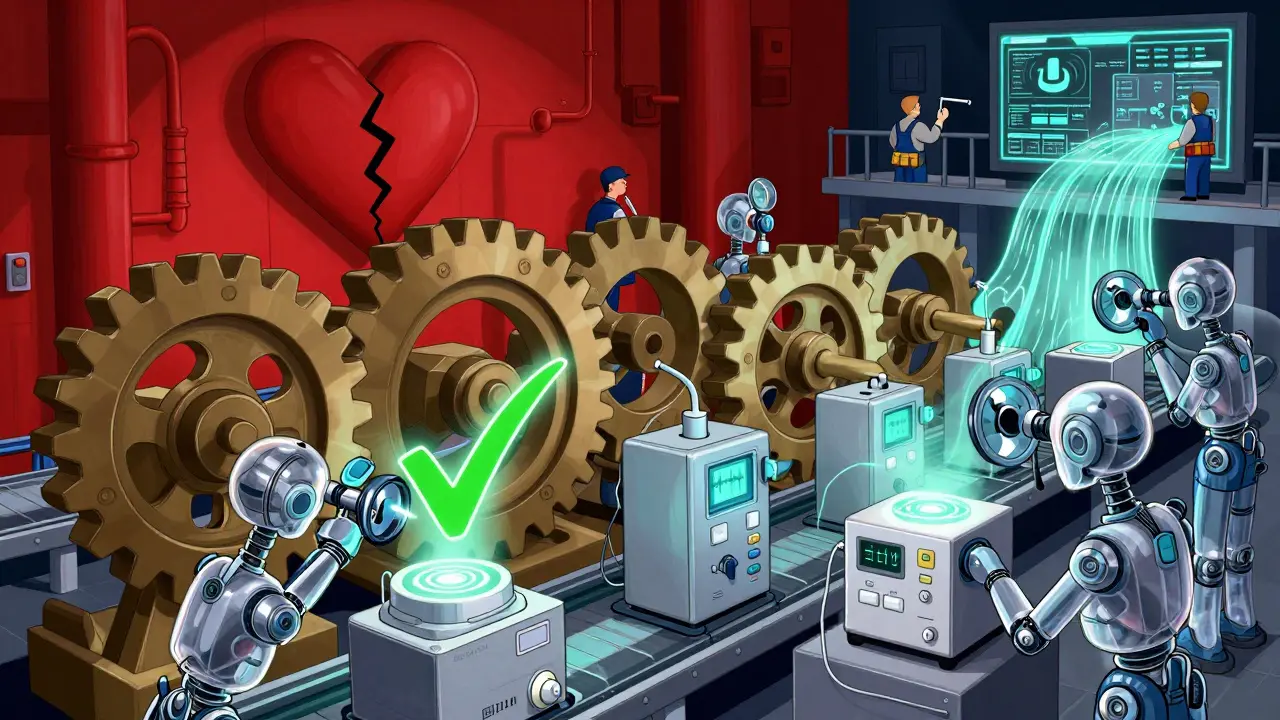
Quality Control in Manufacturing: Safety Standards That Protect Patients
When a pacemaker is implanted, an insulin pump is delivered to a diabetic patient, or a surgical robot assists in a life-saving operation, no one should have to wonder if the device will work as intended. The truth is, without strict quality control in manufacturing, these devices could fail - and patients could die. This isn’t hypothetical. It’s the reason entire regulatory systems exist: to make sure every screw, wire, and software update in a medical device meets non-negotiable safety standards before it touches a human body.
What Exactly Is Quality Control in Medical Device Manufacturing?
Quality control isn’t just about checking a box. It’s a full-system approach that tracks every step of production - from the raw materials coming in to the final product going out. It’s not random inspections. It’s documented procedures, measurable targets, and constant monitoring. If a batch of syringes has a 0.01% defect rate, that might sound tiny. But when you’re making millions of them for hospitals worldwide, that tiny percentage becomes thousands of faulty devices. And each one is a potential risk to someone’s life.
The backbone of this system in the U.S. used to be 21 CFR Part 820 - the FDA’s Quality System Regulation. But in 2024, everything changed. The FDA issued the Quality Management System Regulation (QMSR), which officially adopted ISO 13485:2016 as the new global standard. This wasn’t just a paperwork update. It was a major shift toward aligning U.S. rules with international practices. Now, manufacturers who sell devices both in America and abroad no longer need two separate systems. One standard covers both.
The Core Framework: ISO 13485:2016 and FDA’s QMSR
ISO 13485:2016 isn’t just another certification. It’s a living framework that forces companies to think about risk at every turn. Unlike older systems that focused on checking off procedures, ISO 13485:2016 demands you ask: What could go wrong? and How do we stop it? This includes everything from how suppliers are chosen to how a device is stored after production.
The FDA’s QMSR, effective February 2, 2026, makes this standard mandatory for all medical device makers selling in the U.S. That means if you’re producing a Class II or Class III device - things like ventilators, stents, or implantable neurostimulators - you must follow ISO 13485:2016. No exceptions. This change didn’t come out of nowhere. It was built on decades of data showing that manufacturers using this system had fewer recalls, fewer patient injuries, and faster global approvals.
Before this harmonization, U.S. companies had to jump through two sets of hoops: one for the FDA and another for Europe’s CE marking. That doubled the cost of compliance for many small firms. Now, with one standard, companies save an estimated $400 million per year in redundant audits, documentation, and training. That money doesn’t disappear - it gets reinvested into better testing, better training, and better patient outcomes.
The Technical Rules: What You Can’t Skip
Quality control isn’t abstract. It’s measured in volts, microamperes, and defect rates. For example, any electrical medical device must pass the IEC 60601-1 safety standard. That means it must withstand at least 1,500 volts of electrical stress without leaking more than 100 microamperes of current under normal use. One extra microampere could mean a shock - or worse, a fatal arrhythmia in a cardiac patient.
Each manufacturing stage has checkpoints:
- Incoming components: Every batch of plastic housings, metal connectors, or circuit boards is tested before assembly. No exceptions.
- In-process verification: During production, statistical process control (SPC) tracks variables like temperature, pressure, and assembly torque. If a machine drifts just 2% out of spec, the line stops.
- Final testing: Every single device undergoes functional testing. A glucose monitor must read within ±15% of a lab standard. A defibrillator must deliver its full charge in under 5 seconds. No “close enough.”
Traceability is non-negotiable. Every device must have a unique identifier linked to its production batch, materials used, and quality test logs. If a problem pops up months later - say, a battery fails in 500 devices - the company can pull up exact records and recall only the affected units. Without this, you’d be recalling millions of perfectly safe devices.
How Real Companies Are Doing It - And Where They Fail
Some manufacturers have turned quality control into a competitive advantage. Greenlight Guru, a quality management software platform, reports that users who follow ISO 13485:2016 with integrated risk management saw a 35% drop in field actions - meaning fewer device failures in the wild. One company using traceability matrices caught a software bug in an implanted device that could have led to a Class I recall. They identified the flaw before it left the factory. That saved lives - and millions in legal and reputational damage.
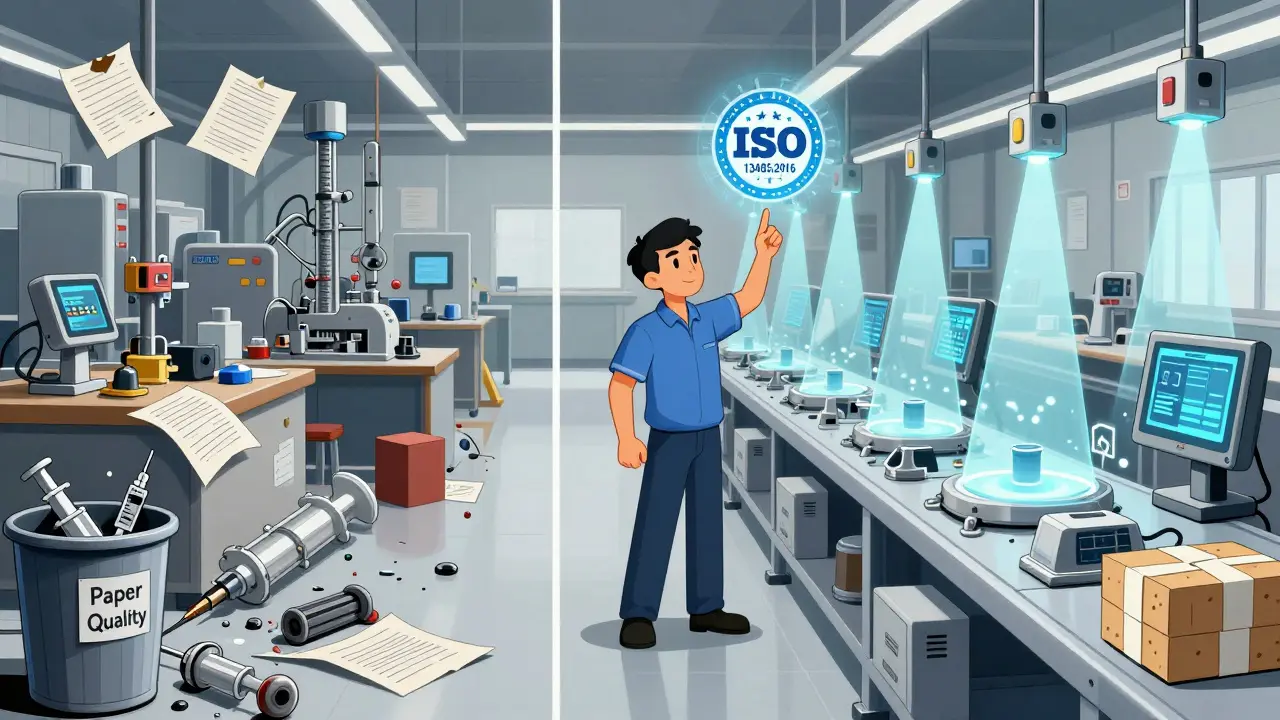
But not everyone gets it right. A 2023 FDA report found that 23% of inspection violations were for “paper quality systems” - meaning the documents looked perfect, but the actual processes were broken. One manufacturer had 12 pages of procedures for cleaning equipment… but no one was trained on how to do it. Another had flawless audit records - but their supplier hadn’t been inspected in three years. The FDA calls these “systemic failures.” They’re not accidents. They’re negligence dressed up as paperwork.
Another common pitfall? Supplier oversight. Nearly half of all FDA warning letters in 2023 cited poor supplier audits. A single faulty component from a third-party vendor can compromise an entire device. That’s why ISO 13485:2016 requires manufacturers to treat suppliers like part of their own team - with regular audits, performance metrics, and documented corrective actions.
The Human Side: Training, Culture, and Time
Technology helps - but people make it work. A senior quality engineer on Reddit shared that implementing ISO 13485:2016 cut their corrective action cycle from 45 days to 17. But it took 18 months of cross-department training. Engineers had to learn risk management. Production staff had to understand why every step mattered. It wasn’t just a new software tool - it was a cultural shift.
Training isn’t optional. Quality professionals need 6-12 months to master ISO 14971 risk management. Production staff need 40-80 hours of hands-on training just to operate the new controls. And it’s not a one-time thing. The FDA requires ongoing competency checks. You can’t just hire someone, hand them a manual, and assume they’ll get it right.
Still, many companies struggle with documentation overload. A 2023 survey found that 68% of quality managers spent more time on paperwork than on actual process improvement. That’s why tools like integrated QMS platforms are growing so fast. The global market for this software hit $1.27 billion in 2023 and is projected to hit $2.84 billion by 2028. Why? Because companies are realizing: automation doesn’t replace quality - it enables it.

The Future: AI, Cybersecurity, and What’s Next
The next wave of quality control is already here. Early adopters are using AI to predict defects before they happen. One manufacturer reduced defects by 30% by training machine learning models on 10 years of production data. The system now flags subtle patterns - a slight vibration in a press, a temperature spike in a sterilization chamber - that humans would miss.
By 2027, Gartner predicts 60% of medical device quality systems will use AI-driven analytics. That could cut human error by up to 50%. But with AI comes new risks. Software-as-a-Medical-Device (SaMD) is exploding - apps that diagnose, monitor, or treat conditions. The next version of ISO 13485 (expected in 2025) will include cybersecurity requirements. A hacked insulin pump isn’t a data breach - it’s a life-threatening attack.
The bottom line? Quality control isn’t about avoiding penalties. It’s about preventing harm. The FDA estimates that strong quality systems stop 30% of device failures before they reach patients. That’s tens of thousands of lives saved every year. And with the global standard now unified under ISO 13485:2016, the entire industry is moving toward one goal: zero preventable harm.
What You Need to Do Today
If you’re a manufacturer, the clock is ticking. The FDA’s QMSR takes effect February 2, 2026. If you haven’t started transitioning from 21 CFR Part 820 to ISO 13485:2016, you’re behind. Start with a gap analysis. Compare your current system to ISO 13485:2016’s 11 core subsystems: management control, design control, document control, purchasing, traceability, production controls, acceptance, nonconforming product, rework, CAPA, and quality audits. Then train your team. Don’t wait for an audit. Build the system now - because when it comes to patient safety, there’s no such thing as too early.
What is the difference between ISO 13485 and FDA 21 CFR Part 820?
ISO 13485:2016 is a global standard focused on risk-based quality management, while FDA 21 CFR Part 820 was a U.S.-specific regulation with detailed procedural requirements. The key difference was that ISO 13485 embedded risk management into every process, while the FDA’s old rule treated risk as a separate section. As of February 2, 2026, the FDA has replaced 21 CFR Part 820 with a rule that incorporates ISO 13485:2016 by reference, effectively merging the two systems into one harmonized standard.
Why does patient safety depend on manufacturing quality control?
Medical devices like pacemakers, infusion pumps, and surgical tools interact directly with the human body. A tiny flaw - a loose wire, a contaminated component, or a software glitch - can cause serious injury or death. Quality control ensures every device meets strict performance and safety thresholds before it leaves the factory. Without it, even a 0.1% defect rate could mean thousands of dangerous devices in circulation. The FDA estimates that robust quality systems prevent about 30% of potential device failures that could otherwise reach patients.
What happens if a company doesn’t comply with ISO 13485:2016 after February 2026?
After February 2, 2026, all medical devices sold in the U.S. must comply with ISO 13485:2016 under the FDA’s QMSR. Non-compliant manufacturers will not be allowed to market their devices in the U.S. The FDA can issue warning letters, seize products, or even shut down operations. For companies selling internationally, non-compliance also blocks access to markets like the EU, Canada, and Australia, which all recognize ISO 13485 as a baseline requirement.
How long does it take to implement ISO 13485:2016?
For Class II and III medical device manufacturers, implementing ISO 13485:2016 typically takes 12 to 24 months. This includes a 4-8 week gap analysis, system redesign, staff training, and internal audits. Smaller companies with fewer resources often take longer. Full compliance requires not just updating documents, but changing culture - which takes time. The FDA’s transition timeline gives companies until February 2026 to complete the shift.
Can AI really improve quality control in medical manufacturing?
Yes. Early adopters using AI for predictive quality control have reported 25-40% reductions in defect rates. Machine learning models analyze real-time production data - vibration, temperature, pressure, and electrical signals - to spot anomalies humans miss. For example, a slight change in motor torque during assembly might indicate a future failure. AI doesn’t replace inspectors - it empowers them with early warnings. Gartner predicts that by 2027, 60% of medical device quality systems will use AI analytics to reduce human error by up to 50%.



Honestly, this is one of those topics that doesn't get enough attention. I work in med device QA and let me tell you, the shift to ISO 13485:2016 was a game changer. Less red tape, more real safety. I used to spend half my week chasing paper trails. Now? We actually have time to fix problems before they happen. 🙌
One defective pacemaker is one too many.
Man, I never realized how much goes into these devices until I had a family member get an implant. The level of detail here is wild. From voltage checks to supplier audits - it’s like a whole universe of precision. And yeah, AI is gonna be huge. My cousin’s company uses it now and they’ve cut defects in half. Crazy stuff.
Let’s be real - most of these 'quality systems' are just glorified PowerPoint decks. I’ve seen factories with 300-page manuals where no one knows what’s in them. The real issue? Companies treat compliance like a checkbox, not a lifeline. And then they wonder why recalls happen. 😒
So we’re trusting machines made by people who can’t even spell 'defect' correctly? Cool. Just let me know when the FDA starts auditing the auditors. Because if your quality system is run by someone who thinks 'ISO' stands for 'I Suck at Organizing', we’re all doomed. 🤡
The harmonization of standards is a significant step forward. It reduces redundancy and increases global consistency. However, implementation challenges remain, particularly for small manufacturers with limited resources. Training and cultural adaptation are critical components that cannot be overlooked.
Quality control my ass. They’re just making us pay more so they can buy nicer offices. I’ve seen the audits. Same people. Same slides. Same coffee. Zero change in real safety. Just more consultants making bank. 💀
India has been doing this right for years. Our pharma and device makers export globally because we don’t cut corners. Why do you think so many US companies outsource? Because we actually care about standards. Stop acting like the US invented safety. We’ve been ahead for decades.
I really appreciate how this breaks down the human side - training, culture, time. So many people think tech fixes everything, but it’s the people showing up, asking the hard questions, and refusing to let a batch slide that actually saves lives. Grateful for those doing the quiet work.
Wait… so you’re telling me the FDA didn’t just make this up? That there’s actual science behind it? I thought this was all a Big Pharma scheme to sell more devices. 😳 Are we sure they’re not using this to track us? I mean… implants. Software updates. Traceable IDs. Hmm.
I wept when I read about the $400 million saved. Not because it’s a lot - but because it’s a drop in the ocean of human suffering we’ve ignored for decades. This isn’t regulation. It’s redemption. A quiet, bureaucratic, soul-crushing redemption - but redemption nonetheless. Every screw tightened is a prayer whispered in a hospital room.
USA invented this. Everyone else just copied it. ISO didn’t create standards - they just took what we built and slapped their logo on it. Don’t let the Europeans fool you. We built the system. We deserve the credit.
This is all fake. They just want to control us. Pacemakers have trackers. The AI is spying. They are using this to put chips in people. I know a guy who works at a factory. He says the machines are always broken. Always. Why? Because they want us to need them. Don't trust this.