
Restless Leg Syndrome: Dopaminergic Medications and Relief
Restless Leg Syndrome (RLS) isn’t just an occasional twitch. For millions, it’s a nightly battle - an unbearable urge to move the legs, often paired with crawling, aching, or tingling sensations that only get worse when you’re trying to sleep. If you’ve ever lain awake at 2 a.m. because your legs feel like they’re being pulled from the inside, you know how exhausting this is. And for years, the go-to fix was dopamine-boosting drugs like Mirapex or Requip. But things have changed - and fast.
Why Dopamine Drugs Used to Be the Go-To
Back in the 2000s, doctors reached for dopamine agonists like pramipexole and ropinirole because they worked - quickly. These pills mimic dopamine, a brain chemical that helps control movement. In RLS, there’s a suspected dopamine imbalance in the A11 region of the brain, which controls spinal motor signals. So, giving more dopamine seemed logical. Many patients felt relief within an hour. For someone suffering from severe nighttime symptoms, that was a game-changer.By 2010, dopamine agonists made up 75% of all new RLS prescriptions. They were easy to prescribe, covered by insurance, and patients reported immediate improvement. But what no one fully understood at the time was how the body reacts over time.
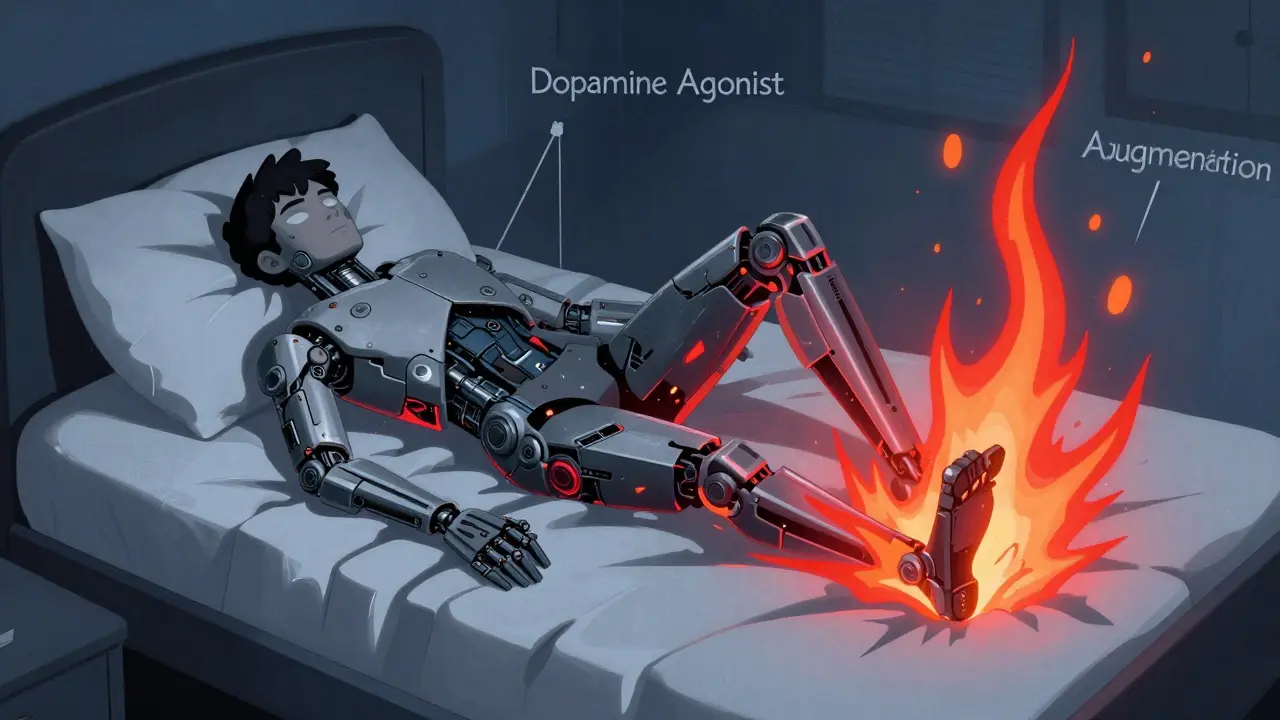
The Hidden Cost: Augmentation
Augmentation is the silent killer of long-term RLS treatment. It’s not a side effect - it’s a worsening of the disease itself. After months or years on dopamine meds, symptoms don’t just stay the same. They get worse. Earlier. Stronger. Spread farther.Instead of kicking in at 9 p.m., the urge starts at 5 p.m. - sometimes even in the afternoon. The tingling spreads from the legs to the arms. The nights you used to manage with one pill turn into five or seven nights a week of unbearable discomfort. Studies show 40% to 60% of people on dopamine agonists develop augmentation within 1-3 years. By five years, that number climbs to 80%.
One patient, ‘RLSWarrior42,’ posted on the RLS Foundation forum in June 2024: “After two years on Mirapex, my symptoms started at 2 p.m. Instead of sleeping, I was pacing the house. I had to quit cold turkey - and it took six months to stabilize.”
Augmentation isn’t rare. It’s predictable. And it’s why the American Academy of Sleep Medicine (AASM) updated its guidelines in December 2024 - and why dopamine agonists are no longer first-line treatment.
What’s Replacing Dopamine Drugs?
The new standard? Alpha-2-delta ligands. These are medications originally developed for epilepsy and nerve pain - gabapentin enacarbil (Horizant) and pregabalin (Lyrica). They work differently than dopamine drugs. Instead of flooding the brain with dopamine, they calm overactive nerve signals in the spinal cord.Here’s the key difference: they don’t cause augmentation.
A 2023 meta-analysis in JAMA Neurology compared pramipexole and pregabalin. At 12 weeks, both reduced symptoms by about the same amount. But at 52 weeks? Pregabalin held steady. Pramipexole lost 35% of its effectiveness due to augmentation. That’s not a small drop - that’s a treatment failure.
Gabapentin enacarbil is FDA-approved specifically for RLS. It’s taken once daily at bedtime. Studies show it reduces symptoms by 40-60% on the standard RLS rating scale. Pregabalin, while used off-label, works just as well and is often cheaper. Side effects? Dizziness, weight gain, fatigue - but none of the terrifying progression that comes with dopamine drugs.

Why the Shift Took So Long
It wasn’t just a medical decision. It was a cultural one. For years, doctors didn’t realize augmentation was the drug’s fault - they thought the disease was getting worse. Patients were told to increase their dose. More Mirapex. More Requip. More suffering.Dr. John Winkelman of Massachusetts General Hospital led the research that exposed this pattern. He says: “Dopamine agonists, once considered the first-line treatment for restless legs syndrome, are no longer recommended because of their long-term complications, particularly augmentation.”
By 2024, 70% of U.S. doctors had changed their first-line approach. In Europe, it’s even higher - 85%. The market followed: dopamine agonist prescriptions for RLS dropped 62% between 2018 and 2024. Alpha-2-delta ligands now make up 65% of new prescriptions.
When Dopamine Drugs Still Make Sense
This isn’t a full ban. There are still cases where dopamine agonists are appropriate - just not for daily, long-term use.If you only have RLS two or three nights a week, and symptoms hit right before bed, a low dose of pramipexole (0.125-0.25 mg) taken as needed might still be a good option. The same goes for carbidopa-levodopa (Sinemet) - it’s fast-acting and great for occasional use. But daily use? That’s a trap.
And if you’re already on a dopamine agonist? Don’t panic. Don’t quit cold turkey. Talk to your doctor. Tapering slowly - reducing the dose by 25% every 1-2 weeks - while switching to gabapentin enacarbil or pregabalin has an 85% success rate in stopping augmentation, according to a 2023 Sleep Medicine study.
Non-Medication Tools That Actually Work
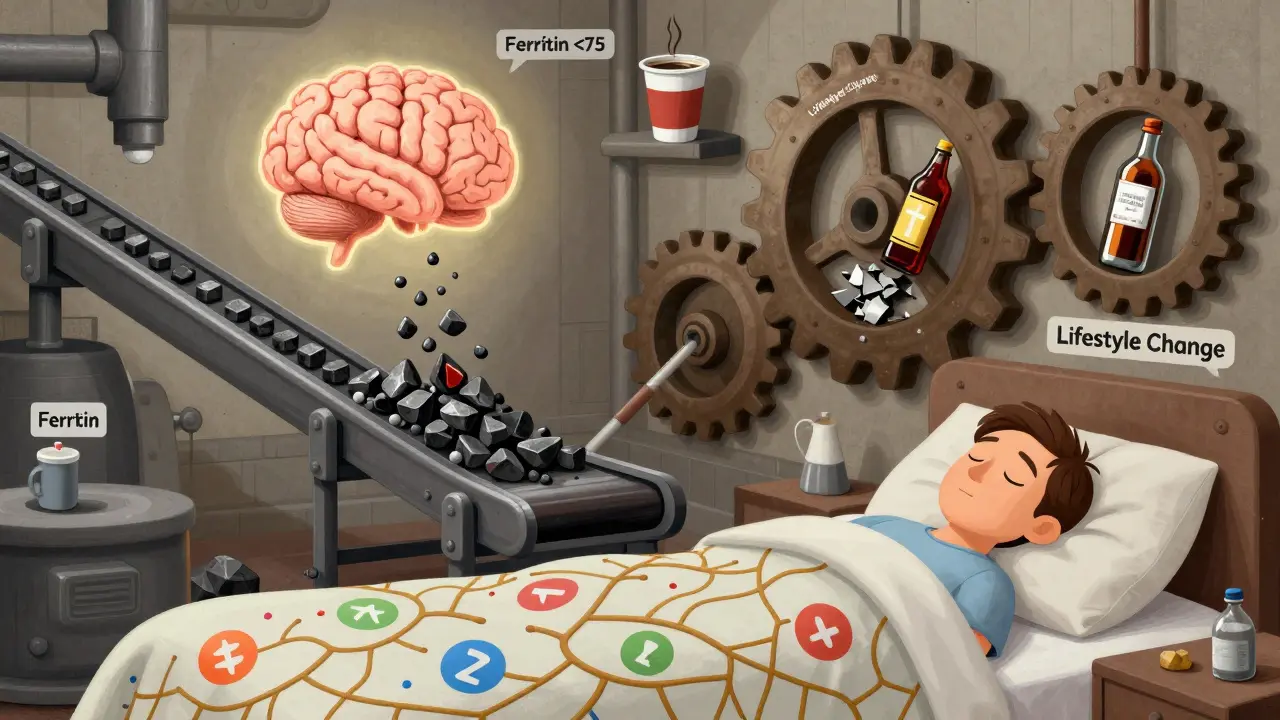
Medication isn’t the whole story. Lifestyle changes can cut symptoms by 20-30% - and they come with zero risk.- Cut caffeine. 80% of RLS patients consume caffeine daily. Even a single cup of coffee after noon can trigger symptoms.
- Limit alcohol. It worsens RLS in 65% of people, even if you only drink on weekends.
- Check your iron. RLS is linked to low brain iron. If your ferritin level is below 75 mcg/L, taking 100-200 mg of elemental iron daily for 12 weeks improves symptoms in 35% of cases. Ask your doctor for a blood test.
- Improve sleep hygiene. Go to bed and wake up at the same time every day. Avoid screens an hour before bed. Cool, dark rooms help.
Some patients find relief with leg massages, warm baths, or light exercise like walking or yoga. Compression socks? Mixed results - but worth trying if you’re not on meds.
What About Opioids?
Low-dose opioids like oxycodone (5 mg) can reduce symptoms by 50-70%. They’re effective - but risky. The fear of addiction is real. However, a 2021 study found only 0.8% of RLS patients on low-dose opioids developed misuse, as long as doses stayed under 30 mg morphine equivalent per day.Still, most doctors won’t prescribe them unless everything else has failed. And even then, they’re used sparingly, with strict monitoring. Dr. Michael Thorpy of Montefiore Medical Center warns: “We must be vigilant about misuse, especially in patients with prior substance use disorders.”
The Future of RLS Treatment
Research is moving beyond dopamine and nerve calming. New trials are testing drugs that target brain iron deficiency directly - the root cause of dopamine dysfunction in RLS. One compound, Fazupotide, is in phase 3 trials and could be a game-changer if it works.Another approach? Transcranial magnetic stimulation - a non-invasive brain therapy that’s showing promise in early studies. And a new selective dopamine agonist designed to avoid triggering augmentation is also in development.
But for now, the clearest path forward is simple: stop reaching for dopamine drugs unless it’s absolutely necessary. Use alpha-2-delta ligands first. Fix your iron. Cut caffeine. Sleep better. And if you’re already on a dopamine agonist? Talk to your doctor about switching - before your symptoms get worse.
What to Do Next
If you’re taking a dopamine agonist for RLS:- Check your ferritin level. If it’s under 75 mcg/L, ask about iron supplements.
- Track your symptoms: Are they starting earlier? Spreading to your arms? Getting worse?
- Review your caffeine and alcohol intake. Cut them out for two weeks and see what happens.
- Ask your doctor about switching to gabapentin enacarbil or pregabalin.
- If you’ve been on dopamine meds for over 6 months, don’t stop suddenly. Work with your doctor on a slow taper.
RLS doesn’t have to control your life. But treating it the old way will make it worse. The science has moved on. It’s time your treatment did too.
Are dopamine agonists still safe for Restless Leg Syndrome?
Dopamine agonists like pramipexole and ropinirole are no longer recommended as first-line treatment for RLS due to the high risk of augmentation - where symptoms worsen over time. They may still be used occasionally for patients with infrequent symptoms (less than 3 nights a week) or as short-term relief, but long-term daily use is strongly discouraged. The American Academy of Sleep Medicine updated its guidelines in December 2024 to reflect this shift.
What are the best alternatives to dopamine agonists for RLS?
Alpha-2-delta ligands like gabapentin enacarbil (Horizant) and pregabalin (Lyrica) are now the preferred first-line treatments. They reduce RLS symptoms by 40-60% without causing augmentation. Gabapentin enacarbil is FDA-approved for RLS and taken once daily at bedtime. Pregabalin is used off-label but works similarly. Both are safer for long-term use than dopamine drugs.
What is augmentation in Restless Leg Syndrome?
Augmentation is when RLS symptoms get worse because of medication - not because the disease is progressing. It typically means symptoms start earlier in the day (often 2-6 hours sooner), spread to other body parts like the arms, become more intense, and occur more frequently. It’s a direct side effect of long-term dopamine agonist use and affects 40-60% of patients within 1-3 years.
Can iron supplements help with Restless Leg Syndrome?
Yes - if you’re iron deficient. Research shows that people with serum ferritin levels below 75 mcg/L often see a 35% reduction in RLS symptoms after taking 100-200 mg of elemental iron daily for 12 weeks. It’s not a cure, but it’s a safe, non-drug way to improve symptoms. Ask your doctor for a blood test before starting.
How long does it take for gabapentin enacarbil to work for RLS?
Unlike dopamine agonists, which work within an hour, gabapentin enacarbil takes several days to weeks to reach full effect. Most patients notice improvement within 5-7 days, but it can take up to 4 weeks for maximum benefit. Patience is key - but once it works, the relief lasts without the risk of worsening symptoms over time.




I switched from Mirapex to gabapentin last year after my symptoms started creeping into my arms. It took about three weeks to feel the difference, but now I actually sleep through the night. No more 3 a.m. pacing. Worth the patience.
Also, my ferritin was 42. After three months of iron supplements, my RLS dropped by half. Not magic, but real.
OMG YES!! I was on Requip for 4 years!! And I thought I was just getting older!! Turns out the DRUG was turning my legs into electric fences!! I cried when I found out it was AUGMENTATION!! Not my fault!! They lied to us!!
Now I take pregabalin, cut ALL caffeine, and I sleep like a baby!! But I still hate that my doctor didn’t warn me!!
They’re hiding the truth. Dopamine drugs were pushed by Big Pharma to keep you hooked. That’s why augmentation was buried. They knew. They ALWAYS knew. The FDA? In the pocket. The AASM? Bought and paid for.
And now they want you to switch to gabapentin? Same company makes both. Same profit. Same scam. You think they care if you sleep? They care if you buy.
Check your blood. Check your meds. Check your mind. They’re not your allies. They’re your landlords.
Iron supplements changed my life 😭 I was skeptical but my ferritin was 38… now it’s 92 and I haven’t needed meds in 8 months. I’m not even joking. I used to need a walking stick at night. Now I just… sleep. 🙏
Also, NO MORE WINE. I didn’t realize how much it made it worse. I’m not a saint, but I’m a better sleeper.
Interesting how the medical community took so long to catch up. The data was there. The patient stories were everywhere. But it took a decade for guidelines to change. I wonder how many people suffered needlessly because doctors trusted the drug reps more than the research.
Still, glad it’s shifting. Even if it’s late.
USA still stuck in 2010 while the rest of the world moved on. Australia switched to gabapentin as first-line in 2020. Here? Doctors still hand out Mirapex like candy. Pathetic. You’re not special because you’re American. You’re just behind.
And don’t get me started on iron. You think your ‘low ferritin’ is unique? It’s the #1 cause. But you’d rather take a pill than check your blood.
As a registered nurse who’s worked with RLS patients for 15 years, I’ve seen the devastation of augmentation firsthand. I’ve watched patients lose their jobs because they couldn’t sit through meetings. I’ve seen marriages crumble because no one understood the pain.
It’s not just about medication. It’s about education. Patients deserve to know the risks before they start. And doctors need to listen-not prescribe.
If you’re on dopamine agonists, please, please talk to your provider. Don’t wait until you’re pacing at 4 p.m.
Why do people still think caffeine is ‘just a cup’? You’re not a coffee connoisseur-you’re a sleep saboteur. And alcohol? You think one glass won’t hurt? It’s like pouring gasoline on a fire and calling it ‘moderation.’
And iron? You’re not ‘a little low’-you’re deficient. That’s not a suggestion. That’s a medical condition. Stop making excuses. Fix your blood. Fix your life.
I’ve had RLS since I was 19. Now I’m 42. I’ve tried everything. Mirapex? Augmented in 14 months. Gabapentin? Took 3 weeks, then I slept like a log. Iron? My ferritin was 29. Now it’s 88. No more midnight yoga in the living room.
Don’t let the fear of change keep you stuck. It’s not about being ‘anti-drug.’ It’s about being pro-sleep.
They told me it was ‘just stress.’ They told me to ‘relax.’ They told me I was ‘too sensitive.’
Then I found out my legs were screaming because my brain was starved of iron-and they gave me a pill that made it worse.
I spent years thinking I was broken. Turns out, the system was.
I’m not angry. I’m just… heartbroken. For all the people still being told it’s ‘normal.’ It’s not. It’s treatable. But only if you know the truth.
And now? I’m telling you. Please. Listen.
It is imperative to underscore that the paradigm shift in the management of Restless Legs Syndrome, as elucidated in the aforementioned discourse, is predicated upon robust longitudinal clinical evidence and meta-analytical outcomes derived from peer-reviewed journals, including JAMA Neurology and Sleep Medicine. The pharmacokinetic properties of alpha-2-delta ligands, particularly their non-dopaminergic mechanism of action, render them superior in terms of long-term safety and efficacy. Furthermore, the correlation between serum ferritin levels below 75 mcg/L and symptom severity is statistically significant (p < 0.01) in multiple cohort studies. It is therefore not merely advisable, but clinically obligatory, to initiate non-dopaminergic first-line therapy in the majority of cases. The persistence of dopamine agonist prescriptions constitutes a deviation from evidence-based practice and may constitute a breach of the standard of care.