
Drug Reaction with Eosinophilia and Systemic Symptoms (DRESS): What You Need to Know
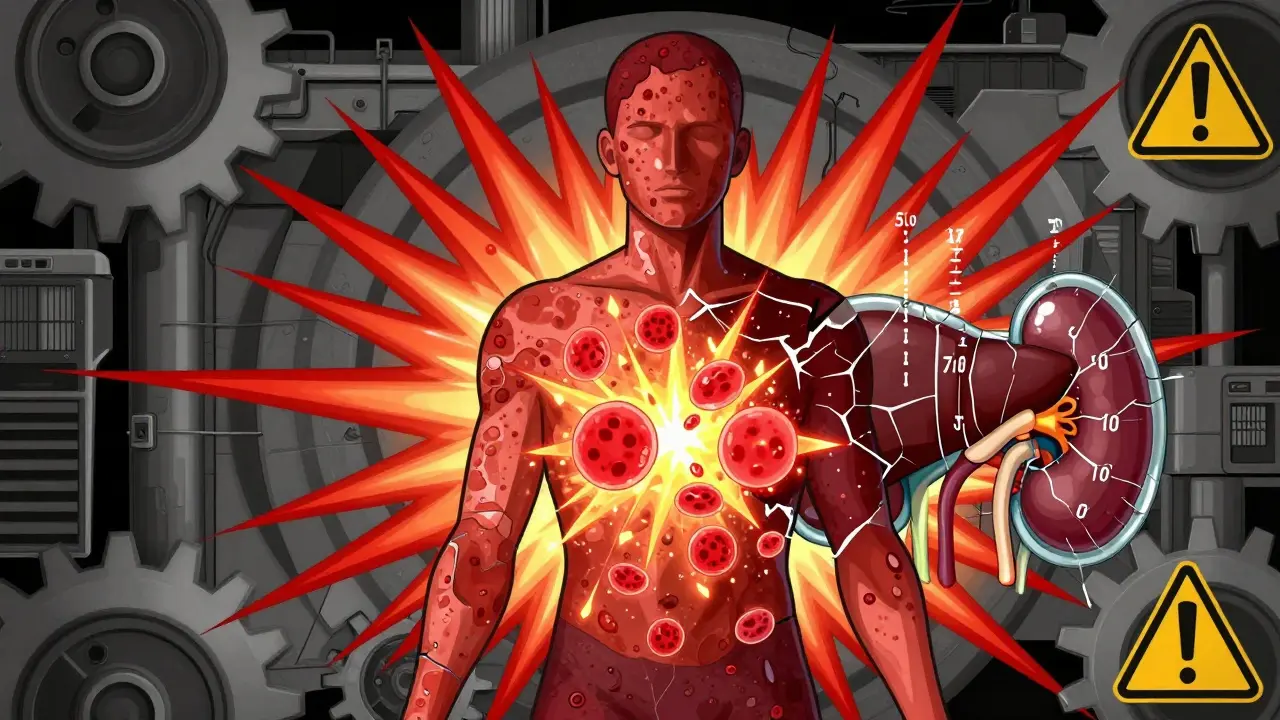
Imagine taking a common medication for gout or seizures, and weeks later, your body starts to shut down. Fever spikes. A rash spreads across your skin. Your liver enzymes climb into the thousands. Your lymph nodes swell. You feel like you’re coming down with the flu-but it won’t go away. This isn’t a bad allergic reaction. It’s DRESS-Drug Reaction with Eosinophilia and Systemic Symptoms. And it’s far more dangerous than most doctors realize.
What Exactly Is DRESS Syndrome?
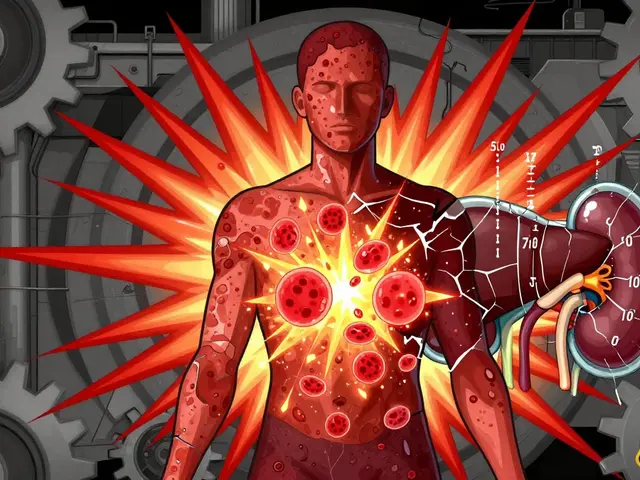
DRESS is not just a skin rash. It’s a full-body immune meltdown triggered by certain drugs. Unlike typical allergies that show up within hours, DRESS hides. It can take 2 to 8 weeks after you start a new medication before symptoms appear. That delay is why so many people are misdiagnosed-doctors think it’s a virus, a flu, or a mild drug rash. By the time they catch on, organs are already damaged.
The classic signs? Fever over 38°C, a widespread red, measles-like rash, and a massive spike in eosinophils-white blood cells that normally fight parasites but in DRESS turn against your own tissues. At least 95% of patients show eosinophilia above 700 cells per microliter. Most also have atypical lymphocytes, meaning their immune system is firing on all cylinders, but wildly out of control.
And it doesn’t stop at the skin. DRESS attacks organs. The liver is hit hardest-in 70% to 90% of cases, liver enzymes like ALT shoot past 1,000 U/L. Kidneys fail in 10% to 30%. Lungs get inflamed. Blood counts crash. In the worst cases, the body goes into multi-organ failure. About 1 in 10 people with DRESS die, mostly from liver necrosis.
Which Drugs Cause DRESS?
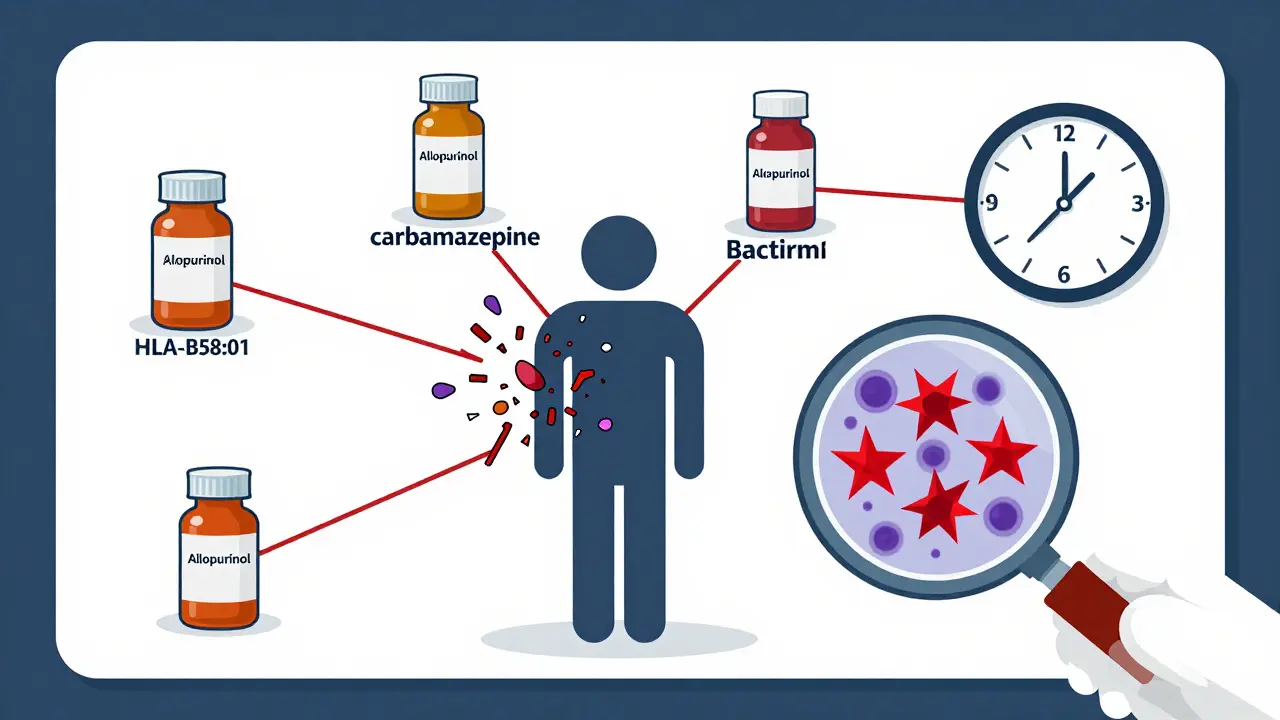
Not every drug causes this. But a few are notorious. Allopurinol, used to treat gout, is the #1 culprit. It’s responsible for 40% to 50% of all DRESS cases. That’s especially true in people with kidney disease-where the drug builds up in the body and triggers an extreme reaction. If you have an eGFR below 60, your risk jumps to 1 in 200.
Antiepileptic drugs like carbamazepine, phenytoin, and lamotrigine come next. These are prescribed for seizures, bipolar disorder, and nerve pain. Even if you’ve taken them for years without issue, DRESS can suddenly appear. Sulfonamide antibiotics like Bactrim are also common triggers.
And here’s the kicker: some people are genetically wired to react. The HLA-B*58:01 gene variant makes you 55 times more likely to develop DRESS from allopurinol. This is why countries like Taiwan now require genetic testing before prescribing allopurinol to high-risk groups. Since the rule started, allopurinol-related DRESS cases dropped by 75%.
DRESS vs. SJS and TEN: The Key Differences
People often confuse DRESS with Stevens-Johnson Syndrome (SJS) or Toxic Epidermal Necrolysis (TEN)-other deadly skin reactions. But they’re not the same.
SJS and TEN show up fast-within days of taking the drug. Their hallmark is blistering and skin peeling. In TEN, more than 30% of your skin can slough off. DRESS? No major skin detachment. The rash is red and bumpy, not blistering. Mucous membranes (mouth, eyes, genitals) are involved in only 30% to 50% of DRESS cases, compared to over 90% in SJS/TEN.
The immune mechanisms are different too. SJS/TEN are driven by cytotoxic CD8+ T cells that kill skin cells. DRESS is fueled by CD4+ T cells and eosinophils. It’s not just about killing skin-it’s about your whole immune system going rogue.
And then there’s the long tail. In DRESS, the virus HHV-6 reactivates in 60% to 70% of cases, often 2 to 4 weeks after symptoms start. That’s why the rash lingers, why fevers come back, and why some patients develop autoimmune diseases like Graves’ disease or lupus months after recovery.
Why Is DRESS So Often Missed?
A 2020 study found only 35% of internal medicine residents could correctly identify a DRESS case. That’s not because they’re untrained-it’s because the signs are scattered. Fever? Common. Rash? Common. Elevated liver enzymes? Common. Eosinophilia? Rarely checked unless you’re looking for it.
Patients report seeing three or more doctors before getting the right diagnosis. One woman from Florida spent six weeks in and out of ERs after starting allopurinol. Her AST hit 2,840 U/L. Her skin was covered in red patches. Doctors thought it was hepatitis C. Then a dermatologist spotted the eosinophilia and asked: “What meds did you start six weeks ago?” That question saved her life.
The problem isn’t just doctors. It’s the system. Most labs don’t flag eosinophilia unless it’s extreme. Most ERs don’t ask about medications from 40 days ago. And most patients don’t realize that a drug taken weeks ago could be the cause.
How Is DRESS Treated?
There’s no magic pill. But there are proven steps that save lives.
Step 1: Stop the drug immediately. If you suspect DRESS, get off the medication within 24 hours. Delaying increases mortality from 5% to 15%. That’s a 10-point swing.
Step 2: Hospitalize. DRESS is not a home treatment. You need daily blood tests, liver monitoring, and infection control. About 40% to 60% of patients need high-dose steroids-prednisone or methylprednisolone at 0.5 to 1 mg per kg per day. Treatment lasts 4 to 8 weeks, then tapers slowly. Stopping too soon can cause a rebound.
Step 3: Watch for infections. Your skin is compromised. Your immune system is exhausted. Bacteria like MRSA and fungi like Candida can invade. About 10% of DRESS patients develop bloodstream infections. Antibiotics and antifungals are often needed.
Step 4: Consider new therapies. For severe cases that don’t respond to steroids, doctors are now using drugs like anakinra (an IL-1 blocker) or tocilizumab (an IL-6 blocker). A 2022 study showed anakinra cut hospital stays from 18.5 days to 11.2 days. Clinical trials are ongoing.
What Happens After You Recover?
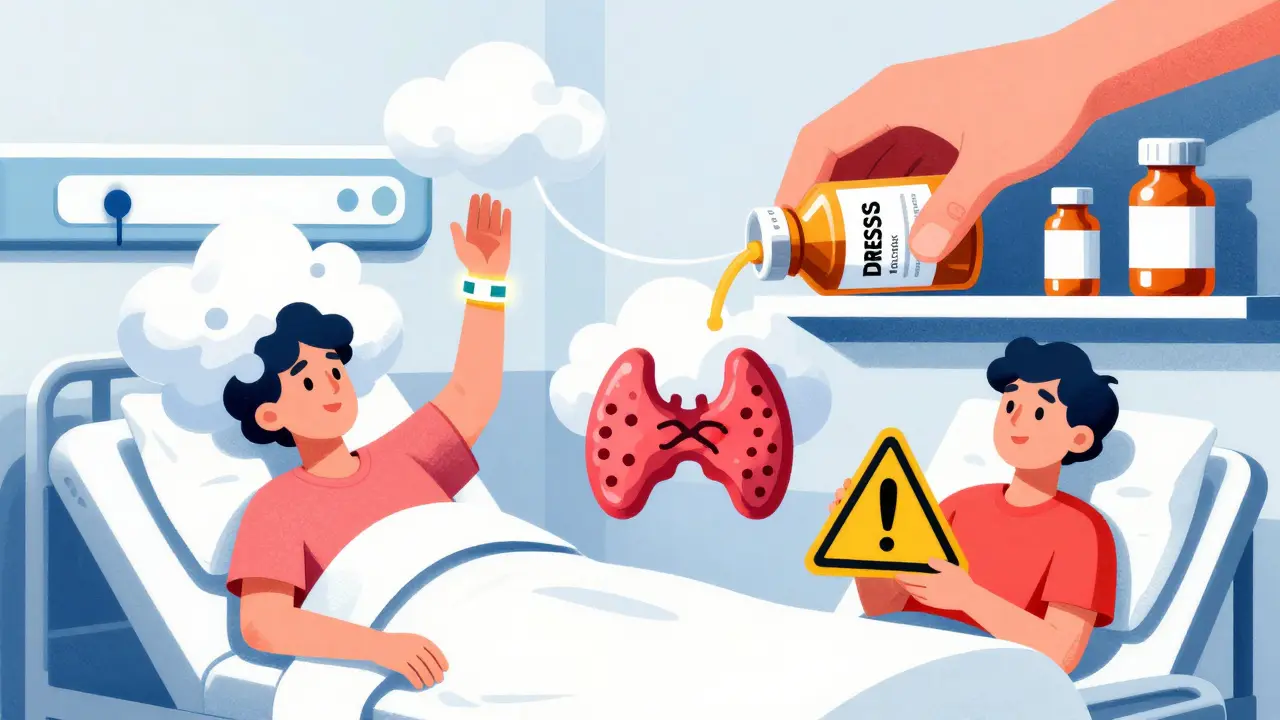
Recovery doesn’t mean you’re back to normal. About 20% to 30% of survivors have lasting organ damage. Kidney function may never fully return. Thyroid problems like Graves’ disease show up months later in 5% to 10% of cases. Some develop chronic hepatitis or autoimmune disorders.
One patient from Texas developed type 1 diabetes 8 months after her DRESS episode. Another needed lifelong dialysis. That’s why follow-up care is critical. You need regular blood work, thyroid panels, liver tests, and kidney checks for at least a year.
And you must avoid all drugs linked to DRESS-not just the one that caused it. Cross-reactivity is real. If allopurinol triggered your reaction, you’re at high risk for reacting to other purine analogs. Same with antiepileptics. Your medical records must clearly state: “DRESS history-avoid all implicated drug classes.”
How to Prevent DRESS
Prevention starts with awareness. If you’re prescribed allopurinol and have kidney disease, ask: “Should I be tested for HLA-B*58:01?” If you’re over 60, on multiple medications, or have a history of drug rashes, tell your doctor.
For gout patients with kidney impairment, guidelines now recommend febuxostat instead of allopurinol. It’s just as effective, and it doesn’t carry the same DRESS risk. The American College of Rheumatology estimates this switch could prevent 1,200 to 1,500 DRESS cases in the U.S. every year.
Keep a list of every medication you’ve taken in the last 90 days. If you develop fever and rash, bring it to your doctor. Say: “Could this be DRESS?” Don’t wait for them to ask.
And if you’ve had DRESS before-wear a medical alert bracelet. Include the drug name and the fact that you’re at risk for severe reactions to similar medications.
Where to Find Help
You’re not alone. The DRESS Syndrome Foundation has helped over 1,200 patients since 2018. They offer patient navigators who help you find specialists, decode lab results, and communicate with your care team. Their website has downloadable symptom trackers and medication avoidance lists.
RegiSCAR, the international registry for severe skin reactions, collects data to improve diagnosis. If you’ve had DRESS, ask your doctor to report your case. It helps future patients.
And if you’re a healthcare provider-learn the diagnostic criteria. Fever, rash, eosinophilia, organ involvement, latency of 2-8 weeks. If three of those are present, suspect DRESS. Don’t wait for the perfect test. Time kills.





man i just started allopurinol last month for my gout... my skin’s been itchy for days and i thought it was just dryness. now im kinda freaked out. thanks for this post.
Of course the FDA doesn’t mandate HLA testing. Because why make healthcare cheaper or safer when you can just bill more?
This is why we can’t have nice things. India and China let people take drugs like candy. Now we’re stuck with this mess because someone didn’t get their genetic test.
So let me get this straight - you take a pill for gout, and three weeks later your body turns into a war zone? And doctors are still acting like it’s just a ‘rash’? 😭 This isn’t medicine, it’s Russian roulette with a prescription pad. And don’t even get me started on how they ignore eosinophils like they’re ghost peppers. I swear, if I had a dollar for every time a doctor said ‘it’s probably stress’… I’d buy a private island and hire a team of immunologists.
You people are so careless. If you’re on meds, you should know the risks. This is why America is falling apart - no personal responsibility.
STOP SCROLLING. READ THIS. SHARE THIS. If you take allopurinol or carbamazepine, your life could depend on it. This isn’t fearmongering - it’s a wake-up call. Tell your doctor. Tell your mom. Tell your cousin who’s ‘just trying to feel better.’
For those newly diagnosed: don’t panic. But do act. Get off the drug. Get liver panels. Get eosinophil counts. And keep a log - even the small things like fatigue or joint pain. Recovery is slow, but you can outlast this.
Thank you for sharing this. I’ve seen DRESS in the ER - it’s terrifying. I wish more patients knew to ask about drug latency. It’s not just ‘what are you taking?’ - it’s ‘what did you start 6 weeks ago?’
As someone from India, I’ve seen how little awareness there is here. Many doctors still think ‘rash = allergy’ and give antihistamines. This post should be translated into Hindi and Tamil. Lives depend on this knowledge.
Per the 2023 ACR guidelines, the diagnostic triad for DRESS includes: (1) temporal latency >14 days post-initiation; (2) eosinophilia >700 cells/μL; and (3) multi-organ involvement - typically hepatic, renal, or pulmonary. The sensitivity of this criteria is 92% (CI: 89–95%). Furthermore, HLA-B*58:01 screening in CKD patients reduces incidence by 74.3% (p<0.001). Therefore, preemptive genotyping should be considered standard of care.
I had a friend go through this. Took lamotrigine for bipolar. Took 8 weeks to diagnose. Liver crashed. Had to be in ICU. Now she’s on a new med and does fine - but she’s terrified of every pill. I just wish doctors asked about meds from ‘a while ago’ - not just the ones you’re on now.
it’s not the drug. it’s the waiting. you take it, feel fine, then boom - your body turns on you. no warning. no sign. just… too late. if you’re on these meds, pay attention. your skin talks. your liver screams. listen.
Why is this even a thing? America lets Big Pharma push drugs without testing for genetics? We’re not China. We’re supposed to be better.