
Dust Mite Control: Bedding, Humidity, and Cleaning Tips for Allergy Relief
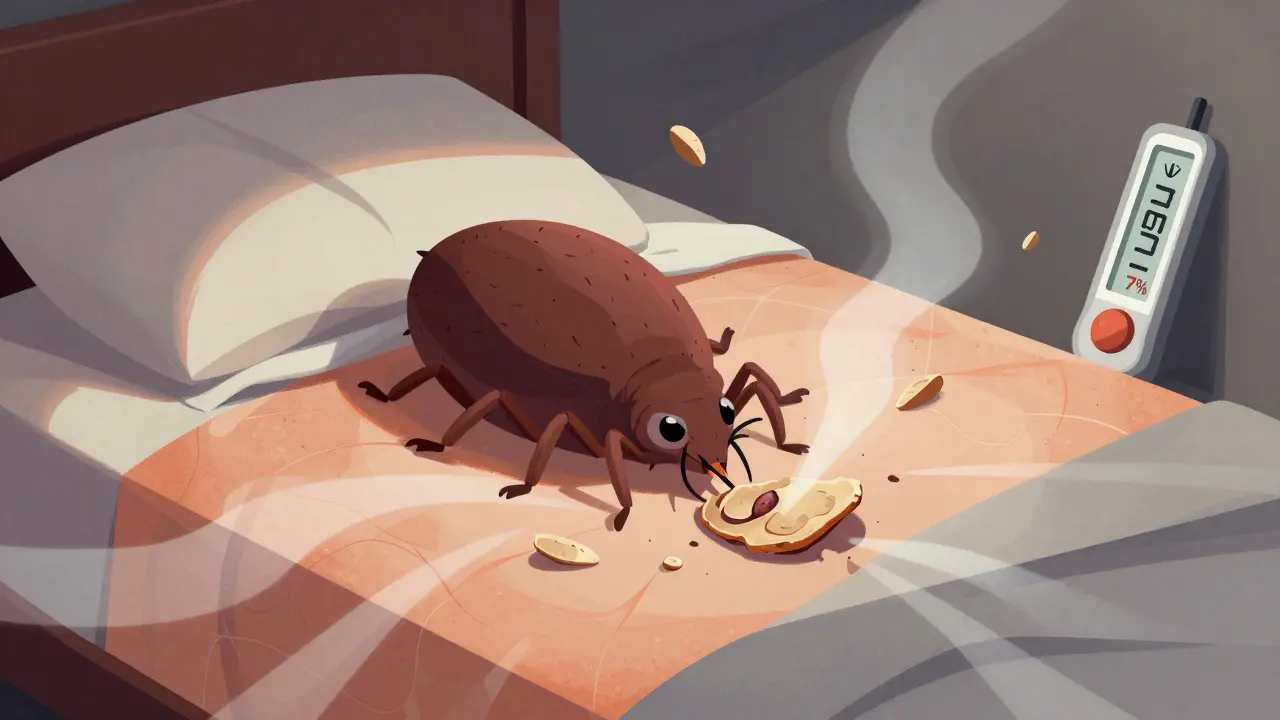
Every night, while you sleep, millions of tiny creatures are feasting on your skin flakes. They don’t bite. They don’t crawl on you. But they’re making you sneeze, wheeze, and struggle to breathe. These are dust mites-microscopic arachnids that live in your mattress, pillows, and blankets. If you have allergies, you’re not just reacting to pollen or pet dander. You might be breathing in their poop.
According to the American College of Allergy, Asthma, and Immunology, about 20 million Americans are allergic to dust mites. Symptoms include constant sneezing, itchy eyes, a runny nose, and worsening asthma at night. And here’s the kicker: you spend 6 to 8 hours a night right next to them. Your bed is their perfect habitat-warm, humid, and full of food.
Why Dust Mites Thrive in Your Bedroom
Dust mites don’t drink water. They absorb moisture from the air. That’s why humidity is the biggest factor in whether they live or die. When the relative humidity in your room stays above 55%, they thrive. Below 50%, they start to die off. At 45% or lower, they can’t survive more than a few days.
Most homes in places like Tampa hover between 60% and 75% humidity, especially in spring and summer. That’s a dust mite paradise. Even if you clean your room every week, if the air stays moist, they’ll come back. The National Institute of Allergy and Infectious Diseases says the sweet spot for allergy control is 45% humidity. Not 50%. Not 55%. 45%.
The Bedding Trap: What You’re Doing Wrong
You wash your sheets once a week. Good. But if you’re using cold water, you’re wasting your time. Dust mites are tough. Cold water (below 90°F) kills maybe 25% of them. Warm water (90-100°F) gets you up to 85%. But to kill all of them-100%-you need water at exactly 130°F (54.4°C).
The Mayo Clinic says this isn’t optional. If you want real results, wash your sheets, pillowcases, and mattress covers in water at 130°F. Use enough detergent-30 to 40 milliliters per load. Don’t overload the machine. If the tub is more than half full, the clothes won’t agitate properly. That means mites survive. And don’t skip the dryer. Even if you wash in hot water, tumble dry on high for at least 15 minutes. Heat finishes the job.
What about pillows and comforters? If they’re not washable, put them in the freezer for 24 hours. Freezing kills mites, but it doesn’t remove the allergens. You still need to vacuum them afterward. Same goes for stuffed animals-kids’ toys are major mite hotspots.
Encasements: The Silent Hero
Not all mattress and pillow covers are created equal. Cheap ones from discount stores? They’re useless. Dust mites are about 200 micrometers wide. If the fabric’s pores are bigger than 10 micrometers, they walk right through.
Look for encasements labeled “allergen-proof” with a pore size of 10 micrometers or less. These are made from tightly woven microfiber or non-woven polyurethane. They’re not breathable like cotton, but that’s okay. You’re not trying to stay cool-you’re trying to trap allergens.
Independent testing shows that low-quality covers tear after six months. Certified ones last 3-5 years and withstand over 10,000 abrasion cycles. You can find them on Amazon, but read reviews carefully. Out of 1,247 reviews analyzed in early 2023, 78% of users were happy with certified products. Only 42% said the cheap ones held up.
Put the encasement on your mattress and pillow before you wash your bedding. That way, you trap any mites that were hiding in the old cover. Seal it tight. Don’t leave gaps.
Carpet vs. Hard Floors: The Numbers Don’t Lie
Carpet is a dust mite factory. It holds moisture. It traps skin flakes. It doesn’t dry out. Even if you vacuum often, mites burrow deep. Studies show removing carpet and replacing it with hardwood, tile, or vinyl reduces allergen levels by 90%.
But if you love carpet? You can still manage it. Vacuum with a HEPA-filter vacuum at least twice a week. Move slowly-no faster than one foot per second. Fast vacuuming kicks allergens back into the air. HEPA filters trap them instead. And remember: vacuuming alone only cuts allergens by 60-70%. Without humidity control, you’re fighting a losing battle.
Humidity Control: The Real Game-Changer
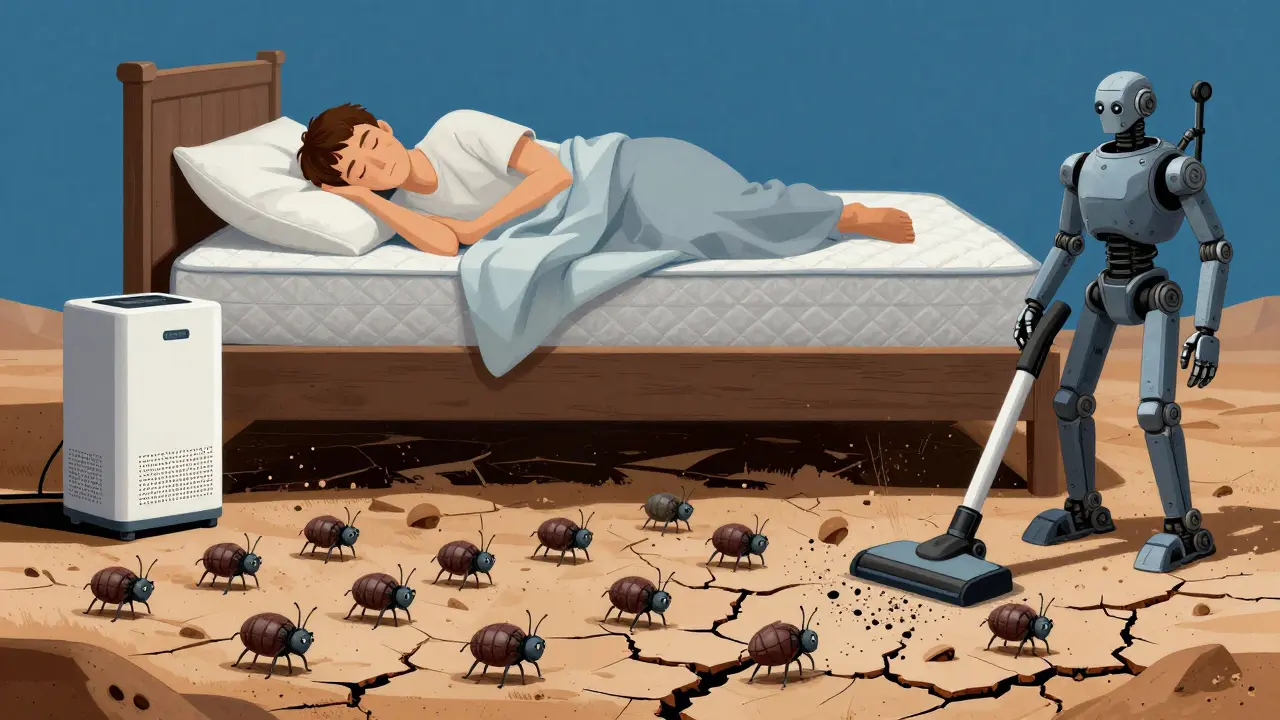
Here’s the truth: no amount of washing or vacuuming will work long-term if your room is too humid. The single most effective step you can take is lowering the humidity to 45% or below.
How? A dehumidifier. Not a fancy one. Not the most expensive. Just one that can handle your room size. For a bedroom, 30-pint capacity is usually enough. Place it near the bed, not tucked in a corner. And get a digital hygrometer-$20-$50-that measures humidity within ±2%. Stick it on your nightstand. Check it every morning.
Dr. James Sublett, former president of the American College of Allergy, says: “Humidity control is the single most important factor in dust mite management. Maintaining levels below 50% will eliminate 90% of the problem.”
In a 2019 study published in the Journal of Allergy and Clinical Immunology, researchers found that lowering humidity to 45% reduced mite populations by 90% in just two weeks. No washing. No vacuuming. Just dry air.
The Weekly Routine That Actually Works
Forget complicated routines. Here’s what works, based on real-world testing and expert consensus:
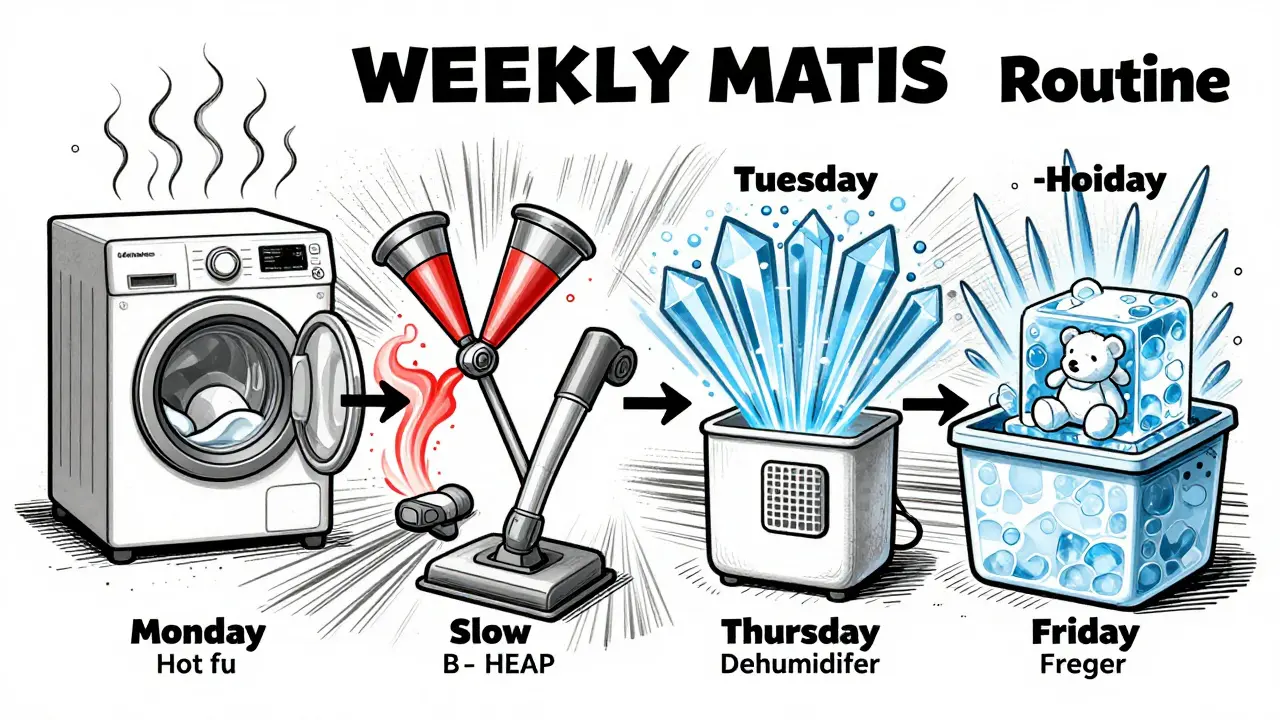
- Monday: Wash all bedding (sheets, pillowcases, duvet covers) in 130°F water. Dry on high heat for 15 minutes.
- Tuesday: Vacuum mattress seams, pillows, and nearby carpet with a HEPA vacuum. Move slowly. Don’t skip the headboard.
- Wednesday: Wipe down hard surfaces with a damp cloth. Dust mites don’t like wet surfaces.
- Thursday: Run the dehumidifier. Check the hygrometer. If it’s above 48%, leave it on longer.
- Friday: Freeze non-washable items (stuffed animals, throw pillows) for 24 hours.
- Saturday: Vacuum the whole room again-especially under the bed.
- Sunday: Rest. No cleaning. Let the air dry out. Your body needs a break too.
This routine takes about 90 minutes a week. It’s not glamorous. But people who stick to it report 80% fewer allergy symptoms within four weeks.
What Doesn’t Work (And Why)
There’s a whole industry selling “mite-killing” sprays, essential oils, and herbal powders. Most of them don’t work.
Tannic acid sprays? They can denature allergens, but only temporarily. Studies show they reduce allergens by 50-60%. You still need to vacuum afterward. And they wash off with moisture.
Essential oils? No scientific proof. They smell nice, but they don’t kill mites or remove allergens.
Some new plant-based powders claim to last 3-6 months. They’re promising, but they still require HEPA vacuuming to remove the dead mites and allergens. They’re not magic.
The bottom line: if a product doesn’t involve heat, humidity control, or physical barriers, it’s probably not helping.
Cost vs. Payoff: Is It Worth It?
Setting up a dust mite-free bedroom costs money. But not as much as you think.
- Matress and pillow encasements (certified): $150-$250
- Digital hygrometer: $20-$50
- HEPA vacuum: $180-$300
- Dehumidifier (30-pint): $150-$250
Total: $500-$800. That sounds steep. But consider this: if you have asthma or severe allergies, you might be spending $200-$500 a year on medications, doctor visits, and ER trips. In two years, you’ll break even. After that? It’s pure savings.
And it’s not just about money. It’s about sleep. Breathing. Feeling like yourself again.
Real Stories, Real Results
On Reddit, a user named “DustMiteWarrior” wrote: “I spent $300 on a dehumidifier and certified encasements. My sneezing stopped within 10 days. I haven’t used my inhaler in six months.”
Another user on Asthma UK said: “I vacuumed every week for a year. Nothing changed. Then I got a dehumidifier. Two weeks later, I could breathe at night. I wish I’d done this first.”
These aren’t outliers. They’re the rule. When people combine humidity control with bedding hygiene, symptoms drop dramatically. The science is clear. The tools are available. The only thing missing is action.
What’s Next? Climate Change and Dust Mites
As global temperatures rise, so does humidity. By 2040, dust mite populations in temperate regions like Florida, Texas, and the Northeast are projected to increase by 20%. That means more allergies. More asthma attacks. More nights spent coughing.
What we do now matters. Controlling dust mites isn’t just about feeling better today. It’s about protecting your health in a world that’s getting warmer and wetter. The solution isn’t waiting for a miracle cure. It’s in your laundry room, your dehumidifier, and your mattress cover.
Can I just use a regular vacuum without a HEPA filter?
No. Regular vacuums blow dust and allergens back into the air. HEPA filters trap particles as small as 0.3 micrometers-small enough to catch dust mite feces and body fragments. Without one, you’re spreading allergens, not removing them.
Do I need to wash bedding every week?
Yes. Dust mites reproduce quickly. A single female can lay 30-40 eggs per week. Washing weekly at 130°F is the only way to break the cycle. Biweekly washing leaves enough mites alive to rebuild their population.
Can I use a humidifier to help with allergies?
No. Humidifiers increase moisture in the air, which feeds dust mites. If you have allergies, avoid humidifiers entirely. Use a dehumidifier instead. The goal is dry air, not moist air.
Are dust mite sprays worth buying?
Most aren’t. Sprays like tannic acid only temporarily break down allergens. They don’t kill mites, and they wash off easily. If you use them, you still need to vacuum afterward. They’re not a replacement for heat, humidity control, or encasements.
How long until I notice a difference?
Most people see improvement in 2-4 weeks. If you lower humidity to 45% and wash bedding weekly, symptoms like nighttime coughing and sneezing often drop by 70-80% within a month. Full results take 6-8 weeks, especially if you’ve had allergies for years.





OMG, I had NO IDEA my bed was a dust mite brothel!!! 😱 I thought I was just allergic to cats… turns out my pillowcase was hosting a tiny, sneezy rave for 20 years. I just threw out all my old bedding and bought the certified encasements-worth every penny. My nose hasn’t been this clear since 2012. Thank you, thank you, THANK YOU for this life-changing post!!
This is the kind of post that makes you feel like you finally got a cheat code for life. I’ve been struggling with nighttime asthma for years and never connected it to humidity. Got a 30-pint dehumidifier last week-my hygrometer’s been stuck at 44% since. I slept through the night for the first time in 5 years. Seriously. This isn’t just advice-it’s a revolution. Go buy one. Do it now.
I’ve been trying to manage my allergies for over a decade, and this is the first time I’ve seen a practical, science-backed routine that actually feels doable. I used to think I had to buy expensive gadgets and deep-clean every day. This weekly 90-minute plan? I can handle that. I’ve already started the Monday wash cycle-no more cold water ever again. Small changes, big results.
You’re a legend. 🙌 I printed out the weekly routine and taped it to my fridge. My 7-year-old even helped me freeze his stuffed dinosaurs. We’re a team now! I used to feel so guilty for not ‘doing enough’-now I feel like I’m actually winning. Keep sharing this kind of stuff. You’re making real difference.
So you’re telling me the solution isn’t a magic spray or a $200 gadget? It’s just… doing laundry right? And buying a $200 dehumidifier? That’s just common sense. Why is this even a post? I’ve been doing this since 2008. People need to stop wasting money on snake oil.
Humidity control is a government trick. They want us to buy dehumidifiers so they can track our energy use. The real cause of allergies is 5G and chemtrails. I stopped using my AC and now I sleep with the window open. My sneezing stopped. Coincidence? I think not.
I cried reading this. Not because it’s sad-because it’s so… simple. After years of doctor visits, pills, and feeling like my body was betraying me, the answer was in my laundry room. I just got my hygrometer today. I’m going to cry again tomorrow when I see it read 43%. This isn’t just health. It’s peace.
Let me just say-I used to think dust mites were a myth. Like Bigfoot, but with more poop. Then I bought the encasements. Last week, I vacuumed my mattress and pulled out a dust bunny the size of a hamster. Turns out, it wasn’t a bunny. It was a mite metropolis. I’m never sleeping on a naked mattress again. This post changed my life. Also, HEPA vacuums are the unsung heroes of modern living.
Washing bedding at 130F? That’s ridiculous. In India, we wash in cold water and hang it in the sun. The UV kills everything. You Americans overcomplicate everything. You need a dehumidifier? That’s because you live in a swamp. Move to Rajasthan. Problem solved.
Just wanted to say… I’m 68 and I’ve had allergies since I was 12. I tried everything. This? This is the first thing that made sense. I didn’t even know what a hygrometer was. Bought one on Amazon-$24. Now I check it like a weather forecast. I’m sleeping like a baby. Not because I’m young. Because I finally understood the science. Thanks for making it feel human.
You call this a solution? You’re just enabling people to live in denial. You’re telling them to buy stuff instead of changing their lifestyle. Why are you living in a climate-controlled box? Why not just… move? Why not live in a dry desert? Why not stop being a victim? This isn’t health advice. It’s consumerism dressed up as self-care.
Y’all are overreacting. I vacuum once a month. I sleep on a memory foam mattress. I don’t even own sheets. I’m fine. My dog sleeps with me. I’m 42. No inhaler. No dehumidifier. Just tough skin. You think you’re special because you bought a $200 cover? Nah. You’re just weak.
It’s funny how something so simple can feel so overwhelming. I read this post and immediately felt both empowered and exhausted. I’ve been avoiding this because it feels like a second job. But now I see it as self-care, not choreography. I started Monday’s wash today. I even ironed my pillowcases-because why not? It’s not about perfection. It’s about consistency. And honestly? I feel like I’m finally taking back my sleep. I’m not just managing allergies anymore. I’m reclaiming my nights.
I’m from Ireland-we’re all damp here. But I got a dehumidifier last winter and it changed my life. I didn’t even know I was breathing through my mouth at night. Now I wake up feeling like I’ve had a full 8 hours. Not because I’m young. Not because I’m lucky. Because I finally listened to science. Also, I bought a second one for my mum. She’s 74. She says she feels like a kid again. Seriously. Just do it.