
How to Check Drug Coverage Tiers and Formulary Changes for Medicare Part D
Every year on January 1st, your Medicare Part D drug plan can change the list of medications it covers and how much you pay for them. That’s not a glitch. It’s normal. And if you’re taking even one prescription, you need to check your formulary every year-not just when you refill a pill bottle.
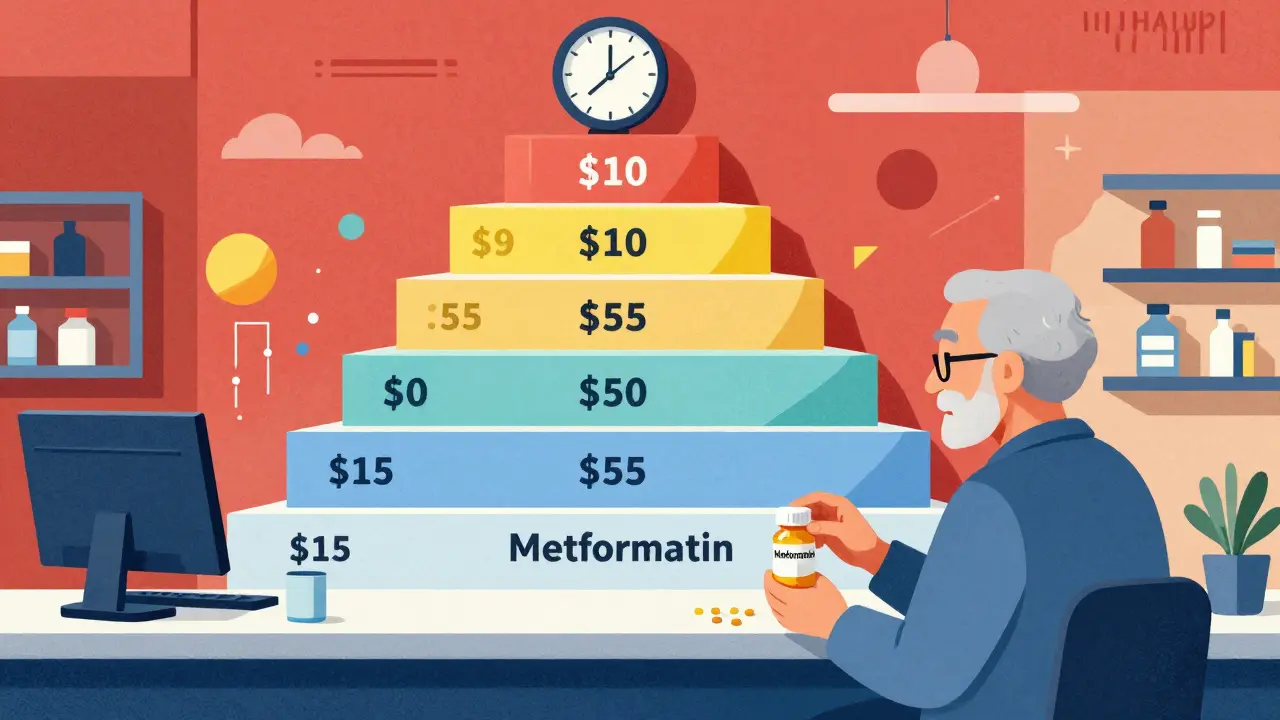
Let’s say you’ve been taking metformin for diabetes for five years. Last year, it cost you $10 a month. This year, you show up at the pharmacy and it’s $55. No warning. No letter. Just a higher price. That’s not rare. In 2023, nearly 1 in 5 formulary changes moved a drug to a higher tier, meaning you pay more. And it’s not just generics. Brand-name drugs like Ozempic or Wegovy are being moved into specialty tiers, sometimes jumping from $20 to $300 a month overnight.
You’re not alone. Over 53 million Medicare beneficiaries rely on Part D plans. Most don’t know how formularies work until they get hit with a surprise bill. But you can avoid that. Here’s how to check your drug coverage tiers and spot formulary changes before they cost you.
What Is a Formulary, Really?
A formulary is just a list of drugs your insurance covers. But it’s not just a list. It’s organized into tiers-like levels in a game-where each level has a different price tag. The higher the tier, the more you pay.
Most plans use 3 to 5 tiers:
- Tier 1: Preferred generics. Usually $0-$10 per prescription.
- Tier 2: Non-preferred generics or low-cost brands. Around $15-$30.
- Tier 3: Higher-cost brand-name drugs. Often $40-$70.
- Tier 4: Non-preferred brands or specialty drugs. Can be $100+.
- Tier 5: Specialty medications-like injectables or oral cancer drugs. Often require prior authorization and cost hundreds or even thousands.
Here’s the catch: the same drug can be in different tiers on different plans. Your metformin might be Tier 1 on Humana but Tier 2 on Cigna. That’s why comparing plans every year matters. A plan with a lower monthly premium might actually cost you more in drug costs if your meds are stuck in a high tier.
How to Check Your Drug’s Tier Right Now
You don’t need to wait for a letter. You can check your drug’s tier in under five minutes.
- Go to your plan’s website. Look for “Formulary,” “Drug List,” or “Prescription Drug Coverage.”
- Use their online search tool. Type in the exact name of your medication-like “Metformin ER 500mg.” Don’t use brand names unless you’re prescribed one.
- Check the tier. It’ll show you the copay or coinsurance. Note the number.
- Do this for every drug you take. Even if you’ve been on the same meds for years.
Most plans-Cigna, Humana, Excellus BCBS, UnitedHealthcare-have these tools. If you can’t find it, call the number on your card. Ask: “What tier is my medication on, and what’s my copay?”
Pro tip: Use Medicare.gov’s Plan Finder. It lets you compare multiple plans side-by-side. Enter your drugs, zip code, and pharmacy. It shows you which plan gives you the lowest total cost-not just the lowest premium.
When Do Formulary Changes Happen?
Most changes happen on January 1st. That’s when new plan years start. But changes can happen anytime.
Plans can remove a drug from the list, move it to a higher tier, or add new restrictions like prior authorization. They’re allowed to do this mid-year if:
- A new generic version hits the market
- New safety data comes out
- A drug becomes less effective
Here’s the rule: If a change affects a drug you’re already taking, they must notify you in writing at least 60 days before it happens. But here’s the problem: most people don’t read those letters. Or they get them buried in the mail.
Don’t wait for a letter. Check your formulary every 3-4 months. Especially if you’re on a new medication or one that’s been on the market for less than two years. GLP-1 drugs like Wegovy and Ozempic are being moved into specialty tiers faster than ever. If you’re taking one, check every quarter.
What If Your Drug Gets Moved to a Higher Tier?
You have options. You’re not stuck paying more.
Option 1: Ask for a formulary exception. This is a formal request to your plan to cover your drug at a lower tier. Your doctor writes a letter explaining why you need it-maybe you tried alternatives and had side effects, or it’s the only one that works for you. In 2022, about 1.2 million people filed exceptions. Approval rates ranged from 55% to 82% depending on the plan and how strong the medical reason was.
Option 2: Switch to a similar drug. Talk to your pharmacist. They know which drugs are in the same class and might be on a lower tier. For example, if your brand-name blood pressure med got moved to Tier 4, ask if a generic like lisinopril is covered at Tier 1.
Option 3: Use a 30-day transition supply. If your plan removes your drug or moves it to a higher tier, they must give you a 30-day supply at your old cost while you work out a solution. This is a legal requirement under Medicare rules.
Don’t stop taking your meds because you’re scared of the cost. Call your plan. Call your doctor. Ask for help.
How to Avoid Being Caught Off Guard
Here’s a simple system to stay ahead:
- January: Check your formulary. Compare your current plan to others using Medicare.gov.
- April: Check again. Look for new drugs added or moved.
- July: Do another check. Watch for safety alerts or new generics.
- October: Prepare for Open Enrollment. If your drug costs jumped, it’s time to switch plans.
Set a reminder on your phone. Or ask a family member to help you check. You don’t have to do it alone.
Also, use your pharmacist. They get formulary updates daily. Ask them: “Is my medication still on the list? Is the price the same?” Most pharmacies have apps or websites where you can track your prescriptions and get alerts.
Who Can Help If You’re Confused?
You don’t have to figure this out by yourself.
Every state has a SHIP-State Health Insurance Assistance Program. These are free, local counselors trained in Medicare. In 2022, they helped over 1.7 million people understand their drug coverage. Find yours at shiphelp.org.
You can also call Medicare directly at 1-800-MEDICARE. They’ll send you a copy of your plan’s formulary by mail if you ask.
And if you’re on a fixed income, check if you qualify for Extra Help-a federal program that lowers your drug costs. It’s not just for people with very low income. Many seniors with moderate income still qualify.
What’s Changing in 2025 and Beyond?
The government is trying to simplify things. In 2025, CMS plans to roll out a standardized 4-tier model across all Part D plans. That means less confusion between insurers.
But there’s a downside. More drugs are becoming “specialty” medications. By 2026, over half of the top-selling drugs will be in Tier 5. These include weight loss drugs, autoimmune treatments, and newer diabetes medications. They’re expensive-and they’re being pushed into the highest tiers.
Insurers are also using more prior authorization. In 2020, 32% of non-preferred brands needed approval before filling. By 2023, that jumped to 41%. That means your doctor has to call your plan before you can get the drug. It adds time. And if they don’t do it right, you’re stuck.
The bottom line? The system is getting more complex. But you can still win. You just need to check, ask, and act.
Real Stories: What Happens When You Don’t Check
One man in Florida was taking a generic version of his cholesterol med. In January, his plan moved it to Tier 3. He didn’t notice. By March, he was paying $68 a month instead of $12. He skipped doses. His cholesterol spiked. He ended up in the ER.
A woman in Ohio was on Ozempic. Her plan moved it to Tier 5. Her monthly cost jumped from $35 to $280. She didn’t know she could ask for an exception. She stopped taking it. Her blood sugar got out of control.
These aren’t rare cases. A 2022 survey found that 68% of Medicare beneficiaries were confused by tier structures. And 1 in 4 said they skipped or cut pills because of cost.
You don’t have to be one of them.





Just checked my plan’s formulary last week - metformin went from Tier 1 to Tier 3. No warning. No email. Just a $45 bill at the pharmacy. I called them. They said ‘it’s within their rights.’ Well, so is switching plans. I’m done with this nonsense.
OMG I JUST HAD THIS HAPPEN TO MY MOM 😭 She’s on Ozempic and now it’s $300 a month. She cried because she didn’t know she could ask for an exception. I’m calling her doctor tomorrow. Don’t let this happen to you. CHECK YOUR FORMULARY. NOW.
Thank you for writing this. I’ve been helping my neighbor navigate this mess for months. She’s 78, lives alone, and thought the price jump was normal. We sat down with Medicare.gov, found a plan that saved her $1,200 a year, and got her metformin back on Tier 1. You’re not alone. And you don’t have to suffer in silence.
Typical. Big Pharma and insurers colluding to screw over seniors. It’s not a glitch - it’s a BUSINESS MODEL. They know you’re too tired, too old, or too confused to fight back. And they count on it. I’ve seen this play out in Canada too - same script, different actors. They’ll keep raising prices until someone says ‘enough.’ Guess who’s saying it? Me.
So you’re telling me the system is designed to punish people who don’t have time to become full-time insurance analysts? That’s not a feature. That’s a bug. And it’s not just Medicare - it’s every damn health plan. The real question is: why are we still pretending this is ‘healthcare’?
EVERYTHING IS A LIE. The government knows. The insurers know. They’re slowly killing us with paperwork and price hikes. They’re replacing your meds with cheaper ones you can’t tolerate. They’re watching you skip doses. They’re counting your pills. This isn’t healthcare. It’s a slow genocide. I’ve seen the documents. They’re coming for your insulin next.
While the procedural mechanics of formulary tiering are well-documented, the underlying structural inefficiencies in the Part D program remain inadequately addressed by current regulatory frameworks. The absence of standardized formulary nomenclature across carriers introduces significant cognitive load for beneficiaries, thereby exacerbating adherence disparities. A longitudinal analysis of formulary change impact on medication persistence would be a valuable contribution to the literature.
They don’t want you to win. They want you to quit.
This is a very important guide. In India, we have similar issues with insurance and drug pricing, though the system is different. The key is awareness - if you know what to look for, you can protect yourself. Thank you for sharing this with clarity.
so like… you just check the website? no cap? i thought they’d send you a letter or something? wow. i’m gonna check mine rn. thx lol
It is imperative to underscore the critical importance of proactive formulary monitoring, particularly given the frequent and often abrupt alterations implemented by Part D insurers. The absence of standardized communication protocols, coupled with the high incidence of beneficiary non-engagement with mailed notifications, constitutes a systemic failure that disproportionately impacts elderly and cognitively vulnerable populations. A structured, multi-channel notification strategy - including SMS, email, and in-pharmacy alerts - is urgently required to mitigate adverse health outcomes.
You’re overcomplicating this. Just call your pharmacy. They know everything. They get the updates daily. You don’t need to go on some website or read letters. Just ask. That’s it. Stop wasting time.
I’m a nurse. I’ve seen this too many times. Patients skip doses. They ration pills. They cry in the exam room because they can’t afford their meds. This isn’t just about money - it’s about dignity. If you’re reading this, take 10 minutes today. Check your drugs. Call your pharmacist. Ask for help. You’re not being dramatic. You’re being smart. And you deserve to stay healthy.