
How to Read Supplement Labels and Spot Dangerous Drug Interactions
Every year, millions of Americans take supplements alongside prescription drugs-vitamins, herbs, protein powders, sleep aids, and more. But here’s the problem: supplement labels rarely tell you if those pills could mess with your medication. Unlike prescription drugs, which come with clear, legally required warnings, most supplements don’t say a word about interactions. And that’s not an accident. It’s the law.
Why Supplement Labels Don’t Warn You About Drug Interactions
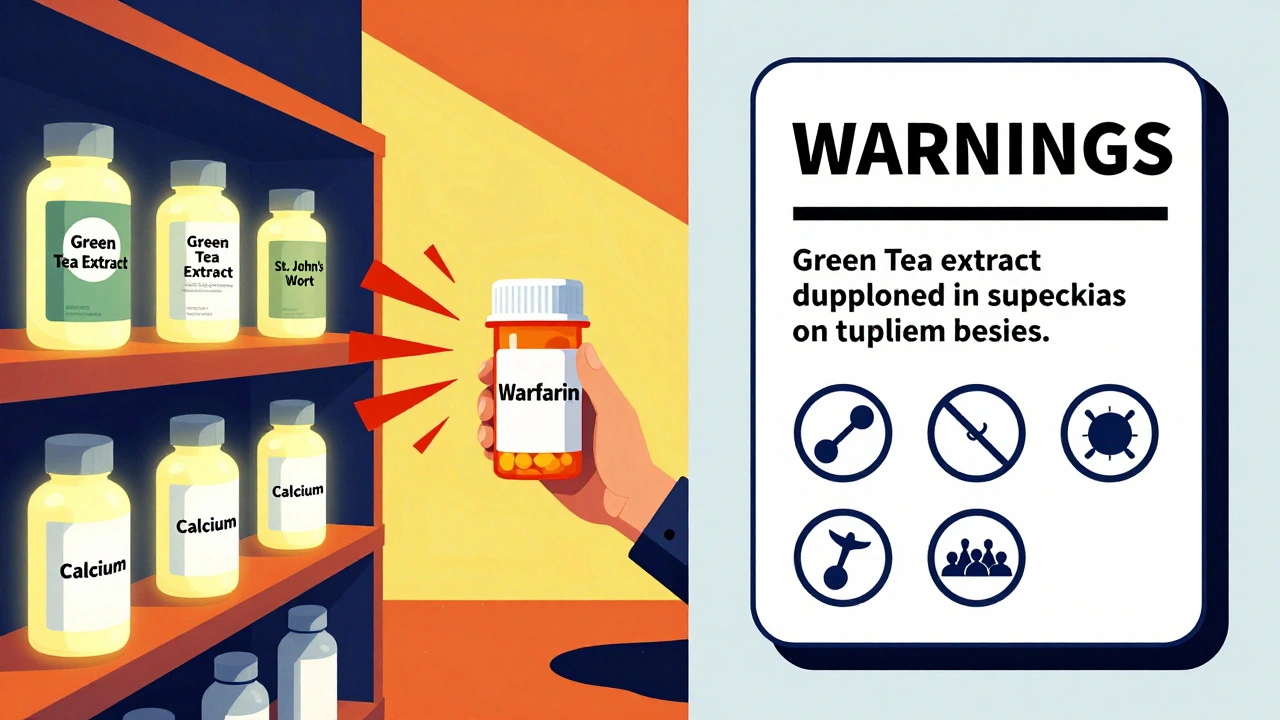
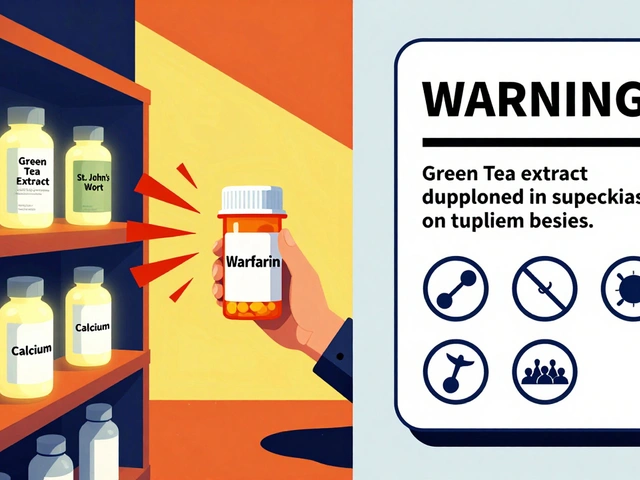
The Dietary Supplement Health and Education Act (DSHEA) of 1994 made supplements legally different from drugs. That means supplement makers don’t need FDA approval before selling their products. They don’t have to prove safety. They don’t have to test for interactions with medications. And they’re not required to warn you about them on the label. Compare that to a prescription pill or even an over-the-counter painkiller. Those labels have to include a full section called “Warnings.” It tells you exactly what drugs to avoid, what side effects to watch for, and when to call your doctor. The FDA enforces this. For prescription drugs, 97% of labels include interaction warnings. For OTC drugs, it’s 94%. For supplements? Only 13% do. This gap isn’t small. In 2022, nearly 2,000 adverse events linked to supplements were reported to the FDA. Almost a third involved dangerous interactions with medications. People ended up in the ER because they didn’t know their blood thinner was being neutralized by green tea extract, or their thyroid medication was being blocked by calcium supplements.What’s Actually on a Supplement Label (and What’s Missing)
Every supplement has a “Supplement Facts” panel. It looks a lot like a nutrition label. You’ll see:- Serving size
- Amount per serving for each ingredient
- % Daily Value (if established)
- Full list of ingredients
- Allergen warnings (for milk, soy, nuts, etc.)
How to Read Drug Labels (The Real Warnings)
If you’re on a prescription or OTC drug, the label is your lifeline. Look for these sections:- Warnings: This is where drug interactions are listed. It tells you which medications to avoid and what symptoms to watch for.
- Active Ingredients: Know what you’re taking. Don’t just rely on brand names-check the chemical names.
- Black Box Warning: The FDA’s strongest alert. If you see this, the drug has serious risks. Never ignore it.
- Other Information: Sometimes includes sodium content or storage instructions. Important if you have kidney or heart issues.
Top 5 Dangerous Supplement-Drug Pairs (And What to Do)
These are real, documented, and life-threatening combinations:- Warfarin + Vitamin K or CoQ10: Vitamin K (in green tea, kale supplements) reduces warfarin’s blood-thinning effect. CoQ10 does the same. Result? Higher risk of clots. If you’re on warfarin, avoid these unless your doctor approves.
- St. John’s Wort + Antidepressants, Birth Control, or Digoxin: This herb speeds up how your liver breaks down drugs. It can drop digoxin levels by 26%, making heart failure worse. It can also make birth control fail.
- Milk Thistle + Metformin: Both lower blood sugar. Together, they can cause dangerous hypoglycemia. One patient’s blood sugar dropped to 42 mg/dL after adding milk thistle.
- Vitamin C (over 1,000 mg/day) + Antiretrovirals: High-dose vitamin C changes stomach pH and reduces absorption of some HIV meds by 22%.
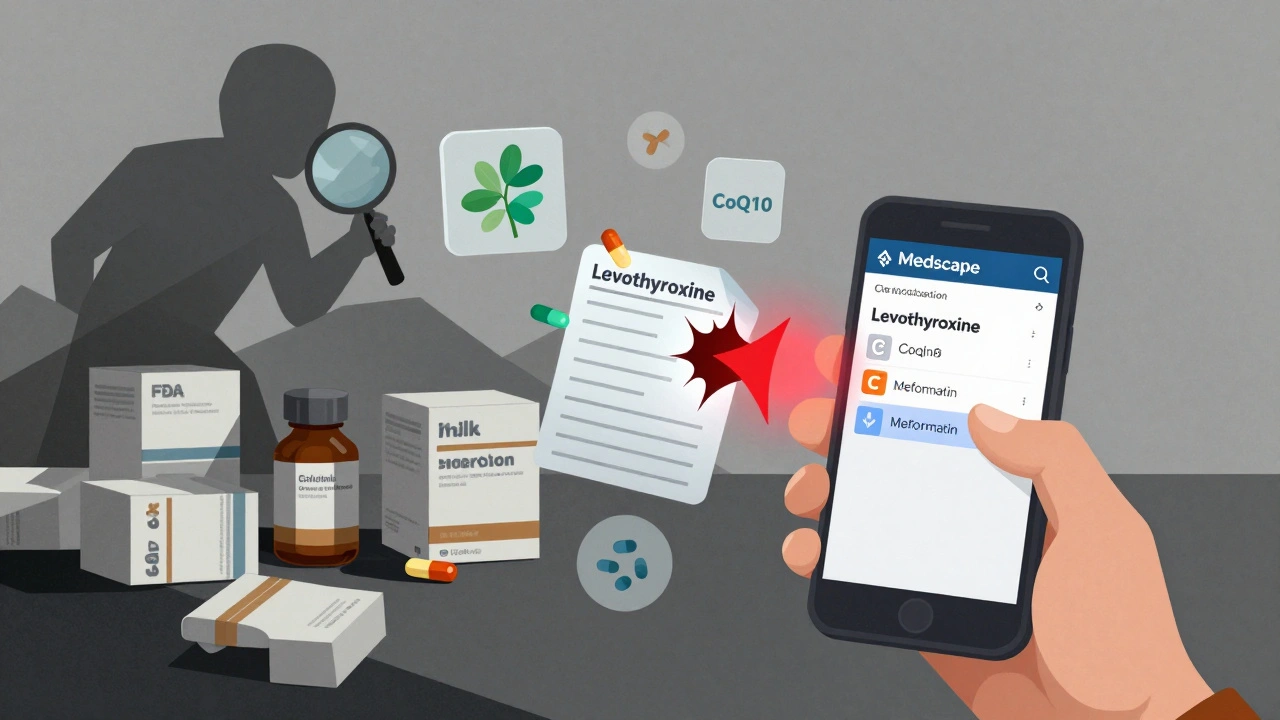
- Calcium or Iron + Levothyroxine: These minerals block thyroid hormone absorption. Take them at least 4 hours apart.
How to Protect Yourself (Step-by-Step)
You can’t rely on labels. You have to take action.- Make a list. Write down every supplement you take-including dose and frequency. Include vitamins, herbs, protein powders, and even CBD oil.
- Take photos. Snap a picture of every supplement label. Show them to your doctor or pharmacist during your next visit.
- Use the Medscape Drug Interaction Checker. It’s free. Type in your medication and supplement. It checks over 24,000 combinations. Don’t guess-check.
- Ask your pharmacist. They’re trained to spot interactions. Most will check for free. Say: “I’m taking X. Is it safe with Y?”
- Look for USP verification. The USP mark means the product was independently tested for ingredients and purity. Only 18% of supplements have it-but those that do are far more reliable.
The Bigger Problem: Regulation Isn’t Keeping Up
The supplement industry made $53 billion in 2023. But the FDA’s entire budget for supplement oversight? $4.7 million. That’s less than 0.03% of their total funding. They inspect less than 1% of products each year. In 2023, over 1,200 supplement labels were found to be misbranded or adulterated. Only 28% led to recalls. The rest stayed on shelves. Congress tried to fix this in 2022 with the Dietary Supplement Listing Act, which would have required pre-market notification. It failed by two votes. So the system stays broken. Meanwhile, the FDA is testing QR codes on supplement labels that link to real-time interaction databases. It’s a start. But until the law changes, the burden falls on you.Final Rule: Never Assume It’s Safe
Just because something is sold in a health food store doesn’t mean it’s safe with your meds. “Natural” isn’t a safety guarantee. “Herbal” doesn’t mean harmless. “No side effects listed” doesn’t mean no risks. If you take any prescription drug-even something as common as high blood pressure medicine or an antidepressant-assume your supplement could interfere. Always check. Always ask. Always document. Your life might depend on it.Do supplement labels have to warn about drug interactions?
No. Under current U.S. law, supplement manufacturers are not required to list drug interaction warnings on their labels. Unlike prescription and OTC drugs, which must include this information, supplements operate under a much looser regulatory system. Only about 13% of supplement labels voluntarily include interaction warnings.
What should I do if my supplement doesn’t mention drug interactions?
Don’t assume it’s safe. Use the free Medscape Drug Interaction Checker or consult your pharmacist. Bring a photo of the supplement label to your doctor. Many interactions are well-documented-even if the label doesn’t say anything. For example, St. John’s wort can reduce the effectiveness of birth control and antidepressants, and CoQ10 can interfere with blood thinners like warfarin.
Are “proprietary blends” dangerous?
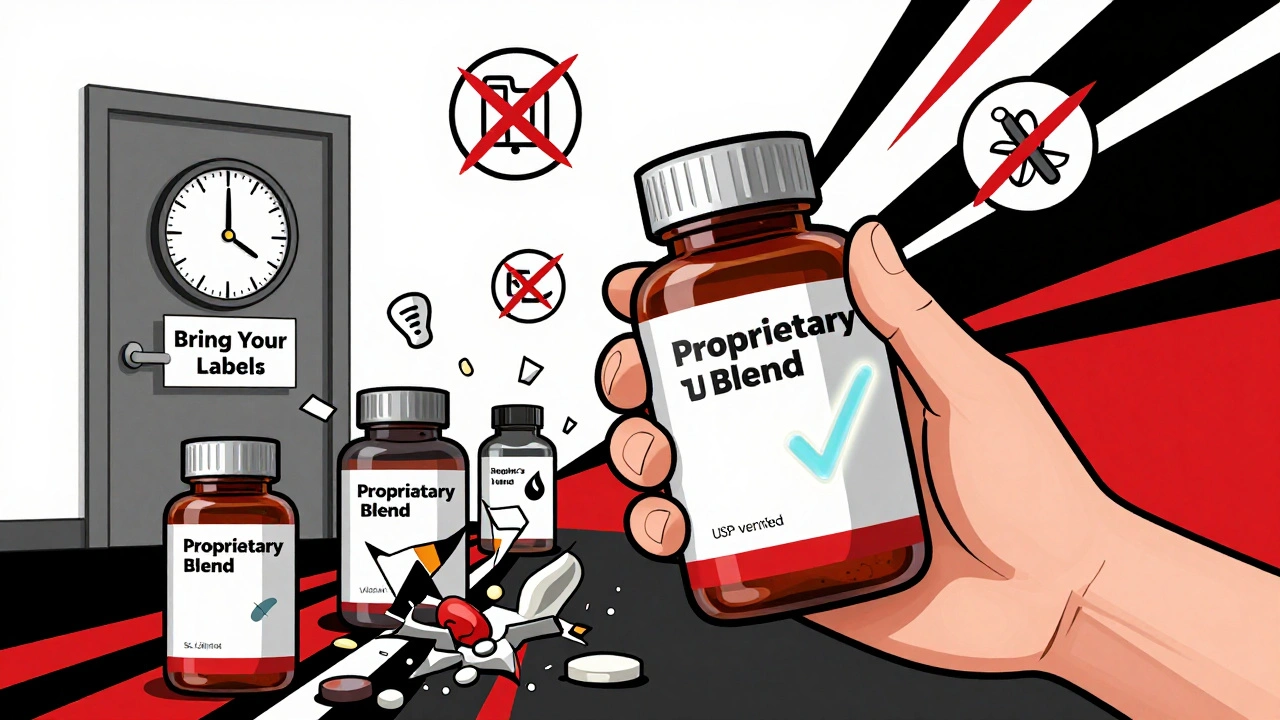
Yes, they can be. Proprietary blends hide the exact amounts of each ingredient. This makes it impossible to know if you’re getting a safe or effective dose. One study found that 38% of supplements use proprietary blends to obscure low doses of powerful herbs-or to sneak in unlisted compounds. Avoid them if you’re on medication.
Can I trust supplements with the “USP Verified” mark?
Yes. USP (U.S. Pharmacopeia) verification means the product was independently tested for ingredients, purity, strength, and manufacturing quality. USP-certified supplements are 92% accurate in labeling, compared to only 67% for non-certified ones. While only 18% of supplements carry this mark, it’s one of the best ways to reduce risk.
Why don’t more supplement companies include interaction warnings?
Because they don’t have to. The Dietary Supplement Health and Education Act of 1994 doesn’t require it. Adding warnings could also scare off customers or open companies to liability. Without a legal push, most won’t. The FDA can’t force them to change labels unless a product is proven unsafe after it’s already on the market.
Next Steps: What to Do Today
If you take supplements and any kind of medication:- Pause. Don’t start any new supplement until you’ve checked for interactions.
- Take a photo of every supplement label you use.
- Call your pharmacist and ask: “Do any of these interact with my medications?”
- Use Medscape’s free tool to check your combo.
- Bring your list to your next doctor’s appointment-even if they don’t ask.



lol so supplements are just magic fairy dust now? 🤡 my grandma took garlic pills with her blood pressure med and lived to 98. maybe the real danger is trusting big pharma who makes 10x more off your prescriptions than any supplement company ever could.
this is why you dont trust anything. the fda is a joke. they let fake weight loss pills with rat poison in them stay on shelves for years. if you take anything not prescribed by a doctor, you're asking for trouble.
The DSHEA of 1994 was a catastrophic deregulatory failure that effectively outsourced public health to corporate marketing departments. The fact that 87% of supplement labels omit interaction warnings is not a loophole-it's a systemic collapse of pharmacovigilance. You cannot rely on 'natural' as a proxy for safety when monacolin K is chemically identical to lovastatin. This is basic pharmacokinetics, not conspiracy theory.
Stop waiting for the government to protect you. If you're on medication, you owe it to yourself to know what you're putting in your body. Take photos of every label. Write down doses. Go to your pharmacist and say, 'I need help.' They're trained for this. Don't be embarrassed. Your life isn't a gamble.
I used to think 'natural' meant safe until my mom ended up in the ER after mixing St. John’s wort with her antidepressant. The label didn’t say a word. Turns out, it’s not just about what’s in the bottle-it’s about what’s *not* in the bottle. Proprietary blends are the wild west. I don’t touch them anymore. Ever.
you guys are overthinking this. i take fish oil, vitamin d, and protein powder with my blood pressure med and i’m fine. if your body can’t handle it, maybe you’re just too sensitive. also, 🌱💪
There’s a difference between ignorance and informed choice. The system is broken, yes-but the solution isn’t fear. It’s education. We’ve been conditioned to trust labels, but labels are marketing tools, not medical documents. The real power lies in knowing how to ask the right questions. Not of the label, but of the people trained to answer them.
i just started taking magnesium for sleep and was nervous about my anxiety med… so i took a pic of the bottle and sent it to my pharmacist. she said it’s fine. i felt so much better after that. you don’t have to be scared-you just have to be curious. 🌿💛
in india we call this 'desi medicine' culture. people take ashwagandha with heart pills and say 'it's from the earth, so it's good.' but earth also has arsenic. knowledge beats tradition every time.
The FDA budget for supplements is less than what some influencers make in a month. This isn’t negligence-it’s corruption. They’re letting billion-dollar companies profit while people die quietly from interactions no one warned them about. Wake up. This is capitalism. Not healthcare.
I’m a nurse and I tell every patient: if you’re on meds, bring me your supplement bottles-even if you think they’re ‘just vitamins.’ I’ve seen people on blood thinners take green tea extract and nearly clot. Don’t wait for an emergency. Be proactive. You’re worth it.
I used to roll my eyes at people who asked about interactions… until my sister had a seizure after mixing melatonin with her antidepressant. The label didn’t say a thing. Now I carry a laminated card with my meds and supplements. I don’t care if it looks weird. I care that I’m alive.
I just found out my protein powder had hidden caffeine. 300mg per serving. I was on beta blockers. My heart was racing at 3am for weeks. I thought it was stress. Turns out it was a label that said 'Energy Blend.' That’s not marketing. That’s a trap. 🚨
this is why america is falling apart. big pharma owns congress. the fda is a puppet. the supplement industry is a front for chemical giants who want to control your health. they don’t want you to know about interactions because then you’d stop buying their drugs. it’s all connected. wake up sheeple.
Let’s be real: if you’re taking supplements, you’re already playing Russian roulette with your biology. The fact that we treat health like a grocery store aisle is the real tragedy. No one’s coming to save you. Not the FDA. Not your doctor. Not your mom’s friend who swears by turmeric. You have to become your own pharmacist. Or die quietly. Your call.