
Seizure Medications and Pregnancy: Risks of Birth Defects and Drug Interactions
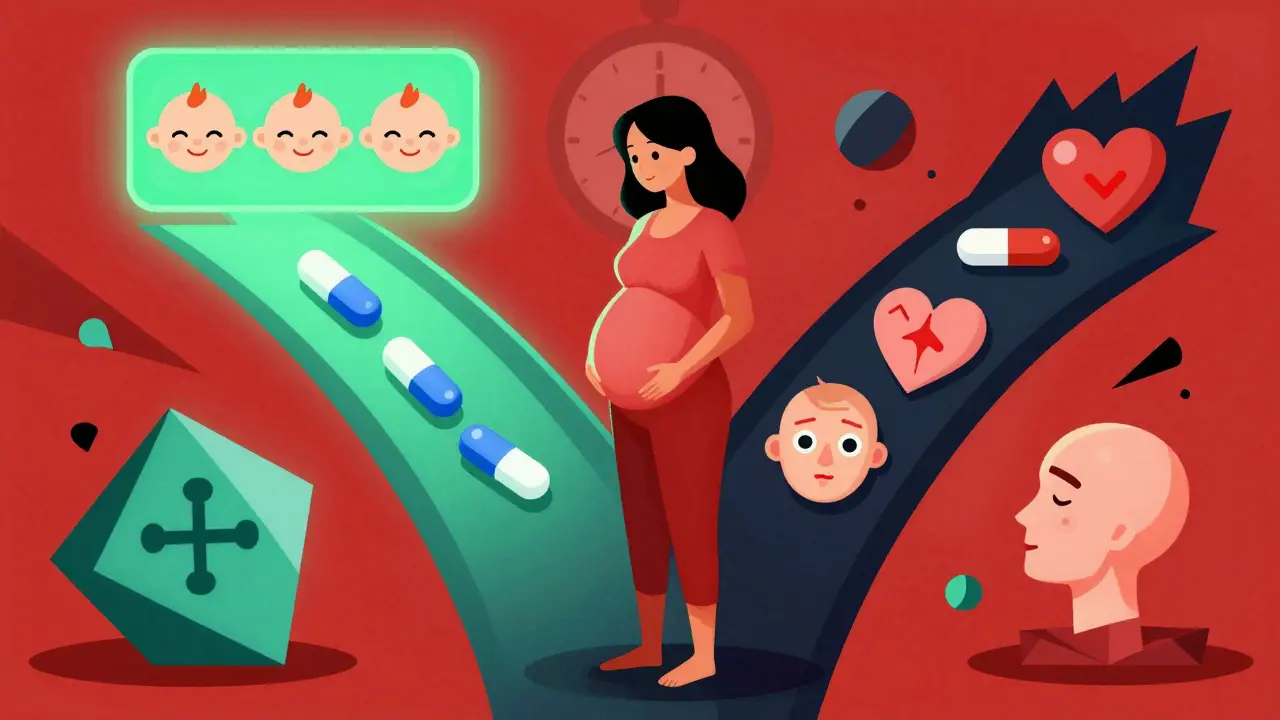
When a woman with epilepsy becomes pregnant, she faces a difficult choice: keep taking her seizure medication to prevent dangerous seizures, or stop it and risk harm to herself and her baby. This isn’t just a medical dilemma-it’s a life-altering decision made every day by women who want to start a family but are caught between two serious risks.
Some Seizure Medications Are Much Riskier Than Others
Not all seizure medications carry the same level of risk during pregnancy. The most dangerous drug is valproate (also called sodium valproate or valproic acid). Studies show that about 10% of babies exposed to valproate before birth develop major physical birth defects. These include heart problems, cleft lip or palate, spinal cord issues, and microcephaly (a smaller-than-normal head size). Valproate also raises the risk of autism and ADHD in children by more than double compared to other seizure drugs.
Other high-risk medications include carbamazepine, phenobarbital, phenytoin, and topiramate. Each of these increases the chance of physical birth abnormalities, though not as severely as valproate. For example, carbamazepine’s risk goes up with higher doses. The more you take, the higher the chance your baby will have a congenital malformation.
The good news? Not all seizure drugs are dangerous. Two medications-lamotrigine (Lamictal) and levetiracetam (Keppra)-have been shown to be much safer during pregnancy. A major review by the UK’s Medicines and Healthcare products Regulatory Agency (MHRA) found these two carry the lowest risk of birth defects. Studies tracking children born to mothers who took lamotrigine or levetiracetam found normal development in language, motor skills, and behavior at age two. In fact, their development was nearly identical to children whose mothers didn’t take any seizure medication at all.
Drug Interactions Can Make Things Worse
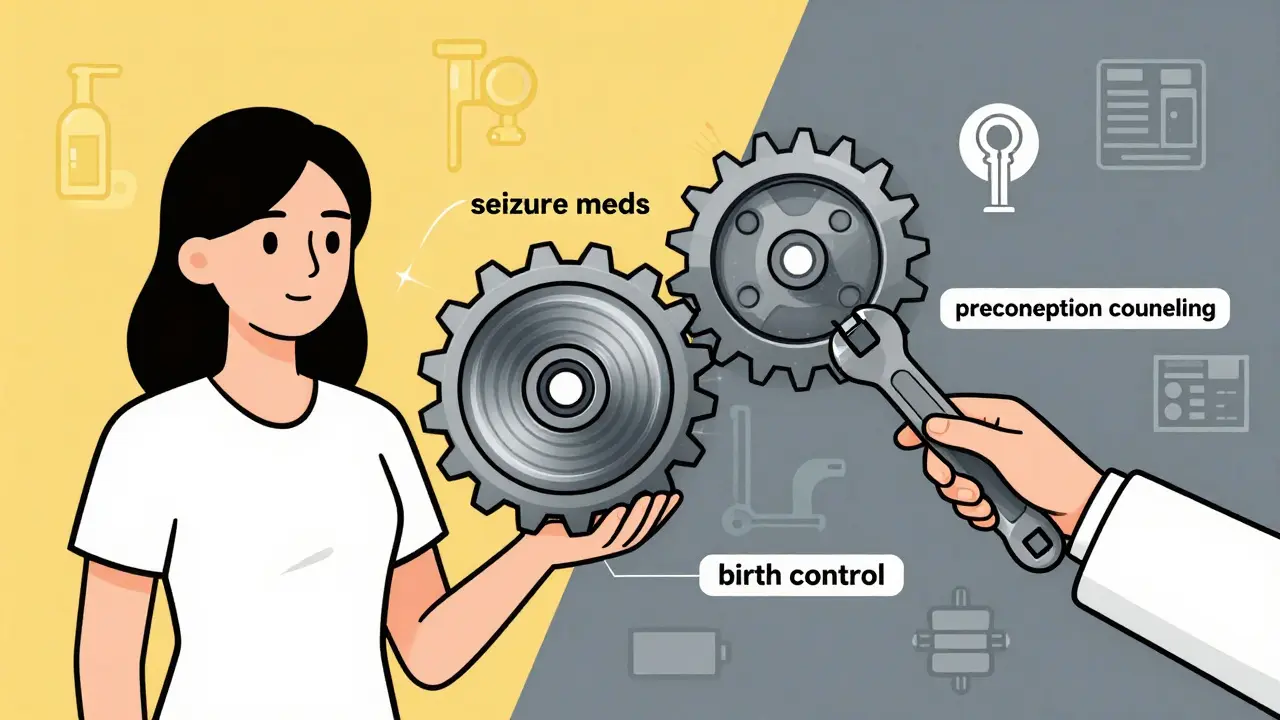
Many women with epilepsy also use birth control. But here’s the problem: some seizure medications can make hormonal birth control (pills, patches, rings) much less effective. Drugs like carbamazepine, phenytoin, phenobarbital, oxcarbazepine, and high-dose topiramate speed up how fast your body breaks down hormones. This means you could get pregnant even if you’re taking birth control exactly as directed.
The reverse is also true. Hormonal birth control can lower the levels of some seizure drugs in your blood. This includes lamotrigine, valproate, zonisamide, and rufinamide. If your seizure medication drops too low, you might start having more seizures. That’s dangerous for both you and your baby.
This creates a dangerous cycle. A woman might be on a safe seizure drug like lamotrigine, but if she’s also using birth control pills, her seizure control could slip. Or she might be on a high-risk drug like carbamazepine, and the birth control isn’t working, leading to an unplanned pregnancy. A 2023 study found that nearly two-thirds of women of childbearing age with epilepsy answered basic questions about these interactions incorrectly. That’s alarming.
Uncontrolled Seizures Are the Real Danger
It’s easy to focus only on the risks of medication. But you have to remember: uncontrolled seizures are far more dangerous. A tonic-clonic seizure during pregnancy can cause miscarriage, premature labor, low oxygen to the baby, or even death. The American Epilepsy Society makes this clear: no seizure medication is as risky as having frequent, uncontrolled seizures.
That’s why experts don’t recommend stopping medication cold turkey. If you’re planning to get pregnant, you need to work with your neurologist months ahead of time. The goal isn’t to stop all drugs-it’s to switch to the safest one possible at the lowest effective dose. For many women, that means switching from valproate to lamotrigine or levetiracetam before conception.
Progress Has Been Made-But Not Enough
There’s real progress here. Between 1997 and 2011, the rate of major birth defects linked to seizure medications dropped by 39%. Why? Better prescribing. More awareness. More women getting preconception counseling. Newer drugs like lamotrigine and levetiracetam are now first-line choices for women of childbearing age.
But gaps remain. A French study found that women with lower income and fewer healthcare resources were still more likely to be prescribed high-risk drugs like valproate and phenobarbital. This isn’t about choice-it’s about access. Not everyone can see a specialist. Not everyone can afford to switch medications. Not everyone gets clear advice.
Even today, 11 other seizure medications don’t have enough data to say whether they’re safe during pregnancy. That means doctors are making educated guesses. That’s not ideal. We need more research, especially on long-term outcomes like learning, behavior, and IQ in children exposed to newer drugs.

What You Should Do If You’re Planning Pregnancy
If you’re a woman with epilepsy and you’re thinking about having a baby, here’s what matters:
- Don’t wait until you’re pregnant to talk to your doctor. Start planning at least 6 months ahead.
- Avoid valproate if possible. It’s the most dangerous option. If you’re on it now, don’t stop on your own-talk to your neurologist about switching.
- Ask about lamotrigine or levetiracetam. These are the safest choices we have right now.
- Review your birth control. If you’re using pills, patches, or rings, ask if your seizure meds are making them less effective. You might need a non-hormonal option like an IUD.
- Take folic acid daily. A 4mg dose (higher than regular prenatal vitamins) before and during early pregnancy can reduce the risk of neural tube defects.
Many women worry that switching medications will cause more seizures. But studies show that with proper planning, most women maintain good seizure control on safer drugs. One study followed 298 children whose mothers took newer medications during pregnancy. Their language skills at age two were just as strong as children in the general population.
Hope Is Real-But It Requires Action
The idea that women with epilepsy can’t have children is outdated. We know better now. With the right care, most women with epilepsy have healthy babies. The key is preparation. It’s not about avoiding medication-it’s about choosing the right one.
There’s no perfect solution. Every drug has trade-offs. But the science is clear: the safest path forward isn’t to stop treatment. It’s to get smarter about what you’re taking-and when.
Can I stop taking my seizure medication if I get pregnant?
No. Stopping seizure medication without medical supervision can lead to uncontrolled seizures, which are far more dangerous to both you and your baby than most medications. Always talk to your neurologist before making any changes.
Which seizure medications are safest during pregnancy?
Lamotrigine (Lamictal) and levetiracetam (Keppra) are currently considered the safest options. Studies show they carry the lowest risk of birth defects and developmental issues. Valproate is the riskiest and should be avoided if possible.
Do birth control pills work with seizure medications?
Not always. Carbamazepine, phenytoin, phenobarbital, oxcarbazepine, and high-dose topiramate can make hormonal birth control less effective. Conversely, birth control can lower levels of lamotrigine, valproate, zonisamide, and rufinamide. Talk to your doctor about using non-hormonal options like an IUD.
Is it safe to breastfeed while taking seizure medication?
Yes, for most medications. Lamotrigine and levetiracetam pass into breast milk in very low amounts and are considered safe. Valproate is generally not recommended, but if you’re on it, your doctor can help you monitor your baby for side effects. Always check with your neurologist before breastfeeding.
How early should I plan before getting pregnant?
At least 6 months. Switching medications, adjusting doses, and ensuring seizure control takes time. Starting folic acid early and getting preconception counseling significantly improves outcomes.
Are newer seizure medications safer than older ones?
Yes. Medications developed after the 1990s-like lamotrigine and levetiracetam-have much lower risks of birth defects compared to older drugs like valproate and phenobarbital. Research shows major birth defect rates dropped 39% between 1997 and 2011 due to better prescribing practices.






I love how this article just says 'don't stop meds' like it's that simple. What about the woman who's had three seizures in six months because her insurance won't cover Lamictal? Or the one who got pregnant because her OB didn't know carbamazepine nukes birth control? This isn't medical advice-it's a privilege. And don't even get me started on how many docs still push valproate because it's cheap. 😅
This is why Britain needs to stop importing American medical nonsense. We've had clear guidelines since 2010. Valproate? Banned for women of childbearing age unless under strict registry. Lamotrigine? First-line. End of story. Why are we still having this conversation like it's 2005? 🇬🇧
LMAO at the idea that 'preconception counseling' is a thing people actually get. My cousin took lamotrigine for 8 years, got pregnant, and her neurologist said 'oh cool, keep taking it'-no dose adjustment, no folic acid talk, no mention that birth control might be useless. She had a healthy baby. But not everyone's that lucky. 😑
In India, we have women on phenobarbital because it's ₹5 a month. Lamotrigine? ₹1200. And no one talks about how the stigma around epilepsy means many women hide their diagnosis until they're already pregnant. The real tragedy isn't the drug-it's the system that makes choice a luxury. We need community health workers, not just neurologists in ivory towers.
I just want to say… I’m so glad we’re talking about this. Seriously. I have a friend who was on topiramate, got pregnant, and didn’t know it was risky. Her baby had a cleft palate. She cried for weeks. But now? She’s helping other women. It’s messy. It’s scary. But we’re getting better. 💛
I just switched from valproate to levetiracetam last year!! 😊 I was terrified but my neuro said 'you're stable, let's move slow' and now I'm 14 weeks pregnant and seizure-free. Also switched to a copper IUD-so much better than pills. Folic acid 4mg daily. Life is weird but good. 🤰💕
You know what's wild? We have data showing lamotrigine is safer than… well, literally anything else. But doctors still default to carbamazepine because it's 'proven.' Proven to cause cleft palates? Cool. Meanwhile, women in rural areas are being told 'just take the pills' while their neurologist is 200 miles away. The real issue isn't medicine-it's access. And privilege. And who gets heard.
I'm a nurse in maternal health. I've seen too many women on valproate because their psychiatrist said 'it's the only thing that works.' Meanwhile, their OB is clueless. We need mandatory training for ALL providers who treat women of childbearing age. Not just neurologists. GPs. Psychiatrists. OBs. Everyone. This isn't optional. It's basic human care.
i read this and thought wow this is so clear but then i remembered my friend took keppra and still had a baby with a heart defect. maybe it's not the drug? maybe it's genetics? or something else? i dont know. but i think we need more studies. like, way more. like, 10x more. and maybe talk to the moms who lived it. not just the data.
This article reads like a pharmaceutical brochure. Lamotrigine? Keppra? Sure. But where's the data on long-term neurodevelopment? The studies are all 2-year follow-ups. What about IQ at 12? Risk of anxiety at 18? We're acting like these drugs are harmless because they don't cause cleft palates. That's not science. That's wishful thinking.
Stop saying valproate is the worst. It's not. It's the most studied. The real problem is we're pushing new drugs without enough data. We have 11 medications with 'insufficient data' and we're treating them like they're safe. That's not progress. That's negligence. If you're going to tell women to switch, at least have real numbers.
I've been on lamotrigine for 12 years. Had two kids. Both are 8 and 10 now. Perfectly normal. But here's the thing nobody says: switching meds isn't easy. You get dizziness. You get mood swings. You get seizures. It's not a simple swap. It takes months. And if you're poor? You can't afford the 6-month transition period. You can't afford the 10 follow-ups. You can't afford the lab tests. So yeah, the science says 'switch.' But reality? It's brutal.
Lamotrigine and levetiracetam are the safest options. Valproate is dangerous. Birth control interactions are real. Folic acid 4mg is critical. Preconception planning saves lives. That's it. No fluff. No drama. Just facts. If you're a woman with epilepsy, get your neurologist on the phone. Now. Not next month. Now.
This is why the West has lost its moral compass. We obsess over drugs and ignore the soul. A woman who chooses motherhood despite epilepsy is a hero. Not because she took the 'right' pill, but because she chose life. We have turned pregnancy into a risk matrix. We have turned love into a spreadsheet. What happened to faith? To courage? To trusting the body? We have forgotten that healing is not just chemical.
Just to add: I'm a neurologist. We have a new 5-year longitudinal study from the UK Epilepsy and Pregnancy Registry showing that children exposed to levetiracetam have normal IQ, language scores, and social development at age 5. Zero difference from controls. And yes, the data on lamotrigine is even stronger. This isn't speculation. It's replicated. If you're still prescribing valproate to a woman who might get pregnant? You're not just outdated-you're endangering lives.