Medication Guide Distribution Requirements for Pharmacists and Providers
Medication Guide Distribution Checker
Medication Guide Distribution Calculator
Determine if a Medication Guide must be distributed based on your specific scenario.
Distribution Decision
What Exactly Is a Medication Guide?
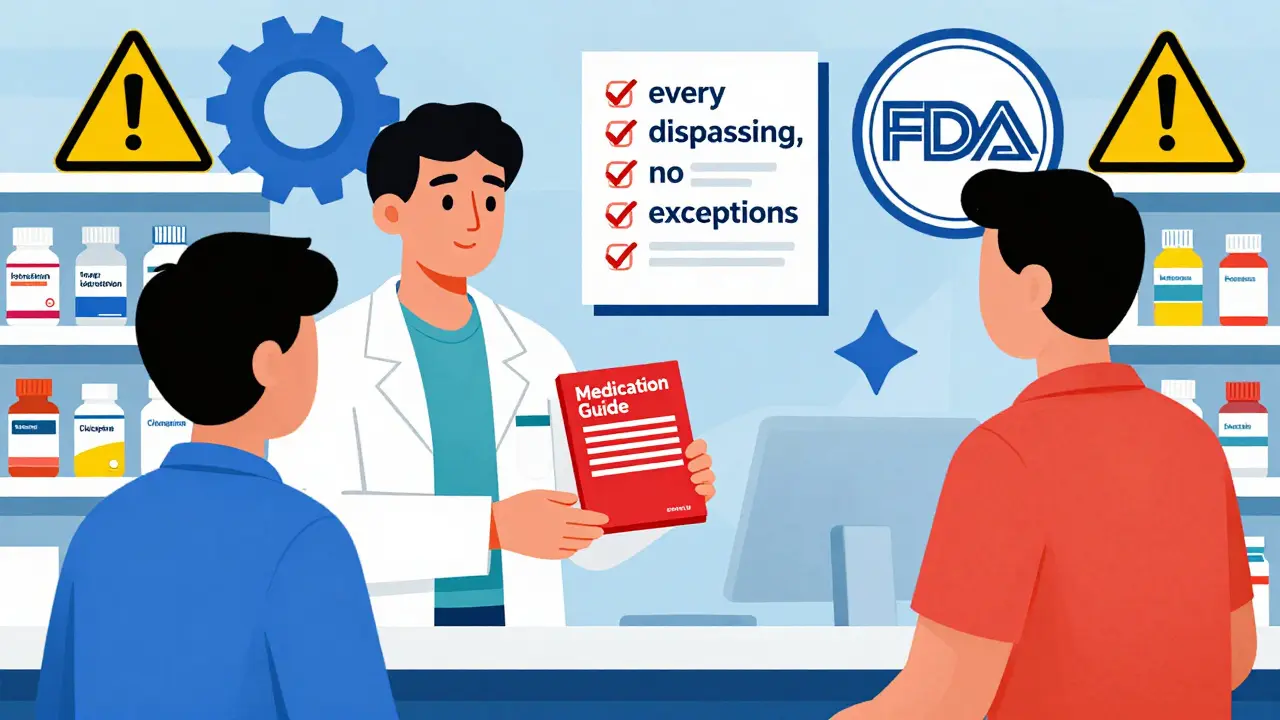
A Medication Guide is a printed handout that comes with certain prescription drugs. It’s not just a pamphlet-it’s an FDA-approved document designed to tell patients about serious risks tied to their medicine. These guides are written in plain language so patients can understand what could go wrong and how to avoid it. Unlike general drug info sheets you might get from a pharmacy, Medication Guides are mandatory for specific high-risk medications. They go through a formal review process by the FDA before they’re allowed to be distributed.
Right now, more than 200 prescription drugs in the U.S. require a Medication Guide. These include drugs like isotretinoin (used for severe acne), clozapine (for treatment-resistant schizophrenia), and estrogen-based therapies. Each one carries a risk that’s serious enough that the FDA believes patients need to be warned directly-before they even take the first pill.
When Do You Have to Give Out a Medication Guide?
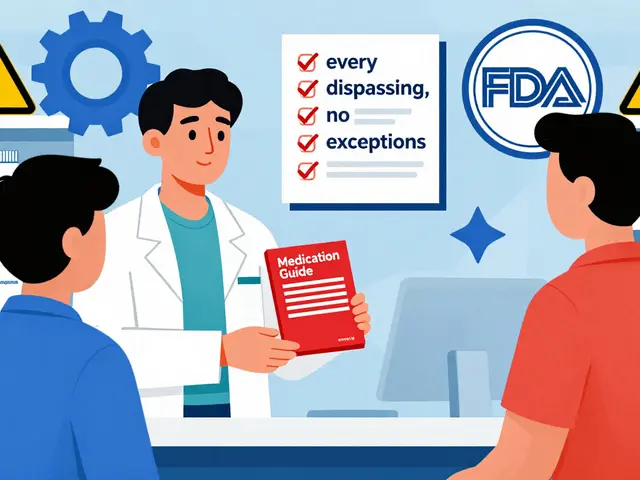
It’s not as simple as handing one out every time a prescription is filled. The rules change depending on where the drug is being given and who’s giving it. In a community pharmacy, if you’re dispensing a drug that requires a Medication Guide, you must give the patient a printed copy every single time-no exceptions. That’s true even if the patient got one last month.
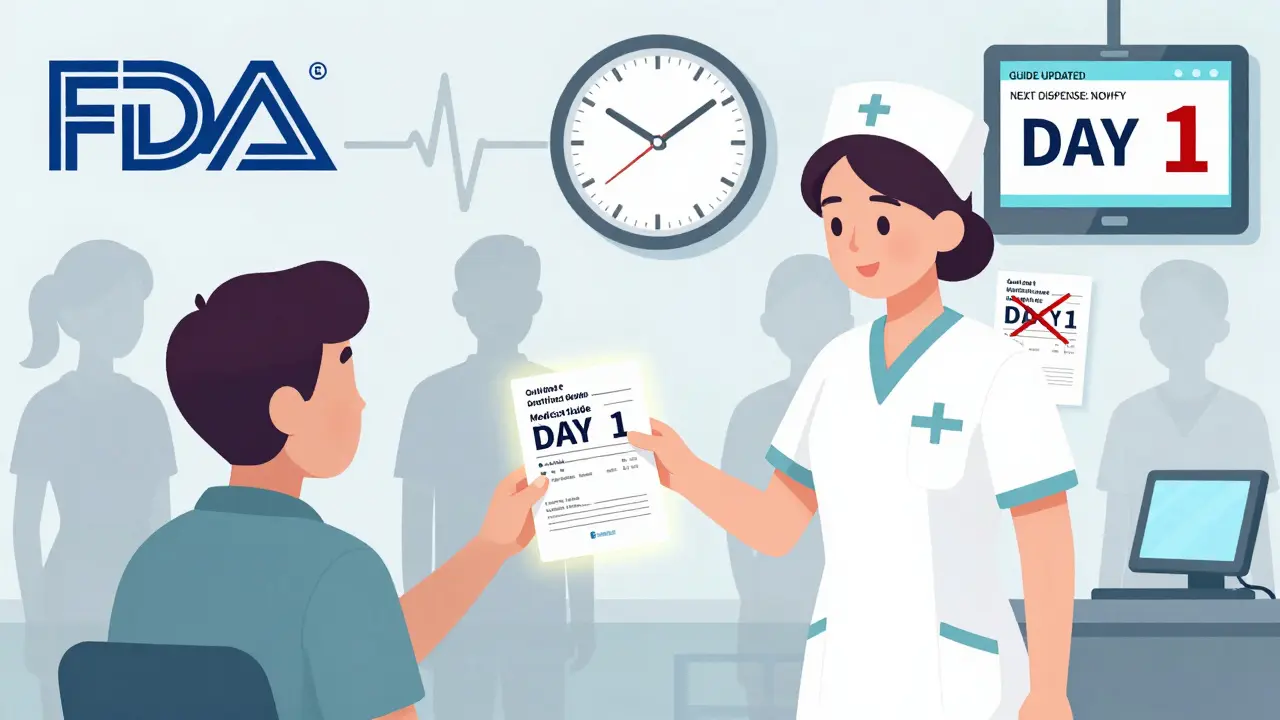
But things get trickier in outpatient clinics, infusion centers, or dialysis units. Here, you only need to hand out the guide the first time the patient receives the drug. After that, you don’t have to give them another copy unless the guide itself has been updated. For example, if a patient gets epoetin alfa every week for anemia, you give them the guide on day one. Week two? No need. But if the FDA approves a new version of the guide in March, then you have to hand out the updated version the next time they come in.
There’s one more key rule: if a patient or their caregiver asks for the guide, you must give it to them-even if the law doesn’t technically require it. You can’t say no. And if they ask for it electronically, you can send it by email or text, but you still have to offer a paper copy if they want one.
Where Are Medication Guides NOT Required?
You don’t need to hand out Medication Guides in hospitals or nursing homes. That’s because patients there are under direct supervision. Nurses and doctors are expected to explain risks during treatment. But here’s the catch: just because you don’t have to hand out the guide doesn’t mean you can ignore the information. If a patient is being treated with clozapine in a hospital, the medical team still has to make sure they understand the risks of seizures or low white blood cell counts. The guide isn’t the only way to communicate safety-it’s just the only legally required written tool for outpatient settings.
This distinction trips up a lot of pharmacists. One Reddit user in June 2023 asked, “We give darbepoetin in our oncology clinic every three weeks. Do we hand out the guide every visit?” The answer: only the first time. But many clinics still give it every time out of fear of getting in trouble. That’s unnecessary-and it wastes paper, time, and money.
How Is a Medication Guide Different From Other Patient Info?
There are lots of patient handouts out there. Some are made by pharmacies, some by drug companies, and some by patient advocacy groups. But only Medication Guides are created and approved by the FDA. They’re not optional. They’re not suggestions. They’re the law.
Compare that to Patient Medication Information (PMI) or Consumer Medication Information (CMI). These are voluntary. Pharmacies can choose whether to print them. They’re often generic, written in a one-size-fits-all way, and never reviewed by the FDA. A Medication Guide, on the other hand, is specific to one drug, includes exact warnings approved by regulators, and is updated when new safety data comes out.
Some drugs also come with REMS programs-Risk Evaluation and Mitigation Strategies. These are extra safety plans for the riskiest medications. A lot of those programs include Medication Guides as a required part. For example, the iPLEDGE program for isotretinoin doesn’t just require you to hand out the guide. You have to review it with the patient, confirm they understand it, and document that they’ve seen it. Miss that step, and you can’t legally dispense the drug.
Why Do These Rules Even Exist?
The FDA doesn’t make these rules just to add paperwork. They’re based on real harm. Drugs like isotretinoin can cause severe birth defects. Clozapine can wipe out a patient’s white blood cells without warning. Estrogen therapies increase the risk of blood clots. If patients don’t know these risks-or worse, they don’t understand them-they might stop taking the drug, take it wrong, or ignore symptoms that could kill them.
Dr. Janet Woodcock, former head of the FDA’s drug center, said it plainly: “Medication Guides are essential tools that help patients understand the serious risks associated with certain medications and how to use them safely.” That’s the whole point. It’s not about compliance. It’s about preventing death.
But here’s the problem: studies show only 37% of patients can recall key safety info from a Medication Guide one week after receiving it. That’s not because the guides are poorly written. It’s because patients are overwhelmed, stressed, or just don’t read them. So the FDA is now looking at ways to make them better-simpler language, bigger fonts, digital versions with videos, and even audio formats for people with low vision.
What Do Pharmacists Get Wrong?
A 2022 survey of over 1,200 hospital pharmacists found that 68% were confused about when to distribute Medication Guides in outpatient clinics. That’s not a small number. It means two out of three pharmacists were unsure whether they were breaking the rules or wasting time.
One common mistake? Giving out a guide every time a patient comes in for a monthly injection, even when it’s not required. That’s not just inefficient-it’s misleading. Patients start to think the guide is just routine paperwork, not a serious safety tool. That erodes trust.
Another issue? Tracking updates. The FDA changes Medication Guides all the time. If a drug’s warning is updated because of new side effects, the new guide must be distributed the next time the drug is dispensed. But many pharmacies don’t have systems to alert them when a guide changes. That’s a compliance risk-and a patient safety risk.
Some institutions, like the University of California San Francisco, fixed this by linking their pharmacy system to a database that auto-triggers a guide alert when a high-risk drug is scanned. That cut distribution errors by 73%. Simple tech. Big impact.
What’s Changing in 2026?
The FDA is reviewing the entire Medication Guide program right now. A congressionally mandated study is due in late 2024, and changes are expected in 2025 and 2026. One big push is toward electronic distribution. The FDA has already said patients can get guides via email or text-but only if they ask for it. Now they’re considering making digital delivery the default, with paper available on request.
Industry analysts predict the number of drugs requiring Medication Guides will grow by 22% over the next five years. Why? Because more complex, high-risk drugs are hitting the market-especially in cancer, rare diseases, and autoimmune conditions. These drugs often have narrow safety margins. One mistake can be deadly.
At the same time, some experts are pushing back. Dr. Lucinda L. Maine, a former ASHP leader, pointed out in 2021 that there’s little evidence these guides actually improve outcomes for many drugs. She called them an administrative burden with unclear benefits. The FDA is listening. They’re not just trying to enforce rules-they’re trying to make them work better.
What Should You Do as a Pharmacist or Provider?
- Know your drug list. Keep a running list of all medications in your practice that require a Medication Guide. Update it monthly.
- Train your staff. Make sure everyone knows the difference between community pharmacy rules and outpatient clinic rules.
- Use technology. If your pharmacy system doesn’t flag Medication Guides, push for it. Barcode scanning and alerts save time and reduce errors.
- Don’t assume. If a patient asks for the guide, give it. If the guide changed, distribute the new version-even if the patient got one last month.
- Don’t over-distribute. In clinics, only hand it out the first time-unless there’s a change. That’s the law.
The goal isn’t to check a box. It’s to make sure someone doesn’t die because they didn’t know what their medicine could do. That’s why these rules exist. And that’s why getting them right matters more than ever.
Can Patients Refuse a Medication Guide?
No. Patients can’t refuse to receive it. The law says you must offer it. But they can refuse to read it. You still have to give them the paper copy-or offer the electronic version. You can’t skip the step just because you think they won’t look at it. The responsibility is yours to deliver the information. What they do with it after that is up to them.
Do Medication Guides Replace Counseling?
No. They don’t. A Medication Guide is a supplement to verbal counseling-not a replacement. You still need to talk to patients about side effects, what to do if they miss a dose, when to call their doctor, and what to avoid (like alcohol or certain foods). The guide is a safety net. The conversation is the lifeline.
What Happens If You Don’t Distribute a Required Medication Guide?
It’s not just a paperwork violation. The FDA can issue warning letters, fine pharmacies, or even suspend a provider’s ability to dispense certain drugs. In extreme cases, especially if a patient is harmed because they weren’t warned, legal liability can follow. Most states also consider it a breach of professional standards. You could lose your license.
How Often Are Medication Guides Updated?
There’s no fixed schedule. Updates happen when new safety data emerges-like a new side effect reported in a clinical trial, or a death linked to the drug. The FDA reviews about 120 new or revised Medication Guides each year. Drug manufacturers are required to submit updates within 30 days of new safety information being approved. Pharmacies should check for updates at least once a month. Many use FDA’s Drug Safety Communications page or subscription alerts to stay current.
Is There a List of All Drugs That Require Medication Guides?
Yes. The FDA maintains a public list on its website. It’s updated regularly and includes the drug name, brand name, and the date the guide was last revised. Pharmacists should bookmark it. It’s not always easy to find, but it’s the only official source. Don’t rely on your pharmacy software alone-verify with the FDA’s list.