
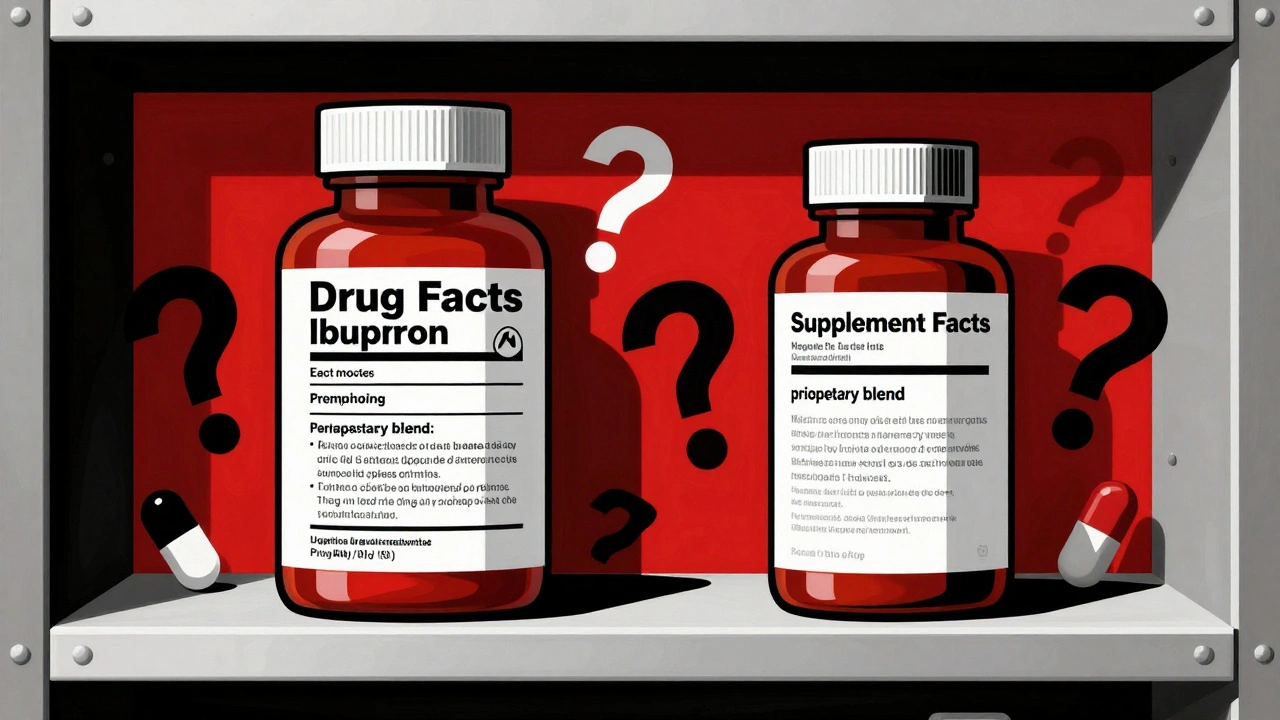
OTC Vitamins and Supplements: What the Drug Facts Label Doesn't Tell You
When you grab a bottle of ibuprofen off the shelf, you know what you’re getting. The label tells you exactly how much is in each pill, what it’s for, who shouldn’t take it, and what other drugs it might mess with. But when you pick up a bottle of multivitamins or a turmeric supplement next to it? That same clarity vanishes. The label looks similar-same box, same font, same layout-but the information underneath is dangerously incomplete. And most people don’t even realize it.
Supplements Aren’t Regulated Like Medicines
| Requirement | OTC Medication (Drug Facts) | Dietary Supplement (Supplement Facts) |
|---|---|---|
| Active ingredient amounts | Exact milligrams listed | May use proprietary blends (hidden amounts) |
| Drug interactions | Required and detailed | Often omitted; only 17% warn about interactions |
| Pregnancy warnings | Explicit, prominent | Generic or missing; even for high-dose vitamin A |
| Sodium content | Must be listed per serving | Not required |
| Expiration date | Required | Not required |
| Usage for specific conditions | Must state intended use | Only "structure/function" claims allowed (e.g., "supports immunity") |
| Pre-market safety review | Required | Not required; FDA acts only after harm occurs |
The reason? Supplements aren’t drugs. They’re classified as food under the Dietary Supplement Health and Education Act (DSHEA) of 1994. That means the FDA can’t require manufacturers to prove they’re safe before they hit store shelves. Instead, the agency has to prove they’re dangerous after people get hurt. That’s a huge gap. A 2022 study found 72% of people think supplements go through the same safety checks as painkillers or cold medicine. They don’t.
What’s Missing From the Supplement Facts Label
Let’s say you’re taking a prenatal vitamin. It says it has 10,000 IU of vitamin A. That’s the same amount found in prescription acne drugs that are known to cause severe birth defects. But here’s the catch: the label doesn’t tell you whether that vitamin A is retinol (the dangerous kind) or beta-carotene (the safe kind). It just says "vitamin A." No distinction. No warning. Just a tiny disclaimer buried at the bottom: "This statement has not been evaluated by the FDA. This product is not intended to diagnose, treat, cure, or prevent any disease."
That disclaimer doesn’t protect you. It protects the company. It’s there because the law says they can’t claim their product treats anything. But it doesn’t stop them from selling you something that could harm you.
And it’s not just vitamin A. Many supplements contain ingredients that interact with prescription drugs-blood thinners, antidepressants, diabetes meds-but you won’t find those warnings on the bottle. A 2021 study in JAMA Internal Medicine found that only 17% of supplement labels mention potential drug interactions. Every single OTC medication label does. That’s not an accident. It’s the law.
Even sodium content gets ignored. If you have high blood pressure or heart failure, you need to watch your sodium intake. OTC medicines like antacids or cold remedies must list sodium per dose. Supplements? No requirement. One popular electrolyte supplement had over 500 mg of sodium per serving-equivalent to a full teaspoon of salt-and not a word about it on the label.
Proprietary Blends: The Hidden Ingredient Trap
Ever seen a label that says "proprietary blend: 1,200 mg"? That’s a red flag. It means the company won’t tell you how much of each ingredient is in that blend. Maybe it’s 1,190 mg of filler and 10 mg of the active ingredient. Maybe it’s the other way around. You can’t know. And you can’t compare products.
NSF International found that 63% of weight-loss supplements and 41% of protein powders use these hidden blends. They’re legal. But they’re not transparent. And they make it impossible to know if you’re getting enough-or too much-of something. A 2023 University of North Carolina study showed that only 28% of people could correctly interpret supplement labels. For OTC drug labels? 89% got it right.

Who’s Really Checking These Products?
The FDA doesn’t test supplements before they’re sold. They wait for complaints. Between 2008 and 2020, the FDA found 776 supplements that contained hidden pharmaceutical drugs-like erectile dysfunction meds, antidepressants, or weight-loss compounds-labeled as "natural" or "herbal."
And when someone reports a problem? It takes the FDA an average of 427 days to act. For OTC drugs? 45 days. That’s almost a year of people taking something dangerous because no one’s watching.
Some companies voluntarily get certified by third parties like NSF or USP. That means they’ve been tested for purity, potency, and contamination. But only about 2,147 products out of tens of thousands carry those labels. And most consumers don’t know to look for them.
Real People, Real Confusion
Walgreens pharmacists logged over 14,000 questions in early 2023 from customers asking why their vitamin D didn’t warn them about interactions with their blood pressure meds. Same question, same pharmacy, same aisle-but one product had clear warnings, the other didn’t.
On Reddit, users share stories of dizziness, liver damage, and hospital visits after taking supplements that didn’t list risks. One man took a green tea extract for weight loss. He didn’t know it could cause liver failure. The label didn’t say. He ended up needing a transplant.
Amazon reviews show 32% of 1-star ratings for top-selling multivitamins mention confusion over dosage or lack of warnings. People think, "It’s a vitamin. It’s safe." But vitamin A overdose can cause liver damage. Too much iron can poison you. High doses of niacin can cause flushing, liver injury, even strokes. None of that is required to be on the label.
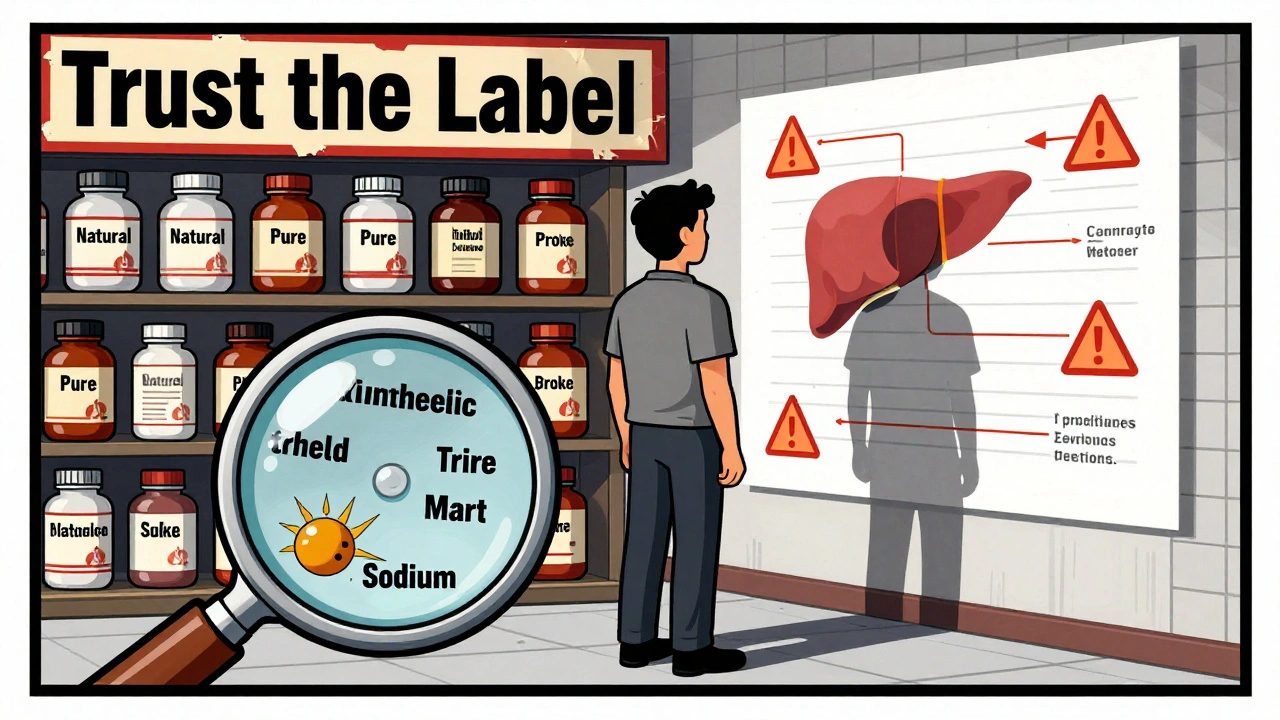
Why Does This Keep Happening?
The supplement industry made $54.2 billion in 2022. That’s a lot of money. And they spend it lobbying. In 2022, they spent $8.2 million to block stricter labeling rules. The same companies that sell you vitamin C pills also fund political campaigns and hire former FDA officials. The system is built to protect sales, not safety.
There’s been talk of change. In June 2023, the FDA proposed new rules for vitamin A labeling-asking manufacturers to use mcg RAE instead of IU and add clear pregnancy warnings. That’s progress. But it’s just a draft. And it only covers one nutrient.
Meanwhile, the NIH launched a free Supplement Label Database with 65,000 products. It’s helpful-but it’s not mandatory. Companies don’t have to submit their labels. And most don’t.
What You Can Do
Don’t assume a supplement is safe just because it’s on the shelf next to aspirin. Here’s how to protect yourself:
- Look for third-party certifications: NSF, USP, or ConsumerLab. These mean independent testing.
- Search for the product on the NIH Supplement Label Database (even if it’s not listed, it’s worth checking).
- Use Examine.com. It’s a free, science-based site that breaks down what each supplement actually does-and what the risks are.
- Ask your pharmacist. They can check for interactions with your prescriptions.
- Check the ingredient list. If it says "proprietary blend," walk away. You’re flying blind.
- Don’t take more than the recommended dose. More isn’t better. High-dose vitamins can be toxic.
The bottom line? Supplements are not regulated like medicines. The label you see is not a guarantee of safety. It’s a marketing tool. And until the rules change, you’re the one who has to do the digging.
Why don’t supplement labels have the same warnings as OTC drugs?
Because supplements are regulated as food, not drugs. The FDA doesn’t require them to list drug interactions, pregnancy risks, or exact dosing for medical conditions. Only OTC medications must follow the Drug Facts format, which includes those warnings. Supplements only need to list ingredients and serving size under the Supplement Facts panel, with minimal safety info.
Can I trust the "natural" label on supplements?
No. "Natural" has no legal definition in supplement labeling. It doesn’t mean safe, effective, or free of contaminants. Many supplements labeled "natural" contain synthetic chemicals or hidden drugs. Always check for third-party testing instead of relying on marketing terms.
Are there any supplements that are actually safe?
Some are, but you need to verify. Vitamin D (in moderate doses), magnesium, and fish oil (with third-party certification) have strong evidence for safety and benefit when used correctly. But even these can interact with medications. Always check with your doctor or pharmacist before starting any new supplement.
What should I do if I had a bad reaction to a supplement?
Stop taking it immediately. Contact your doctor and report the reaction to the FDA through their MedWatch program. You can file a report online at fda.gov/medwatch. Even if you’re not sure it was the supplement, report it. The FDA needs this data to track dangerous products.
Is it better to get nutrients from food instead of supplements?
Yes, almost always. Whole foods contain hundreds of compounds that work together in ways supplements can’t replicate. A vitamin C pill doesn’t give you the fiber, antioxidants, and phytonutrients you get from an orange. Unless you have a diagnosed deficiency or specific medical need, food is the safest and most effective way to get nutrients.

Let me tell you, I took a "natural" energy booster last year because I was tired all the time. No warnings on the label. Two weeks in, I ended up in the ER with a racing heart. Turns out it had hidden caffeine and a stimulant banned in the EU. The bottle said "organic" and "herbal" like that meant safe. It didn’t. I’m lucky I didn’t have a stroke.
Third party certs are the only way to go. NSF or USP. Period. If it doesn’t have one, it’s a gamble. I stopped buying supplements without them after my cousin got liver damage from a "detox" powder. No label, no warning, no accountability.
Yeah I’ve been using USP-certified fish oil for years. It’s pricier but I sleep better knowing it doesn’t have heavy metals or fake ingredients. Also, Examine.com is my bible now. No more guessing.
Let’s be clear: the FDA’s hands are tied by DSHEA. It’s not negligence-it’s legislative capture. The supplement industry spent $8.2 million lobbying last year to keep the status quo. That’s more than the entire NIH budget for supplement research. The system is rigged to prioritize profit over protection. Until Congress reclassifies supplements as drugs-or creates a new category with teeth-we’re all just rolling the dice.
I used to think supplements were harmless because they were "natural." Then I started reading the fine print on every bottle I bought. Proprietary blends? That’s a scam. One label said "2000mg blend" but listed 12 ingredients. That means each ingredient is probably less than 170mg-barely a placebo. And the sodium? I have hypertension. I had no idea my electrolyte powder had over 500mg per serving. That’s like chugging a can of soda. No warning. No disclosure. Just a pretty label with a mountain on it. I’m done trusting marketing. I only buy what’s certified, and even then, I double-check with my pharmacist.
And don’t get me started on the vitamin A thing. I bought a prenatal because it said "supports healthy pregnancy." Turns out it had 10,000 IU of retinol-no distinction from beta-carotene. That’s the same dose that causes birth defects. The disclaimer at the bottom? "Not evaluated by the FDA." That’s not a disclaimer-it’s a waiver of responsibility. They’re not lying. They’re just not telling you the truth. And that’s worse.
I’ve started reading every study I can find. The NIH database helps, but most companies don’t even submit their labels. So I use Examine.com. It’s not perfect, but it’s science-based. I’ve stopped taking half the supplements I used to. Why? Because more isn’t better. Niacin can cause strokes. Iron can poison you. Vitamin D overdose? Liver damage. We treat these like candy, but they’re pharmacologically active substances. And we’re not even told how much we’re taking.
And the worst part? The people who need this info the most-the elderly, pregnant women, people on multiple meds-are the least likely to dig into it. They trust the shelf. They trust the label. They trust the word "natural." And that’s why people end up in hospitals. Not because supplements are evil. But because the system is designed to let them be dangerous.
I wish I’d known this five years ago. I’d have saved myself a lot of money, anxiety, and health scares. If you’re taking anything besides a basic multivitamin, you owe it to yourself to do the work. Don’t rely on the label. Don’t trust the brand. Don’t believe the hype. Look for the seal. Check the database. Talk to your pharmacist. And if you see a proprietary blend? Walk away. It’s not worth the risk.
They’re all connected. Big Pharma owns the supplement companies. That’s why the FDA doesn’t act. The same people who make your blood pressure meds also make the "natural" version that doesn’t work. They want you to buy both. The FDA doesn’t test because they’re paid off. Look at the revolving door-former FDA commissioners go to work for supplement giants. It’s not a coincidence. They’re letting dangerous stuff slide so they can sell you more pills. And they’re making billions off your ignorance. The fact that you don’t know what’s in your vitamins? That’s the business model.
My mom took a calcium supplement for years. No warning about kidney stones. She ended up with one the size of a marble. Turns out it had 2000mg per serving-way above the recommended limit. The label didn’t say anything about that. She didn’t know. Neither did her doctor. We found out because she went to a naturopath who checked her bloodwork. Why isn’t that on the bottle? Why isn’t it required? This isn’t about choice. It’s about informed consent. And we’re not getting it.
i had a friend who took green tea extract for weight loss and got liver failure. the label said "pure" and "natural". no warning. she needed a transplant. i dont buy any supplement without usp or nsf now. its not worth it.
It’s not just about safety-it’s about the illusion of control. We buy supplements because we want to feel like we’re doing something proactive about our health. But the truth? Most of us are just chasing marketing. We think we’re being smart. We’re not. We’re just giving our money to companies who’ve mastered the art of making us feel guilty for not taking their $40 bottle of mystery powder. And the worst part? We’re proud of it. "I take my vitamins!" Like it’s a virtue. It’s not. It’s a trap.
As a pharmacist in Canada, I see this every day. Patients come in asking why their vitamin D didn’t warn them about interactions with warfarin. I have to explain that it’s not required. They’re shocked. I tell them to always check the NIH database and look for USP. Most don’t know it exists. And I’ve seen too many cases where people combine supplements with prescriptions and end up in the ER. The system is broken. The law is outdated. And the people paying the price? The ones who trust the label.
I used to be the guy who bought every new supplement that came out. Now? I eat real food. I walk. I sleep. I drink water. I don’t need a pill to fix what a balanced lifestyle can do. And if I do need something? I get it from my doctor. Not the shelf next to the gum. The supplement industry thrives on fear and misinformation. Don’t feed it.
Just wanted to say I started using Examine.com after reading this and it changed everything. I used to just grab whatever looked good. Now I check the evidence level for each ingredient. Turns out most of my supplements were useless. I’ve cut my spending by 70% and feel better. Also, I finally know why my multivitamin didn’t help with fatigue-because it had zero B12. The label didn’t say how much. Ugh.
Why are you all acting like this is new? This has been going on since the 90s. The FDA is useless. The supplement industry is a scam. People die because of this. And you’re all just sitting here talking about USP seals like that’s the solution? It’s not. It’s a Band-Aid on a hemorrhage. The real problem is the law. DSHEA needs to be scrapped. Supplements should be regulated like drugs. Full stop. Until then, you’re all just rearranging deck chairs on the Titanic.
The deeper issue here is epistemic vulnerability. We’ve outsourced our health literacy to corporate labeling systems designed for consumption, not comprehension. The supplement facts panel is a performative artifact of regulatory minimalism-it mimics the form of drug labeling to induce trust while omitting the substance of safety. We are not merely misinformed; we are structurally disempowered by a legal framework that conflates consumer autonomy with corporate impunity. The proprietary blend is not a loophole-it is a linguistic weapon. It weaponizes ambiguity. And until we demand epistemic justice-transparency as a right, not a privilege-we remain complicit in our own commodified ignorance.