
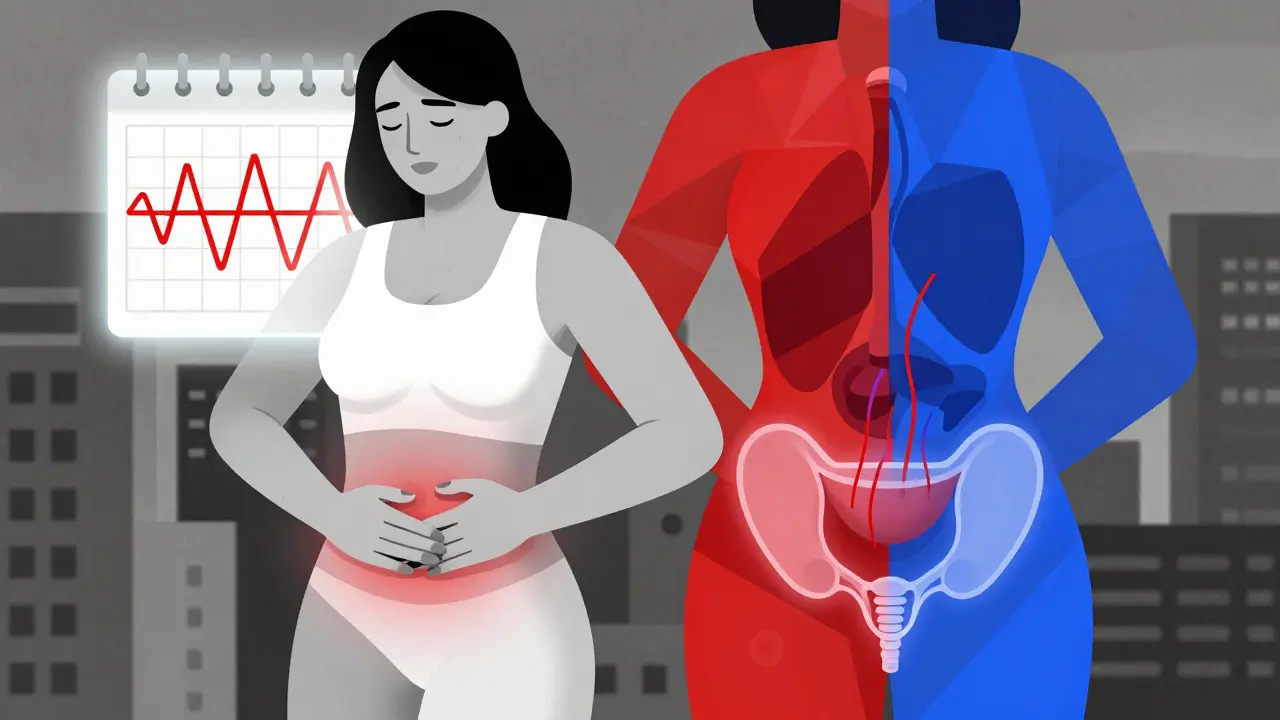
Pelvic Pain in Women: How to Tell Endometriosis Apart from Interstitial Cystitis
Chronic pelvic pain in women is often dismissed as "just bad periods" or "stress." But for millions, it’s a daily battle with no clear answer. Two conditions - endometriosis and interstitial cystitis - are behind most of these cases. They look alike. They feel alike. And too often, they’re misdiagnosed - leaving women trapped in a cycle of pain, antibiotics, and doubt.
What You Feel: The Overlapping Symptoms
If you’re dealing with pelvic pain, you’ve probably heard this list before: frequent urination, burning when you pee, pain during sex, pressure in your lower belly. These are the hallmarks of both endometriosis and interstitial cystitis. In fact, a 2011 study of 178 women with chronic pelvic pain found that 65% had both conditions at the same time. That’s not coincidence. It’s a pattern. You might think your bladder is the problem because you’re peeing every hour. Or you might blame your uterus because the pain spikes during your period. But here’s the catch: endometriosis can grow on your bladder. And interstitial cystitis can make your pelvic floor muscles lock up so tight, it feels like your organs are screaming. Both conditions cause:- Pain that lasts longer than six months
- Urinary urgency - the sudden, intense need to go
- Dysuria - pain or burning during urination
- Dyspareunia - pain during or after sex
- Chronic lower abdominal pressure
The Critical Difference: When the Pain Happens
Endometriosis follows your cycle like a clock. If your pain gets worse a few days before your period, peaks during it, and eases after - that’s a red flag for endometriosis. One study found 92% of women with endometriosis have pain that cycles with their period. Interstitial cystitis doesn’t care about your period. The pain is usually steady, though it can flare up around menstruation in about 45% of cases. That’s not because IC is hormonal - it’s because your body is already stressed. Your bladder is inflamed. Your nerves are on edge. Your pelvic floor is tight. And your period just adds fuel to the fire. Here’s another key clue: blood in your urine. If you see even a trace of red in your urine - especially around your period - that’s a strong sign of bladder endometriosis. Pure interstitial cystitis almost never causes visible blood. If you’ve been told it’s just a UTI and antibiotics didn’t help? That’s not a UTI. That’s likely endometriosis on your bladder wall.How Doctors Diagnose (And Often Miss) These Conditions
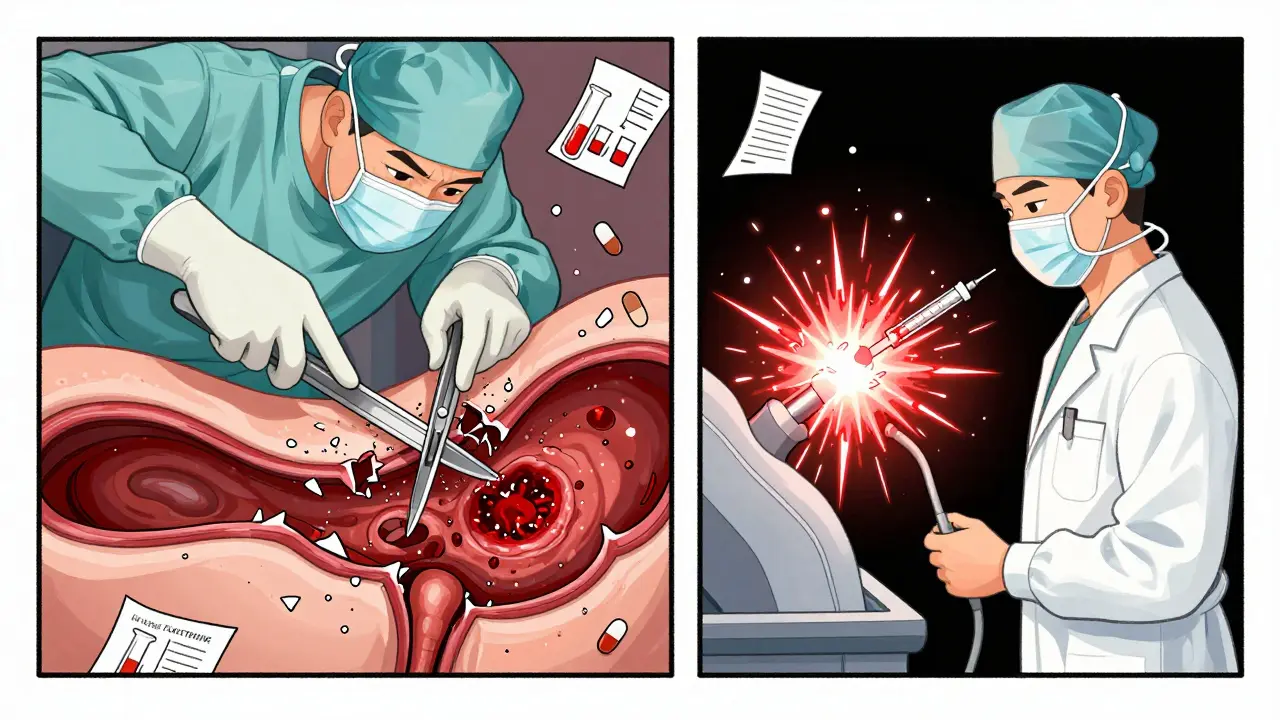
Endometriosis can’t be seen on an ultrasound or MRI. The only way to confirm it is through surgery - laparoscopy with deep excision. A surgeon cuts into your abdomen, looks for lesions, and removes them. Then, a pathologist checks the tissue under a microscope. That’s the gold standard. But here’s the problem: only 15% of OB/GYNs in the U.S. are trained in this kind of surgery. Most don’t look beyond the ovaries. If endometriosis is on your bladder, bowel, or ureters, it’s easy to miss. Interstitial cystitis is even trickier. There’s no blood test. No scan. No biomarker. Diagnosis means ruling out everything else. You need:- A negative urine culture (to rule out infection)
- A cystoscopy (a camera inserted into your bladder)
- A Potassium Sensitivity Test (PST) - where a potassium solution is put in your bladder to see if it causes pain
- A PUF score of 8 or higher on the Pelvic Pain and Urgency/Frequency scale
The Real Problem: Doctors Look for One Thing
Most doctors are trained to find one diagnosis. If you have urinary symptoms, you’re sent to a urologist. If you have menstrual pain, you’re sent to a gynecologist. But these conditions don’t live in separate boxes. Dr. Tamer Seckin, a leading endometriosis specialist, says: "It is not possible to confirm interstitial cystitis without first excluding endometriosis." And he’s right. A 2022 study found that up to 80% of patients diagnosed with IC actually had undiagnosed endometriosis. That’s not a mistake. That’s a system failure. Pelvic floor dysfunction is the hidden link. Ninety-two percent of women with either condition have tight, painful pelvic floor muscles. These muscles don’t relax. They spasm. They pull on nerves. They make every bladder sensation feel like a scream. And no one checks for it.What Happens When You Get the Wrong Diagnosis
If you’re told you have IC and you actually have endometriosis, you’ll get bladder treatments that do nothing: dietary changes, bladder instillations, oral medications like Elmiron. You might even get nerve stimulators implanted. All while the endometriosis grows deeper, scar tissue spreads, and your pain worsens. If you’re told you have endometriosis and you actually have IC, you’ll get surgery - laparoscopy, excision, hormone therapy - and nothing changes. Your bladder still burns. Your urge to pee never stops. You’re left wondering why you’re still in pain after a major operation. And then there’s the emotional toll. A 2023 survey found that 76% of women with IC were told their pain was "all in their head." One Reddit user shared her 9-year journey: misdiagnosed with IC, treated for UTIs five times, and finally found stage IV endometriosis on her bladder wall after her third surgery. Her urinary symptoms dropped 80% after the lesions were removed.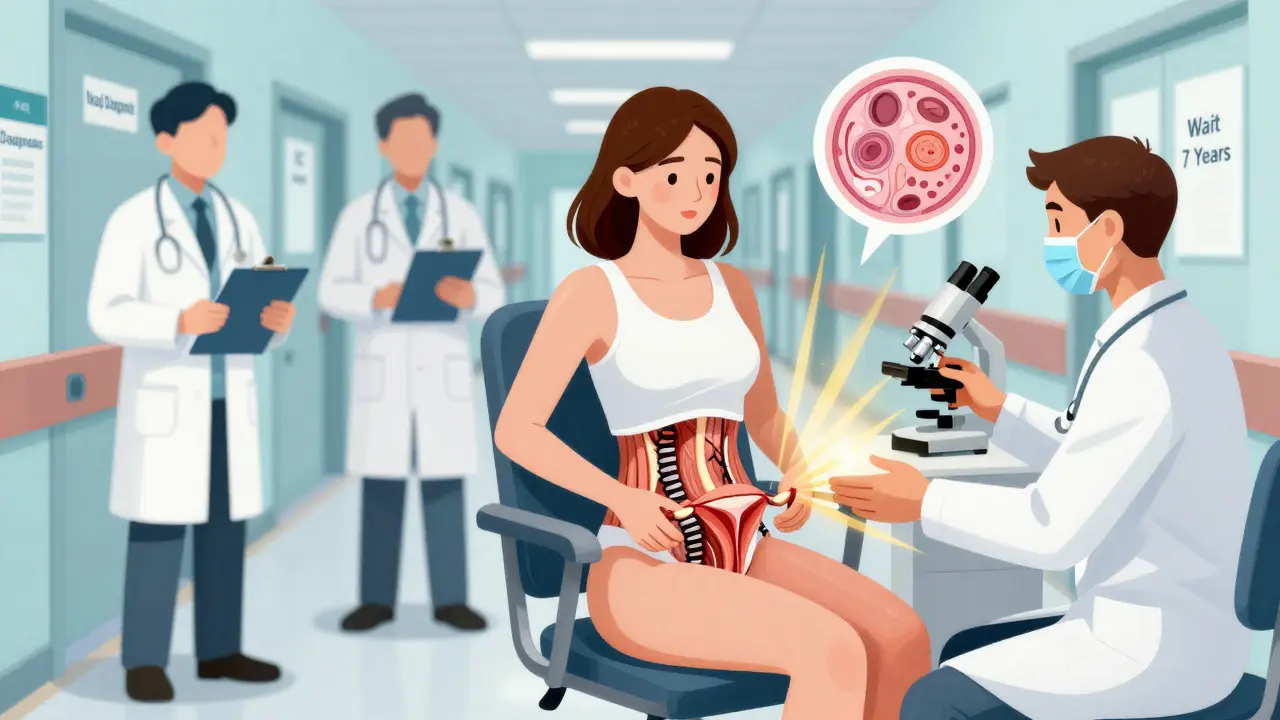
What You Can Do Right Now
You don’t have to wait years for answers. Here’s how to push for the right diagnosis:- Keep a pain and voiding diary for two weeks. Note when pain happens, how often you pee, what triggers it (coffee, sex, period), and if you see blood.
- Ask for a referral to a specialist who treats both conditions - a gynecologist trained in endometriosis excision AND a urogynecologist. These doctors exist, but they’re rare. Only about 350 are board-certified in the U.S.
- Request a cystoscopy with PST if you have bladder symptoms - even if you’ve been told you have endometriosis.
- Insist on a pelvic floor physical therapy evaluation. Tight muscles can mimic or worsen both conditions.
- Bring the PUF scale with you. Print it. Fill it out. Ask your doctor to score it.
The Future Is Changing - But You Can’t Wait
The NIH just awarded $4.2 million to find biomarkers that can tell endometriosis apart from IC. The Endometriosis Foundation now requires bladder checks during every excision surgery. By 2030, multidisciplinary pelvic pain centers will be the standard. But that’s five years away. You need answers now. If you’ve been told it’s "just IC" or "just endometriosis" - question it. If your pain doesn’t fit neatly into one box - you’re not crazy. You’re one of the millions caught in the gap between specialties. The truth is, these conditions aren’t rivals. They’re partners. And until doctors treat them as such, women will keep suffering.Can endometriosis cause bladder symptoms without being on the bladder?
Yes. Even if endometriosis isn’t directly on the bladder, lesions on nearby structures - like the uterosacral ligaments or rectovaginal septum - can irritate nerves that also serve the bladder. This is called referred pain. It feels like a bladder problem, but the source is elsewhere. That’s why removing endometriosis from other areas often improves urinary symptoms.
Is interstitial cystitis real, or is it just undiagnosed endometriosis?
It’s real - but it’s often misdiagnosed. Interstitial cystitis is a chronic bladder inflammation with no known cause. But studies show that in up to 80% of cases labeled as IC, endometriosis is found during surgery. That doesn’t mean IC doesn’t exist - it means we’ve been looking in the wrong place. Many women have both. The key is checking for both.
Why do antibiotics keep being prescribed if I don’t have an infection?
Because the symptoms - burning, urgency, frequency - look exactly like a UTI. Doctors aren’t being careless; they’re following a common pattern. But if antibiotics don’t work after one or two courses, you’re not dealing with an infection. You’re dealing with endometriosis, IC, or pelvic floor dysfunction. Push for further testing.
Can pelvic floor therapy help with both conditions?
Yes - and it’s often the missing piece. Up to 92% of women with either condition have pelvic floor muscle spasms. These muscles can cause pain even when the bladder or uterus is fine. Physical therapy teaches you to relax those muscles, reduce nerve sensitivity, and improve bladder control. Many women see big improvements even before surgery.
What’s the best way to find a doctor who knows about both conditions?
Look for a center that specializes in chronic pelvic pain. Ask if they do both laparoscopic excision for endometriosis and cystoscopy with PST for IC. The Endometriosis Foundation and Interstitial Cystitis Network have directories. Avoid doctors who say "you can only have one." If they dismiss the possibility of both, find someone else.



Been there. Diagnosed with IC, then found endometriosis on my bladder after 5 years. No blood? Doesn't matter. Pain that spikes with my cycle? That's your clue.
Let's be precise here: the neuroanatomical overlap between endometriotic lesions and the pudendal nerve complex is staggering. The referred pain patterns from uterosacral ligament involvement can mimic IC with 94% clinical fidelity. This isn't just misdiagnosis-it's a systemic failure in neuro-pelvic integration training for OB/GYNs and urologists. We need multidisciplinary protocols, stat.
They don't want you to know this but the pharmaceutical companies own the AMA and they profit more from lifelong IC meds than one-time excision surgery. That's why they push Elmiron and nerve stimulators. They don't want you cured-they want you dependent. Check the FDA warning labels. They know.
It is imperative to underscore the significance of interdisciplinary collaboration in the management of chronic pelvic pain syndromes. The current siloed approach within medical specialties represents a critical deficiency in patient-centered care. A paradigm shift toward integrated diagnostic protocols is not merely advisable-it is ethically obligatory.
I cried when they finally cut out the endo on my bladder after 8 years of being told it was stress or anxiety I was just broken and no one listened and now I can pee without screaming and I’m so mad I wasted so much time
My sister had this. She pushed for cystoscopy and PST after her third UTI that didn't clear. Found endometriosis on her bladder wall. Surgery fixed 90% of her symptoms. Don't take no for an answer. Get the tests. They're not optional if your pain is real.
It is a lamentable reality that the modern medical establishment continues to perpetuate a diagnostic myopia rooted in reductionist paradigms. The conflation of pelvic pain etiologies reflects not merely ignorance but institutionalized negligence. Women are being pathologized as psychosomatic when the pathology lies in the surgeon's inability to visualize lesions beyond the ovaries. The failure to perform deep-excision laparoscopy with concurrent cystoscopic evaluation constitutes malpractice by omission. This is not medicine-it is bureaucratic abandonment.
My pelvic floor PT was the only thing that gave me relief before surgery. They taught me how to release the spasms with breathing and dilators. No one told me that part. It’s not magic-it’s science. And it’s free if your insurance covers PT. Ask for it.
You’re not alone. I was told I had IC for 6 years. Then I found a specialist who did a full excision. Turns out I had endo on my bladder, bowel, and diaphragm. My life changed. Keep going. You deserve answers.
The data is irrefutable. The 2022 study cited demonstrates that 80% of IC diagnoses are, in fact, endometriosis. This is not a diagnostic gray area-it is a diagnostic catastrophe. The failure of urology to routinely collaborate with endometriosis specialists constitutes a systemic breach of medical ethics. One must question the integrity of institutions that prioritize billing codes over biological truth.
So we’re supposed to believe that a disease with no biomarker, no imaging signature, and no cure is real… but a disease that grows on organs and bleeds during periods is the real villain? Huh. I guess if you don’t want to cut people open, calling it IC is way easier. Classic medical gaslighting. 🙄
My doc didn't know the difference either. I printed out the PUF scale and the 2023 guidelines and handed them to him. He looked at it, sighed, and booked me for cystoscopy. Sometimes you just gotta be the expert on your own body.
Let’s be real-doctors don’t get paid to find endo on the bladder. They get paid to prescribe antibiotics and refer you to PT. That’s why it takes 7 years. The system doesn’t reward curiosity. It rewards speed. So you’ve got to be the one who slows it down. Demand the PST. Demand the excision. Don’t let them rush you.
They’re hiding this because it’s cheaper to keep women on painkillers than fix the root cause. The pharmaceutical lobby owns the FDA. They don’t want you to know that surgery cures this. They want you addicted to Elmiron so you keep paying. This isn’t medicine-it’s a racket.
Key point: bladder endometriosis often presents without visible lesions on imaging. That’s why laparoscopy is non-negotiable. Also, the potassium sensitivity test isn’t perfect-but if your PUF score is >8 and your urine is sterile, you’re not getting IC without ruling out endo first. Don’t accept a diagnosis without that sequence. It’s not just best practice-it’s your right.