
Medical Society Guidelines on Generic Drug Use: What Doctors Really Think
When a pharmacist hands you a pill bottle with a different name than what your doctor wrote, you might wonder: is this the same drug? The answer isn’t as simple as it seems. Medical societies-groups of doctors who set standards for how medicine is practiced-have taken clear, often conflicting, stances on when generic drugs can be swapped in for brand-name ones. These aren’t just policy papers. They shape what prescriptions get filled, what patients trust, and sometimes, whether a seizure is controlled or a tumor keeps growing.
Why Generic Drugs Are Everywhere (And Why It Matters)
Generic drugs make up 90% of all prescriptions filled in the U.S. But they cost only 23% of what brand-name drugs do. That’s not a typo. Nine out of ten pills you pick up at the pharmacy are generics. The reason? The FDA approved them as bioequivalent-meaning they deliver the same active ingredient, in the same dose, the same way, with the same effect as the original. For most drugs, that’s true. For some, it’s a much bigger gamble.
The system works because of the Hatch-Waxman Act of 1984. It created a fast-track path for generics to enter the market without repeating expensive clinical trials. All they had to prove was bioequivalence: that their drug’s absorption in the body fell within 80% to 125% of the brand’s. That’s the legal standard. But medicine doesn’t always follow math.
The American Academy of Neurology’s Hard Line
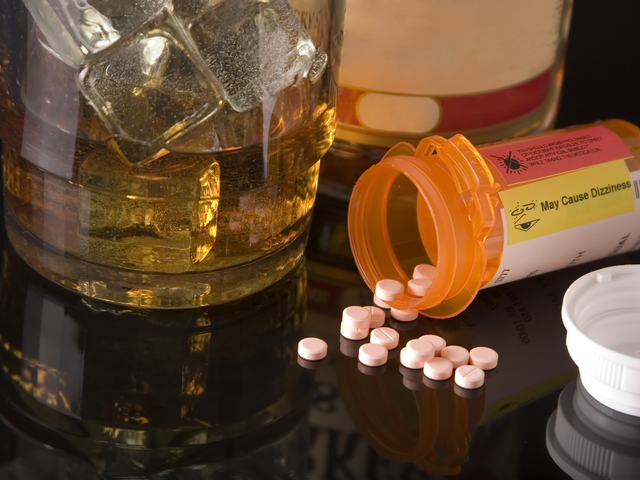
Not all doctors agree that 80-125% is good enough. The American Academy of Neurology (AAN) has one of the strongest positions against generic substitution: they oppose swapping generic versions of anticonvulsants. Why? Because for epilepsy patients, even tiny changes in blood levels can trigger a seizure.
Think about it: if a patient’s blood level of levetiracetam drops from 12 mcg/mL to 9.5 mcg/mL-still within FDA’s acceptable range-that could be enough to lose seizure control. A 2023 ASPE report noted that 68% of neurologists believe generic substitutions have led to complications in their patients. The AAN doesn’t just warn doctors. They’ve pushed state legislatures to require explicit permission from the prescriber before swapping these drugs. Only a handful of states have taken that step, but the message is clear: some drugs aren’t interchangeable.
It’s not that generics are unsafe. It’s that the margin for error in neurological drugs is razor-thin. These are drugs with narrow therapeutic indices (NTIs). A small change in concentration can mean the difference between healing and hospitalization.
What Other Medical Societies Say
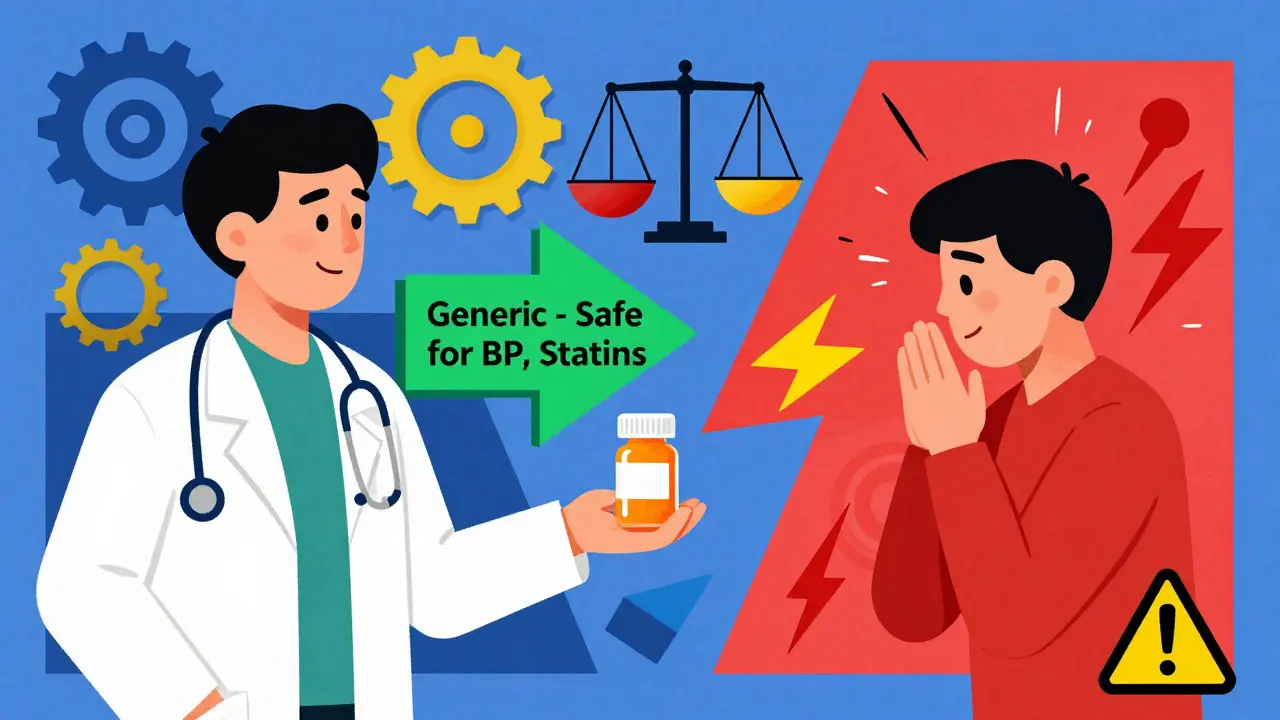
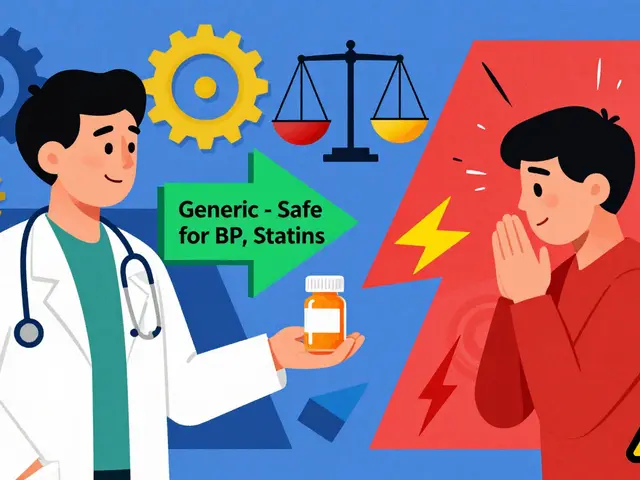
Contrast that with the American College of Physicians (ACP). They generally support generic substitution across the board-for blood pressure meds, statins, antibiotics, diabetes drugs. Their stance is simple: if the FDA says it’s equivalent, it’s equivalent. And the FDA has approved over 20,000 generic drugs with the same rigor as brand-name ones.
The National Comprehensive Cancer Network (NCCN) takes a different approach. They don’t just accept generics-they actively use them for off-label cancer treatments. If a generic drug is approved for one use, and research shows it works for another, the NCCN includes it in their compendium. That’s huge. Medicare uses the NCCN Compendium to decide what cancer drugs to cover. So if a generic drug is listed there, insurers pay for it-even if the FDA hasn’t officially approved it for that cancer type.
This creates a patchwork. A patient with high blood pressure can switch generics without a second thought. But a patient on epilepsy meds might be stuck with the same brand for years, even if it costs $500 a month instead of $30. The difference isn’t science-it’s specialty.
How Drug Names Are Designed to Keep You Safe
Ever notice how generic drugs have names like metoprolol and metoprolol succinate? That’s not random. It’s by design.
The American Medical Association’s United States Adopted Names (USAN) Council decides what generic drugs are called. Their job isn’t to be catchy. It’s to avoid confusion. A name should tell a pharmacist or nurse what the drug does, what class it’s in, and how it’s different from others.
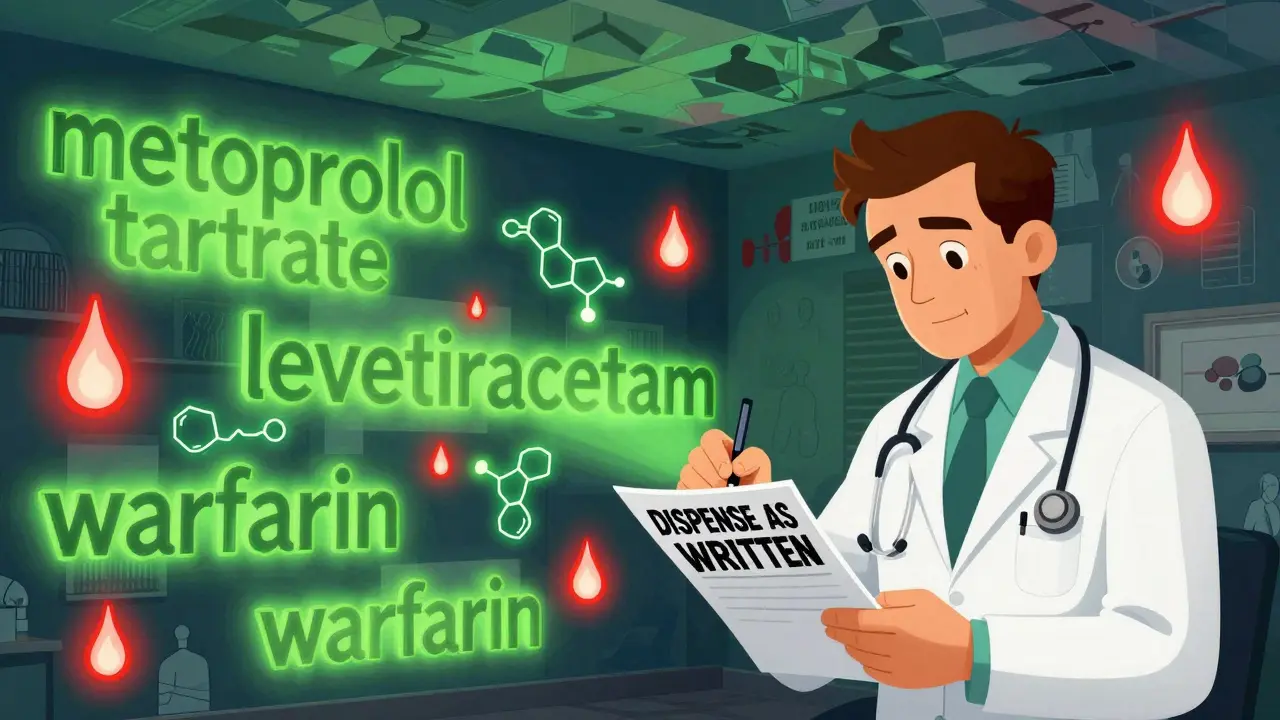
For example, drugs ending in “-lol” are beta-blockers. “-pril” means ACE inhibitor. “-mab” is a monoclonal antibody. These stems help reduce errors. If a doctor writes “metoprolol” and the pharmacy dispenses “metoprolol tartrate,” you know it’s the same drug, just a different salt form. But if two drugs sound too similar-say, “duloxetine” and “duloxitine”-the council will reject the name. They’ve turned down names before because they looked too much like another drug on the shelf.
This naming system isn’t just bureaucracy. It’s a safety net. A 2023 AMA Journal of Ethics article called it “one of the most underappreciated tools in patient safety.”
State Laws vs. Medical Guidelines
Here’s where things get messy. The FDA says generics are interchangeable. The AAN says they’re not for epilepsy drugs. So who wins?
It depends on your state. Some states require pharmacists to notify the prescriber before substituting an NTI drug. Others allow automatic substitution unless the doctor writes “dispense as written.” Still others don’t have any rules at all.
Pharmacists are caught in the middle. They want to save money. But they also don’t want to be the reason a patient has a seizure or a stroke. Many now ask: “Is this for epilepsy? For thyroid? For warfarin?” If yes, they’ll call the doctor before swapping.
One study found that even when generics are available, substitution rates drop to 50% or lower for NTI drugs-because prescribers and pharmacists are being cautious. That’s not because the drugs are bad. It’s because the stakes are high.
The Economic Pressure and the Real Cost of Caution
The generic drug industry is worth over $150 billion a year. Companies like Teva, Mylan, and Sandoz push hard for broader substitution. They want more sales. But medical societies aren’t just fighting for profits-they’re fighting for outcomes.
For a patient on warfarin, switching generics might mean weekly blood tests for months to adjust the dose. For someone on thyroid hormone, it could mean fatigue, weight gain, or heart palpitations. These aren’t theoretical risks. They’re real, documented problems.
On the flip side, forcing a patient to pay $500 a month for a brand-name drug they don’t need means they might skip doses, skip refills, or skip care altogether. That’s a different kind of risk.
Medical societies walk a tightrope: lower costs vs. preventable harm. There’s no perfect answer. But the guidelines reflect what doctors see in their clinics every day.
What This Means for You as a Patient
If you’re on a medication that’s not for epilepsy, thyroid disease, blood thinners, or certain cancer drugs-you’re probably fine switching to a generic. The science supports it. The FDA backs it. Your wallet will thank you.
But if you’re on one of those high-risk drugs? Don’t assume the switch is safe. Ask your doctor: “Is this drug on the list of ones we shouldn’t swap?” If your pharmacist switches it without asking, speak up. Write “dispense as written” on the prescription. Keep your medication log. Track how you feel after a switch.
Generic drugs are a triumph of modern medicine. They’ve saved billions in healthcare costs and made treatment possible for millions. But they’re not all the same. Some need extra care. And knowing which ones those are? That’s the difference between convenience and safety.
Where Things Are Headed
Medical societies are starting to align more closely with the FDA’s Orange Book, which rates drugs by therapeutic equivalence. But exceptions won’t disappear. For NTI drugs, the caution will remain.
Future guidelines may include clearer labeling-like a “NTI” flag on the prescription or in the electronic health record. Some hospitals are already doing this. Others are training pharmacists to flag high-risk substitutions automatically.
One thing’s certain: the conversation isn’t over. As more drugs go generic, as more patients rely on them, and as new drugs with narrow windows enter the market, the medical community will keep refining its stance. Because in medicine, safety isn’t just a guideline. It’s the only rule that matters.



Bro I switched my blood pressure med to generic last year and never looked back. Saved me $400 a year and my BP is better than ever. The FDA doesn't lie.
Stop overthinking it unless you're on something like seizure meds.
They’re lying to us. The FDA is owned by Big Pharma. Generics are cut with fillers that cause brain fog and anxiety. I know people who went from fine to disabled after a switch. They don’t tell you this because they profit off the chaos.
India makes 40% of the world’s generics and we know this game better than anyone. We’ve been using generics since the 80s. But here’s the thing - not all generics are made equal. Some factories in the US and Europe still cut corners. I’ve seen patients on warfarin switch and end up in the ER because the new batch had different bioavailability.
It’s not about brand vs generic - it’s about who made it and where. Trust the pharmacist who knows the manufacturer, not just the label.
If you’re on an NTI drug and your doctor didn’t write ‘dispense as written,’ you’re playing Russian roulette. This isn’t theory - I’ve seen patients have seizures after a generic swap. Don’t let cost savings override safety. Your life isn’t a spreadsheet.
The notion that the FDA’s 80-125% bioequivalence standard is sufficient for all drugs is a dangerous fallacy. It is mathematically absurd to assume that a drug with a narrow therapeutic index behaves identically when its concentration varies by 45%. This is not a regulatory oversight - it is a systemic betrayal of patient safety. The AAN is right. The rest are complicit.
I switched my thyroid med to generic and felt like a zombie for three weeks. My doctor said it was ‘just my imagination.’ But I tracked my symptoms, went back to the brand, and boom - energy returned. Why didn’t anyone warn me? I’m not paranoid - I’m just paying attention.
Oh, so now we’re supposed to trust ‘the system’? The same system that gave us OxyContin? The same system that let pharmaceutical CEOs make billions while patients go bankrupt? Generics are fine - unless they’re made in a factory in Bangalore with no oversight. And don’t even get me started on how the US imports 80% of its active ingredients from China. This isn’t medicine - it’s a global lottery.
As a former hospital pharmacist with 27 years of experience, I can tell you that generic substitution is a double-edged sword. We always verified the manufacturer. We kept logs. We called prescribers for NTI drugs. We did not just dispense. The problem isn’t generics - it’s the lack of standardized protocols across states and pharmacies. The FDA sets the floor, not the ceiling. We need mandatory labeling of the manufacturer on the bottle. That’s it. Simple. Safe.
People are so naive. You think the government cares about you? They care about money. Generics are cheaper because they use cheaper ingredients. You think your body can’t tell the difference? Your body knows. That’s why you feel tired. That’s why you get headaches. That’s why your doctor doesn’t understand - because he’s paid by the system. Wake up.
My mom had a stroke after switching to a generic statin. The pharmacist didn’t even call the doctor. The label said ‘equivalent.’ Turns out, the filler in that generic caused an inflammatory reaction. Now she’s on life support. So yeah, I’m not ‘overreacting.’ I’m just the guy whose family got screwed by the system.
They’re hiding the truth. The FDA doesn’t test generics the same way. They use lab rats, not humans. And the studies? Written by the generic companies themselves. It’s all a cover-up. If you’re on anything for your brain or heart, stick with the brand. Or better yet - don’t take any pills at all. Natural remedies work better anyway.
I get why people are scared. I’ve been there. But here’s what I learned - communication is everything. I asked my neurologist which meds were risky. I told my pharmacist I was on levetiracetam. I wrote ‘DAW 1’ on every script. Now I switch without fear. It’s not about fear. It’s about being informed. You have power. Use it.
In India, we call generics ‘jugaad medicine’ - clever, cheap, life-saving. But we also have strict pharmacy rules. You can’t swap warfarin without a doctor’s note. You can’t switch epilepsy meds without a blood test first. The US needs that. Not fear. Not conspiracy. Just common sense. A little regulation, a little education, and we stop turning patients into guinea pigs. The science is there. The will? Not so much.