
On-Target vs Off-Target Drug Effects: How Side Effects Really Happen
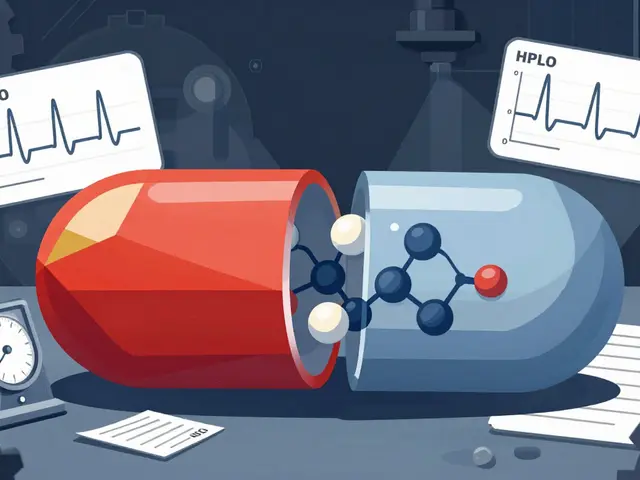
When you take a pill for high blood pressure, diabetes, or cancer, you expect it to fix the problem-not give you a rash, diarrhea, or heart palpitations. But side effects are common. Why? The answer isn’t just "it’s a side effect." It’s deeper. It’s about whether the drug hit the right target-or accidentally hit something else.
What Exactly Are On-Target Effects?
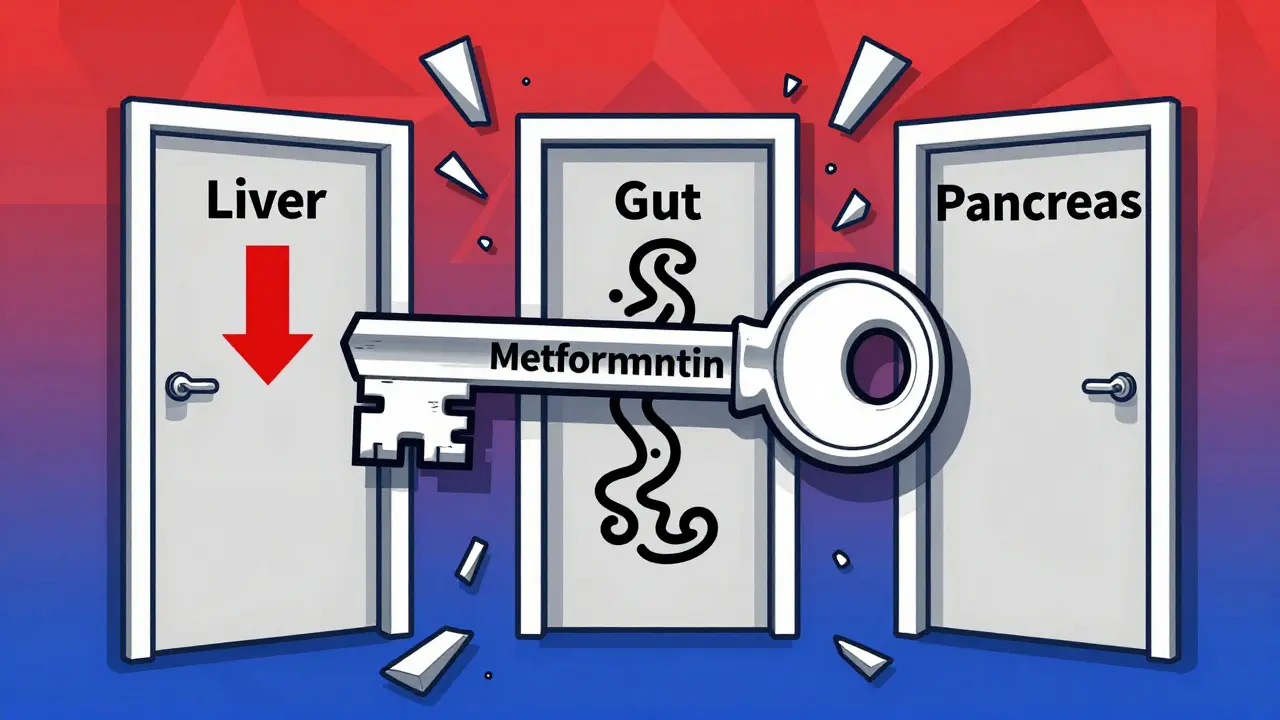
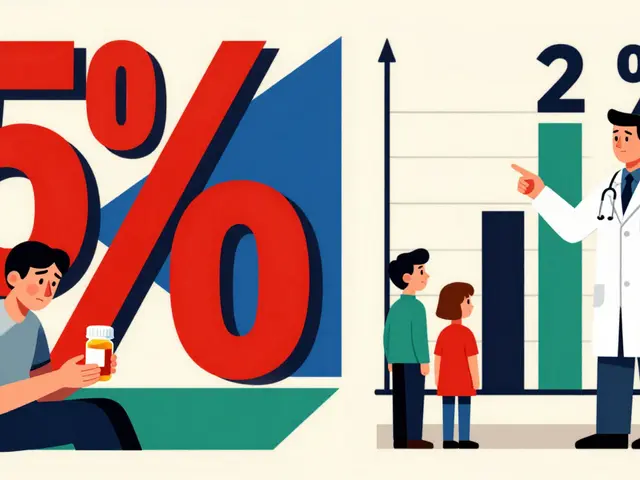
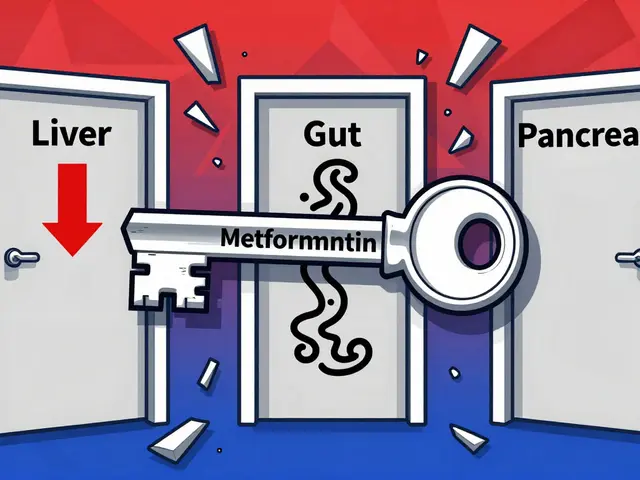
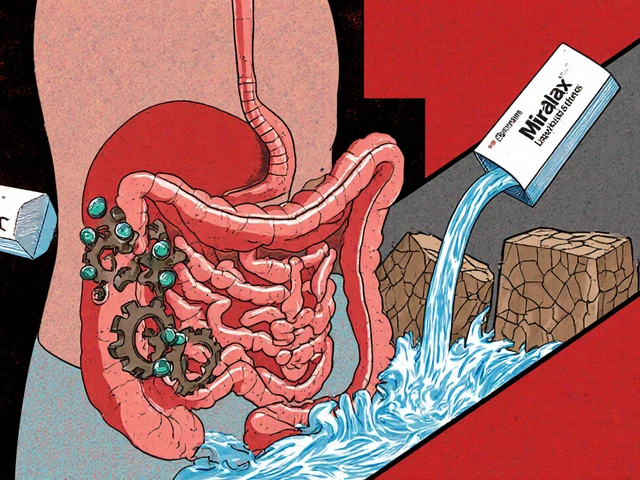
On-target effects happen when a drug does exactly what it’s supposed to do-but in the wrong place. Think of it like a key that fits one lock perfectly. That’s your target. But if that same lock exists in your skin, your gut, or your heart, the drug opens it there too. That’s not a mistake. That’s the drug working as designed.Take metformin, a common diabetes drug. It lowers blood sugar by making the liver produce less glucose. But it also slows digestion in the gut. That’s why so many people get diarrhea. It’s not a flaw. It’s the same mechanism, just in a different tissue. Same with EGFR inhibitors for lung cancer. They block a protein that helps tumors grow. But that same protein is in your skin. So you get acne-like rashes. About 68% of patients on these drugs get them, according to data from Memorial Sloan Kettering. Doctors don’t stop treatment. They manage it.
These effects are predictable. They show up in clinical trials. They’re listed in the drug’s label. And they’re often dose-dependent. Take a higher dose? More side effects. Lower it? The side effects fade. That’s why oncologists say on-target side effects are "expected and manageable." In a 2021 JAMA survey, 82% of physicians agreed.
What Makes Off-Target Effects So Dangerous?
Off-target effects are the wild card. The drug wasn’t meant to touch that target-but it did anyway. And you can’t always see it coming.Statins, for example, are designed to block HMG-CoA reductase, a liver enzyme that makes cholesterol. That’s their on-target job. But they also interact with other proteins in muscle cells. In rare cases, this causes rhabdomyolysis-a severe breakdown of muscle tissue that can damage kidneys. One patient in a 2019 NEJM case report had normal muscle enzyme levels for five years. Then, out of nowhere, their muscles started dying. No warning. No pattern. Just an off-target interaction.
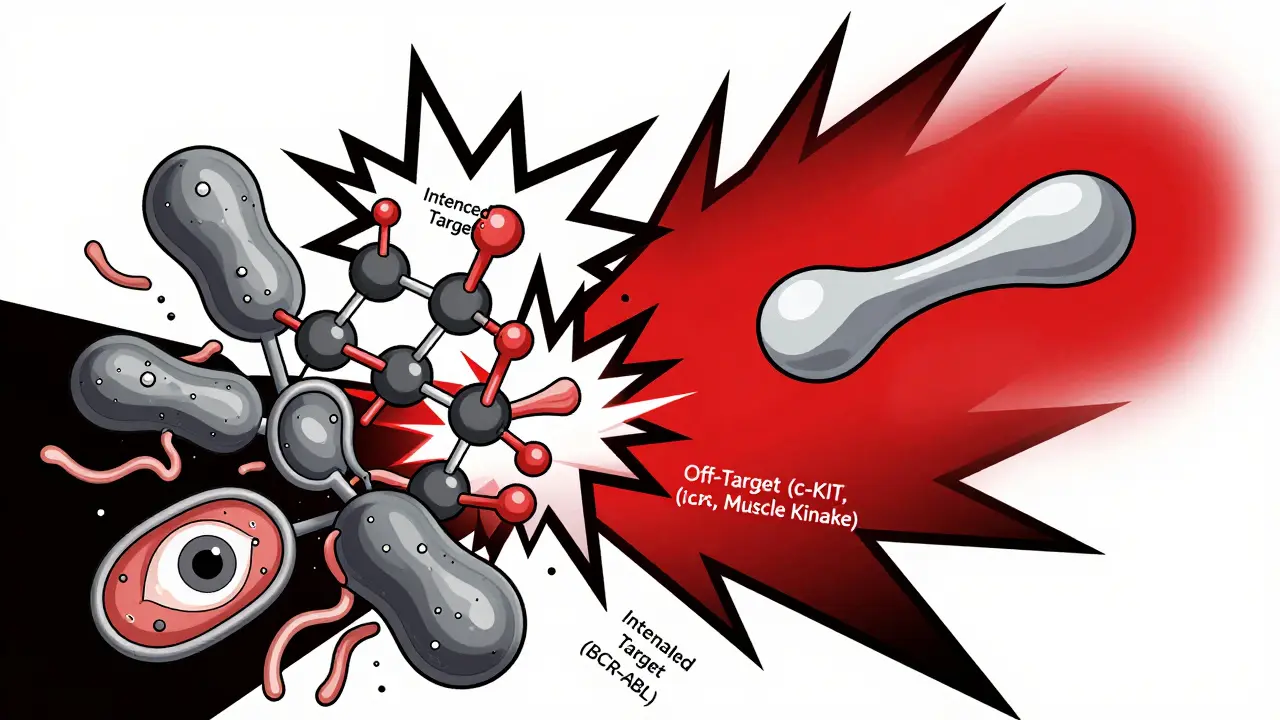
Kinase inhibitors are especially messy. A single drug like imatinib (Gleevec) was made to block the BCR-ABL protein in leukemia. But it also hits c-KIT, a protein in gut cells and mast cells. That’s why it works for gastrointestinal stromal tumors (a bonus). But it also causes swelling in the legs and around the eyes. That’s not the goal. It’s collateral damage.
And it’s not rare. A 2017 study in Nature Chemical Biology found that most small-molecule drugs bind to at least six other proteins besides their intended target. Kinase inhibitors? They average 25 to 30. That’s why they show up so often in FDA reports. In fact, 42% of all off-target toxicity reports from 2015 to 2020 came from kinase drugs.
Why Do Some Drugs Have Fewer Side Effects?
Not all drugs are created equal. Biologics-like monoclonal antibodies-tend to be more precise. Trastuzumab (Herceptin) targets HER2, a protein found mostly on breast cancer cells. It doesn’t wander far. So its side effects are fewer and mostly related to heart function-because HER2 is also in heart muscle. That’s still on-target. But it’s rare for biologics to hit unrelated proteins.Small molecules? They’re smaller. They slip into places antibodies can’t. That’s why they’re more likely to cause off-target chaos. A 2018 Nature Reviews Drug Discovery analysis showed small molecules average 6.3 off-target interactions. Biologics? Just 1.2.
And then there’s thalidomide. Originally pulled from the market in the 1960s because it caused severe birth defects-an off-target effect on fetal development. But decades later, doctors discovered it also suppresses inflammation and stops blood vessel growth in tumors. Today, it’s a frontline treatment for multiple myeloma. The same molecule. The same off-target effect. One time, disaster. Another, breakthrough.
How Do Scientists Find These Hidden Effects?
You can’t just guess what a drug will bind to. You need tools.One method is chemical proteomics. Scientists attach the drug to a bead, then dip it into a cell lysate. Anything that sticks? That’s a potential off-target. Another is transcriptome analysis. In a landmark 2019 study in Nature Scientific Reports, researchers treated three different cell lines with four different statins. At the gene level, the responses looked totally different. But when they looked at pathways-like cholesterol synthesis or immune signaling-they saw patterns. The cholesterol pathway? Consistently turned down. That’s on-target. The immune pathways? Spiked unpredictably. That’s off-target.
They used something called MARA (Motif Activity Response Analysis) to trace which transcription factors were activated. That helped them link gene changes to biological outcomes. This kind of systems-level thinking is now standard in big pharma. Companies like Genentech and Novartis use proprietary platforms like KinomeScan to map every possible interaction before a drug even reaches humans.
And regulators are catching up. The European Medicines Agency now requires at least two different methods to test for off-target effects in new therapies. The FDA’s 2021 guidance for gene therapies says the same. It’s no longer optional-it’s mandatory.
What Does This Mean for Patients?
If you’re on a drug and you get a weird side effect, ask: Is this expected? Or is this new?Diarrhea on metformin? Likely on-target. It’s the drug working too well in your gut. Your doctor might lower the dose or switch you to an extended-release version.
But if you’re on a new cancer drug and suddenly your fingers turn blue, or your liver enzymes spike without explanation? That’s a red flag. It could be off-target. Those are the effects that force doctors to stop treatment. In the same JAMA survey, only 37% of doctors felt off-target side effects were manageable. Most said they were unpredictable-and dangerous.
And patients notice. On Reddit’s r/pharmacy, one user wrote: "I didn’t realize the diarrhea from my diabetes med was the drug working too hard in my intestines." That post got over 1,200 upvotes. People are confused. They think side effects are always bad. But sometimes, they’re just the same effect in the wrong place.
What’s Changing in Drug Development?
The industry is shifting. Ten years ago, drug discovery was all about picking one target and designing a perfect key. Now, they’re looking at the whole system.Phenotypic screening-testing drugs on whole cells or animals instead of isolated proteins-is making a comeback. Why? Because it reveals the real-world balance between benefit and harm. A 2017 analysis found that 60% of first-in-class drugs approved between 1999 and 2013 came from phenotypic screening, not target-based design.
Companies are also using AI. The Open Targets Platform, used by 87% of top pharmaceutical firms, predicts off-target risks by comparing drug structures to known protein interactions. Its 2023 update can predict off-target effects with 87% accuracy.
And it’s working. Companies with strong off-target screening programs have 22% higher success rates in clinical trials. Drugs with clean profiles earn 34% more revenue over their lifetime. That’s not just science-it’s business.
What’s Next?
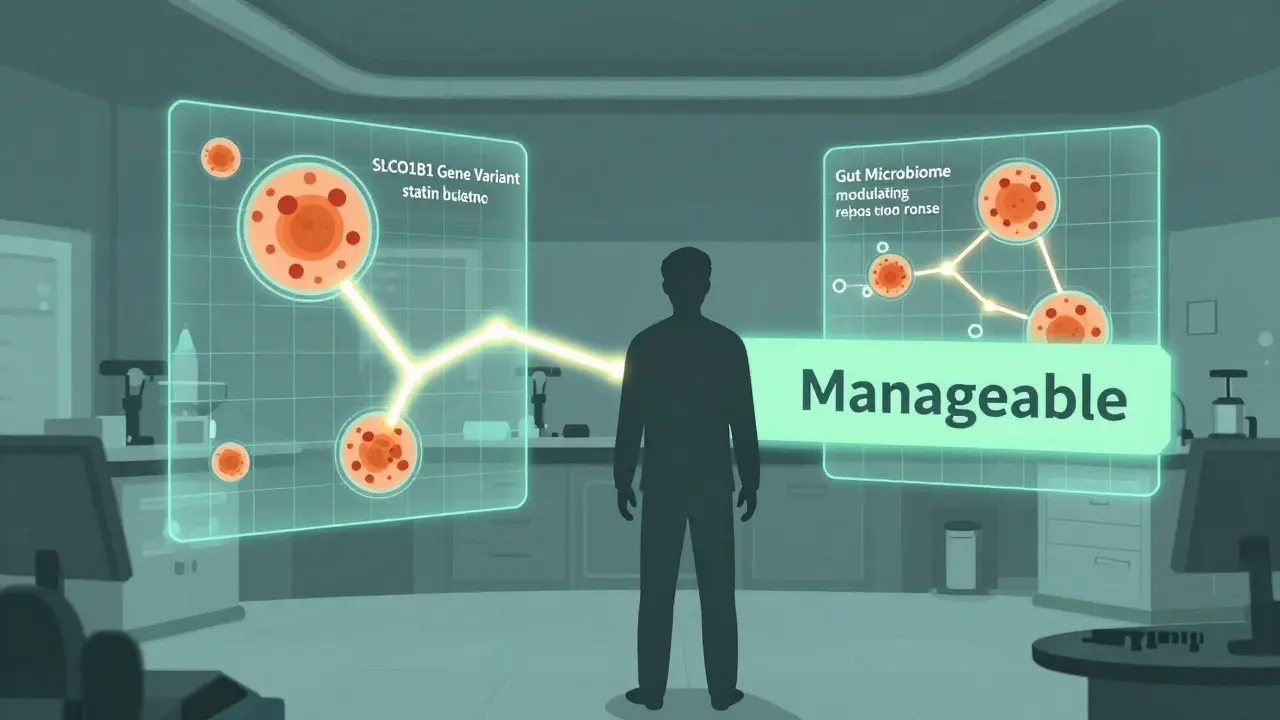
The future is personal. Not just personalized medicine-but personalized side effect profiles.Scientists are mapping how your genes, your gut microbiome, and your liver enzymes affect how you respond to drugs. Two people on the same statin. One gets muscle pain. The other doesn’t. Why? Genetics. A variant in the SLCO1B1 gene makes it harder for the liver to clear the drug. That’s why some people get side effects and others don’t.
The NIH’s $150 million Molecular Transducers of Physical Activity Consortium is building reference maps of how the body changes under stress, exercise, and drugs. That data will help us predict not just what a drug does-but who it will hurt.
For now, the message is simple: Side effects aren’t random. They’re mechanistic. Some are unavoidable consequences of hitting the right target in the wrong place. Others are accidents-drugs slipping through the cracks. Understanding the difference isn’t just for scientists. It’s for every patient wondering why their medicine is making them feel worse.
The goal isn’t zero side effects. It’s knowing which ones you can live with-and which ones mean it’s time to change course.


so like... drugs are just government mind control tools disguised as medicine? i mean why would they make something that messes with your gut if it wasn't intentional? they want us weak lol
this is actually so fascinating 😍 i never thought about side effects being the drug working too well in the wrong place. metformin diarrhea = liver doing its job but in the gut?? mind blown 🤯
The distinction between on-target and off-target effects is clinically significant and often undercommunicated to patients. It is imperative that healthcare providers articulate this mechanism clearly, as it informs adherence and reduces unnecessary discontinuation of otherwise effective therapies.
I mean, think about it-pharmaceutical companies are profit-driven entities that operate within a regulatory framework that incentivizes speed over safety, and yet we’re supposed to trust that the ‘on-target’ side effects are ‘manageable’? But what does ‘manageable’ even mean? Is it manageable if you’re vomiting for six weeks? Is it manageable if your skin peels off? Or is it manageable only if you don’t die? And then there’s the off-target stuff-the stuff they didn’t even test for properly because the trials were too short, too small, too whitewashed-and now we’re all just guinea pigs in a corporate experiment that’s been going on for decades and nobody’s asking the real questions-like, who benefits? And who pays the price?
this makes so much sense now! i had no idea my diabetes meds were just being too helpful in my gut 😅
The data presented here aligns with current pharmacological understanding. On-target effects are predictable and dose-dependent; off-target effects are stochastic and often idiosyncratic. The emphasis on chemical proteomics and systems biology represents a necessary evolution in drug safety profiling.
USA still thinks pills fix everything. In India we just eat turmeric and pray. Works better.
This is such a helpful breakdown!! 🙌 I’ve had friends quit their meds because they thought side effects = bad drug, not = expected biology. Sharing this with everyone!
Ah yes, the classic Western medical approach: throw a molecule at the problem and hope it doesn’t break your kidneys. Meanwhile, Ayurveda has been mapping body systems for 5000 years. But sure, let’s keep funding AI models to rediscover what ancient cultures already knew.
I just sat here staring at my metformin bottle for 10 minutes... and now I get it. My diarrhea wasn't a curse... it was a feature. A very inconvenient, very wet feature.
The mechanistic framing of side effects as either on-target or off-target is a reductive epistemological framework that obscures the ontological complexity of pharmacodynamic interactions within emergent biological systems. In essence, we’re still operating within a Cartesian reductionist paradigm when the body is a nonlinear, adaptive network. The real issue isn’t the drug-it’s the assumption that biology can be reduced to target-pathway binaries.